
Ivory plaque, carved in high relief with religious miniature scenes, Italy or France, 14th century
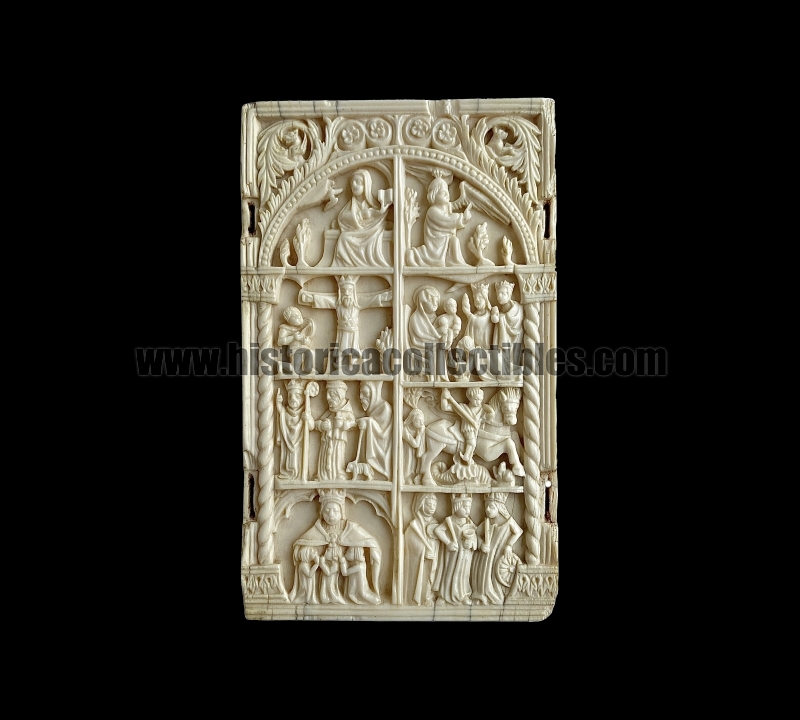
Rectangular ivory plaque carved in high relief, made in France or northern Italy during the Gothic period, considered to be the 14th century, which was certainly originally the central element of a "Triptych" as, on its sides, ancient holes and slots can be seen used to join two small doors with hinges, which allowed it to be opened and closed.
The scenic composition is divided into eight meticulously miniature and sculpted aedicules, drawn from both the New Testament and some from the "Golden Legend" (Legenda Aurea o Sanctorum), a medieval collection of hagiographical biographies composed in Latin by Jacopo da Varagine (Jacobus de Voragine), a Dominican friar and bishop of Genoa, from around 1260 until his death in 1298.
It is unusual to find, in these ivory sculptures, a combination of scenes from the Gospels and the Golden Legend; however, many artists drew inspiration from the Golden Legend for their works. Among them was Giotto with the Scrovegni Chapel in Padua, where the pictorial cycle is developed around three main themes: episodes from the life of Joachim and Anne, episodes from the life of Mary, and episodes from the life and death of Christ. Below these frescoes, a series of panels illustrate the allegories of the Vices and Virtues. And Piero della Francesca in the Stories of the True Cross in the Basilica of San Francesco in Arezzo. The Legend also served as a reference source for the Cursor Mundi.
In fact, in the two upper aediculae, we see the images of a Griffin and a Lion, depicted in their well-known apotropaic meaning as guardians of the sacred. Within the space itself, delimited by the two twisted columns and the semicircular arch, are the aediculae divided into eight scenes. Starting from the lunette at the top left, the Madonna is depicted in the presence of the Holy Spirit.
On the right is the figure of the Archangel Gabriel as God's ambassador at the Annunciation of Christ's birth.
On the left is the crucified Christ in his robe, with the chalice at his feet and the figure of the Centurion Longinus holding a spear with which he pierces his side.
Next, the sixth aedicule depicts the adoration of the Three Wise Men before Jesus in Mary's arms.
In the seventh aedicule, a scene from the "Golden Legends" features a bishop with a crosier (or staff) about to deliver a stern warning to two friars who demonstrate their loyalty to the church by appearing with a dog on a leash and the written rules of the three Franciscan orders.
Continuing, another scene from the "Golden Legends" shows Saint George on horseback protecting Princess Silene by slaying the dragon.
In the penultimate aedicule, the figure of Our Lady of Mercy is depicted with her cloak, under which all humanity finds shelter.
Concluding with the last aedicule, the sculptor likely intended to depict the images of three saints to whom he was devoted: Saint Catherine of Alexandria (with the wheel of life), Saint Clare of Assisi holding the sacred host (Corpus Christi), and Saint Barbara holding the chalice and host. These symbolize his unwavering faith in Christianity and his desire to face death and martyrdom with serenity, representing a spiritual accompaniment in death.
The sculpture, carved from the finest "Loxodonta Africana" (African elephant) ivory, is perfectly carved and engraved, with no missing or broken parts, even in the smallest details.
The sculpture is accompanied by an expert's report and CITES certification year 2025.
Height 145 mm, Width 90 mm, Thickness 12 mm.
References:
Goldschmidt, Adolph, and Kurt Weitzmann. Die Byzantinischen Elfenbeinskulpturen des X.-XIII. Jahrhunderts. Vol. 2. Berlin: Bruno Cassirer, 1934. no. 137, pp. 18, 63, pl. XLIX, fig. 137.
Victorian & Albert Museum of London - Accession number: 747-1877 (https://collections.vam.ac.uk/item/O106916/the-cru...)
Victorian & Albert Museum of London - Accession number: A.31:1-1996 (https://collections.vam.ac.uk/item/O306792/triptyc...)
Victorian & Albert Museum of London - Accession number: A.25-1949 (https://collections.vam.ac.uk/item/O312866/panel-w...)
Victorian & Albert Museum of London - Accession number: 300-1866
Victorian & Albert Museum of London - Accession number:A.556-1910
Victorian & Albert Museum of London - Accession number: 2818-1856
Victorian & Albert Museum of London - Accession number: 4336-1857
Victorian & Albert Museum of London - Accession number: A.5-1999
Victorian & Albert Museum of London - Accession number: CIRC.383-1920
Metropolitan Museum of New York: Object Number: 2003.131.4
Metropolitan Museum of New York: Object Number: 17.190.43
Metropolitan Museum of New York: Object Number: 1980.294
Metropolitan Museum of New York: Object Number: 17.190.44
Metropolitan Museum of New York: Object Number: 41.190.99
Metropolitan Museum of New York: Object Number: 1977.421
Metropolitan Museum of New York: Object Number: 1970.324.7a, b
Metropolitan Museum of New York: Object Number: 17.190.37
Metropolitan Museum of New York: Object Number: 17.190.133
Metropolitan Museum of New York: Object Number: 17.190.253
Metropolitan Museum of New York: Object Number: 1970.324.6
Metropolitan Museum of New York: Object Number: 17.190.275
Metropolitan Museum of New York: Object Number: 17.190.276
Dom-Museum Hildesheim: (DS 18)