
Sundial and Compass (Diptych) Johann Georg Kleininger, circa 1785
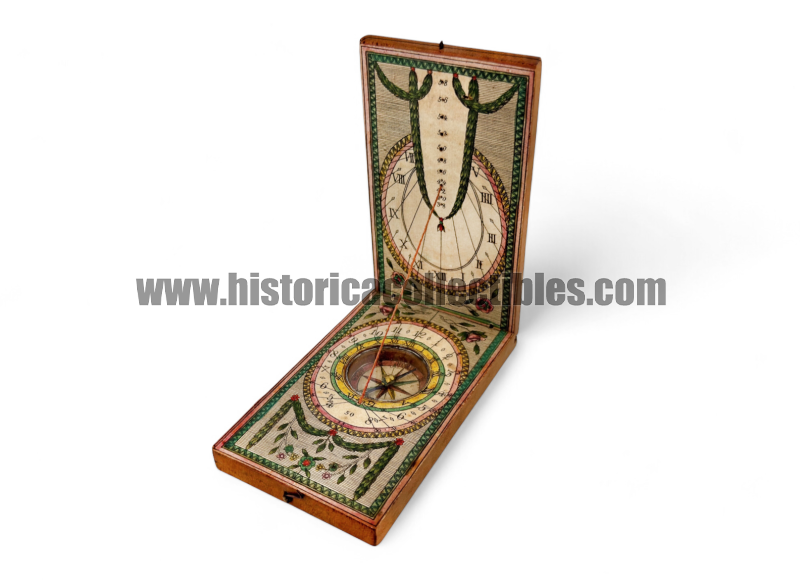
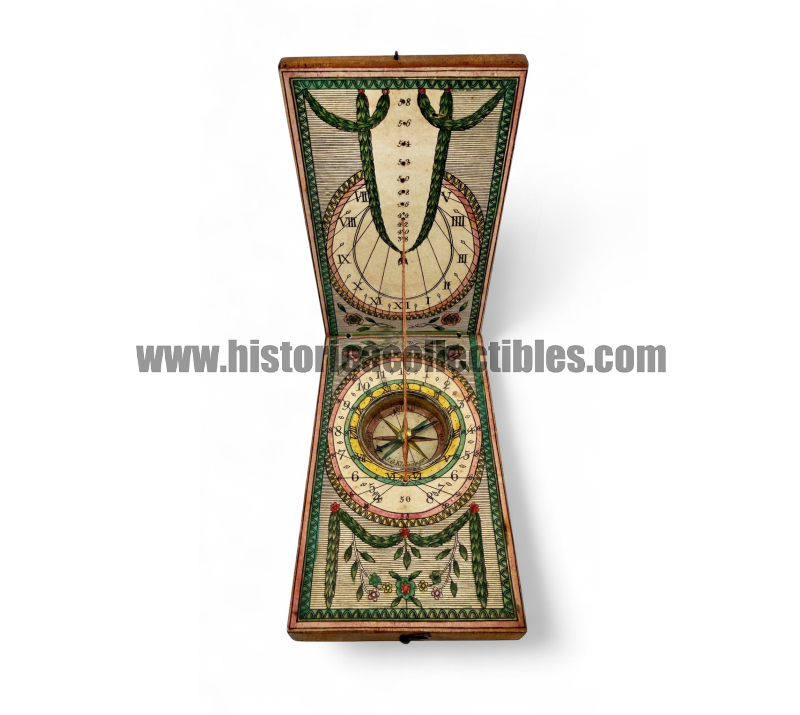
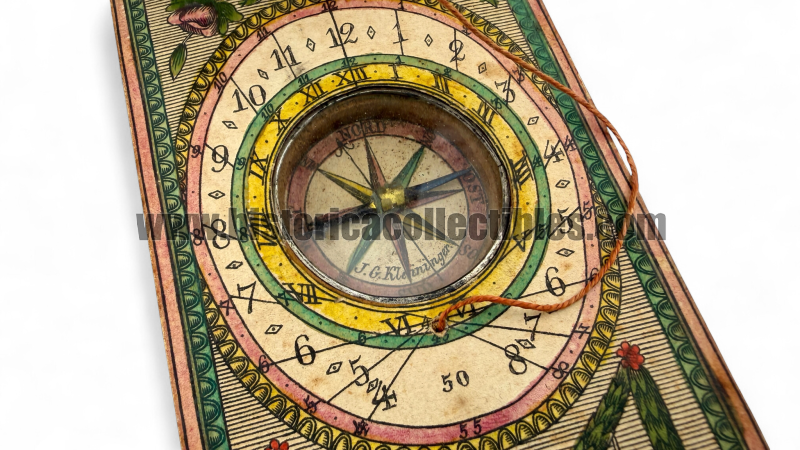
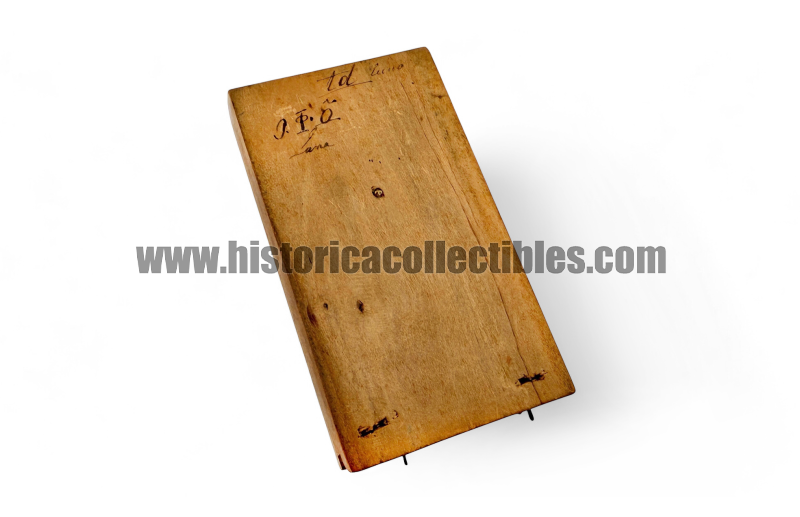
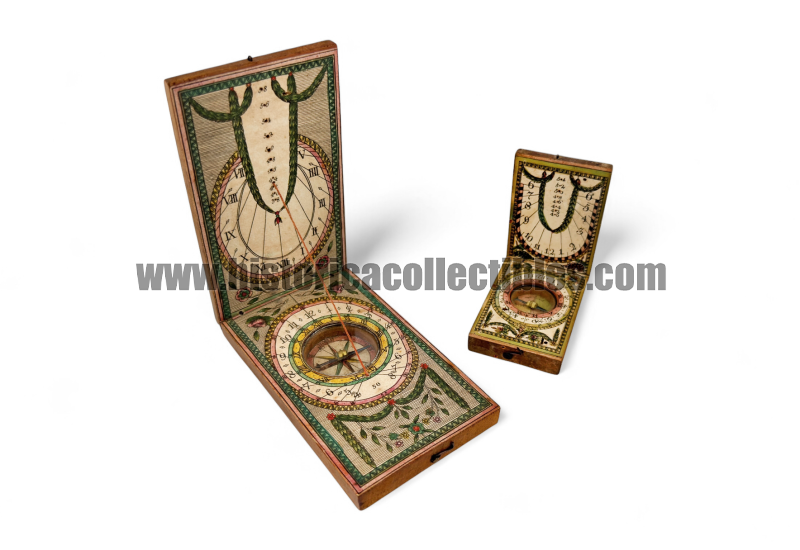
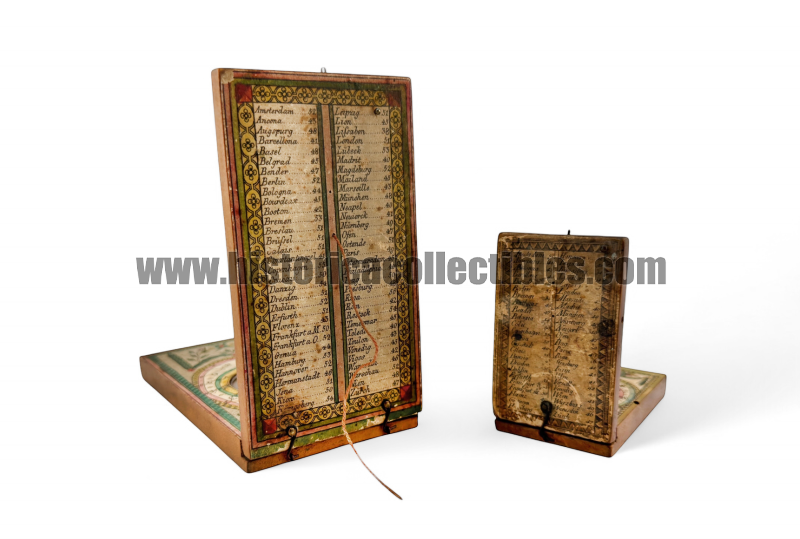
Diptych with Sundial and Compass, in boxwood, made by Johann Georg Kleininger around 1785, a skilled and important sundial maker in Fürth.
This diptych sundial (or tablet sundial) is a portable instrument made of two parts that can be folded with hinges to fit in a pocket and carried, similar to a modern clock for telling the time. The sundial combines a horizontal and a vertical dial, usually joined at a right angle, both operated by a "single thread" or "thread gnomon," which provides solar time by casting a shadow at the correct time.
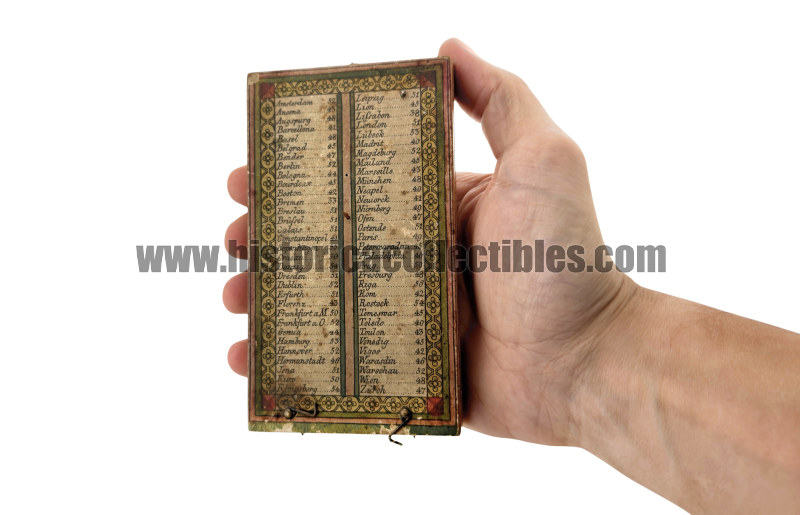
This model also includes a compass for correct orientation with respect to true north and tables of cities and latitudes for correct instrument settings.
Diptych sundials were first produced in the 15th or 16th century, primarily in the city of Nuremberg, Germany. They served as navigational and timekeeping instruments while traveling, offering a fairly accurate way to read solar time from any location.
The "Diptychs" of the Sundial and Compass, created by Johann Georg Kleininger, are preserved in major museums around the world.
How the Diptych works:
- To begin, open the tool and set the latitude of the location of use;
- Place the sundial on a flat surface and orient it so that the gnomon is aligned with true North using the built-in compass;
- The shadow of the Gnomon is projected onto one of the dials (horizontal or vertical) indicating the local solar time.
Comparison of diptychs:
Measurements of the large diptych: Length 126 mm, Width 72.5 mm, Thickness 18.5 mm, approximately.
Measurements of the small diptych: Length 73 mm, Width 46 mm, Thickness 16 mm, approximately.
History of Johann Georg Kleininger:
J.G. Kleininger (Schwabach, April 20, 1763 - Fürth, September 23, 1824) appears to have lived in Fürth since his marriage on April 26, 1791, in St. Michael, to Maria Barbara Helena (August 24, 1772 - April 1, 1847), daughter of the master turner Conrad Matthäus Wich of Breslau. In the 1799 address list, his son Johann Paul Kleininger is listed as residing at Alexanderstraße 20. It is likely that his son Paul, born March 7, 1798, was listed at that address as a new member of the family. At the time of his death, Johann Georg Kleininger was living in house 538 in Fürth, his address being Bäumenstraße 32, right next to Hallplatz. He died of pulmonary paralysis.
References:
https://www.astronomie-nuernberg.de/index.php?cate...
Museum of the History of Science, Oxford website, inventory number 20302 (accessed 12 September 2002).
The Whipple Museum of the History of Science, Catalogue 6: Sundials and Related Instruments, Part 2, Object 170
Online Register of Scientific Instruments, (accessed 12 September 2002).
Personal Communication, Hans Gaab, January, 2022.
JG Kleininger, National Maritime Museum, London
National Museum of American History - Accession number: 1987.0706 (ID Number MA.330853)
Adler Planetarium Chicago - Object number: W-71
Museum of the History of Science - Oxford Website: Inventory number 20302
Art Institute, Chicago
The Whipple Museum of the History of Science: Catalogue 6: Sundials and Related Instruments, Part 2, Object 170
Havard University
Stadtmuseum Berlin - Inventarnummer: II 62/1103 i
University of Toronto
Mathematisch-Physikalischer Salon, Dresden
Germanisches Nationalmuseum, Nürnberg