Aussichts-Standfernrohr monokular Carl Zeiss "ASEM", Marine-Feldbatterie Kriegsmarine, 1912-1940
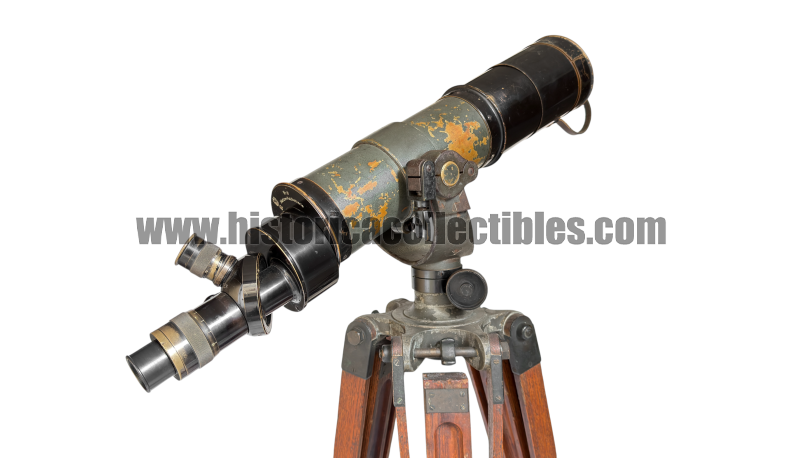
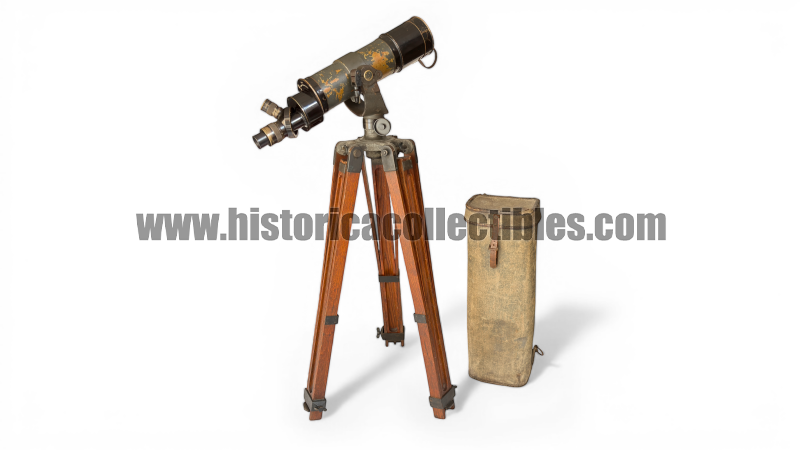
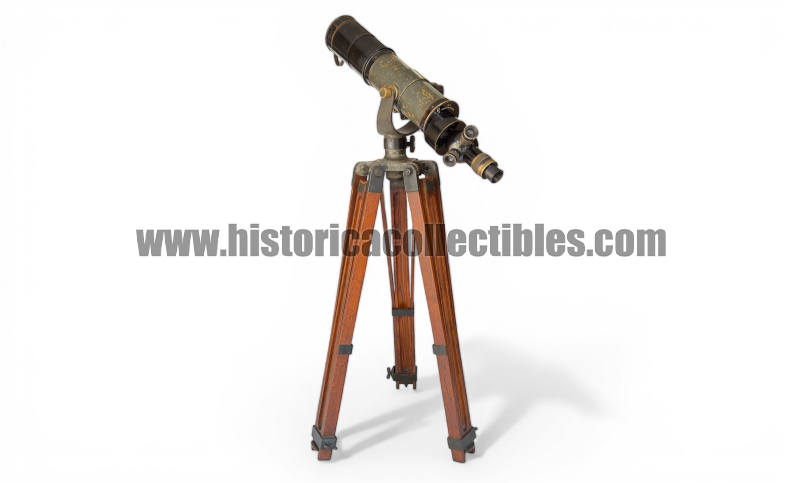
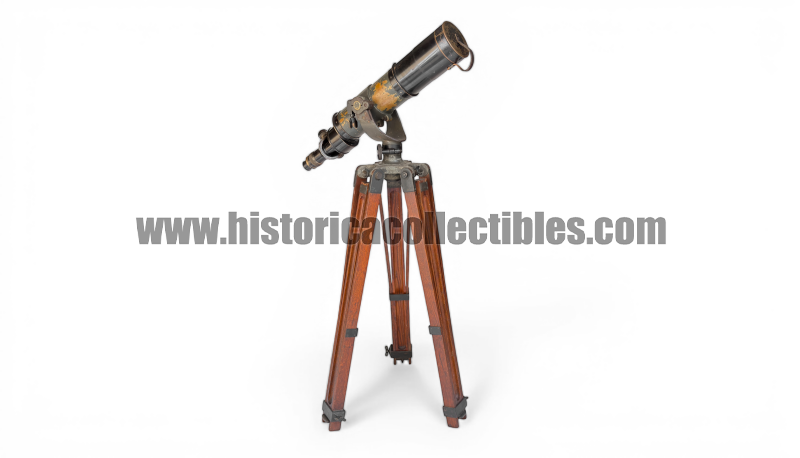
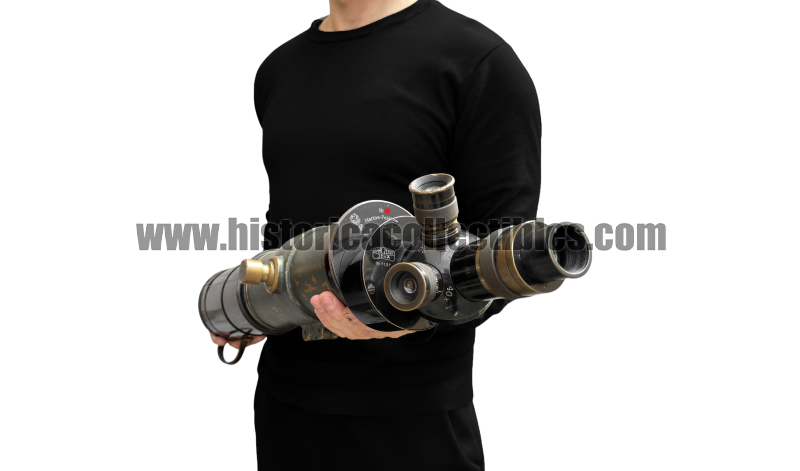
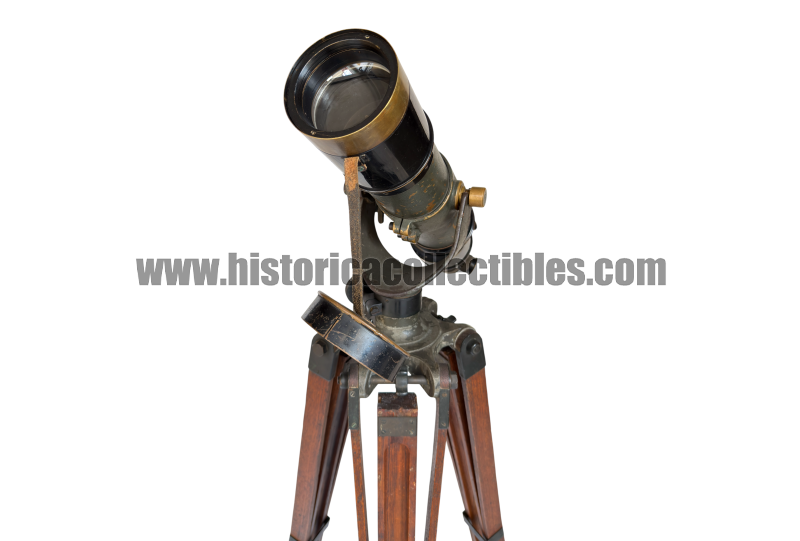
Aussichts-Standfernrohr monokular or also called "ASEM", produced by Carl Zeiss, and assigned to the Marine-Feldbatterie of the Kriegsmarine.
The ASEM was produced from 1912 to 1940 in three (probably four) different variants, all of which maintained the same technical and optical specifications. Its versatility led to this exact model being assigned to the Marine Field Battery of the Kriegsmarine between 1928 and 1935.
The revolver turret, equipped with three magnifications of 12, 24, and 40x with an 80 mm objective lens, provided extremely adaptable viewing even at long distances, the same distances faced by the German Navy's coastal artillery units.
It is equipped with a sturdy tripod with a mono-locking mount for quick installation, as well as its original carrying case.
It is in good condition: rotating the revolver turret allows for very sensitive selection of each magnification.
The view is very bright and sharp.
Zeiss Archiv Ident-Nummer 1097, Device Name Asem 80 mm:
The Asem is a simple, bright, and easily portable monocular spotting scope, featuring a triple turret, diopter adjustment, elevation and windage adjustment, and a retractable dew cap/rain shield. It is suitable as an astronomical telescope for observing fixed stars, lunar craters, Jupiter's moons, double stars up to 1.4 arc seconds away, the Orion and Andromeda galaxies, and similar objects. The Asem allows for observing stars up to magnitude 10.5. For solar observations, a sunshade and dew shield are available upon request. Optical specifications include selectable magnifications of 12x, 20x, and 40x, an 80 mm objective lens with a focal length of 50 cm, and exit pupils of 6.7 mm, 4.4 mm, or 2 mm. The field of view at a distance of 1000 m is 61 m, 36 m or 18 m respectively, with a maximum light gathering power of 10.5 arc seconds.
Carl Zeiss takes its name from its founder, Carl Zeiss, who on November 17, 1846 chose the small city of Jena, in Thuringia, as the location for his precision optical equipment factory. Thanks to the strict quality control that Carl Zeiss imposed on its products, going so far as to personally destroy the microscopes that did not pass the tests, the newborn Zeiss became the official supplier of the University of Jena and received the gold medal of the industrial exhibition in 1861 of Thuringia as the best research instrument manufactured in Germany, awarded to the microscope Stand I of 1857.
In 1866, the thousandth microscope was produced and the Zeiss name became known in all European scientific circles. Thanks to the studies on the Porro prism, in 1893 Abbe patented a double prism binoculars, which accentuated the perception of depth.
The mass production of Zeiss binoculars began in 1894, already at the beginning of the twentieth century more than 30,000 were made, by the beginning of the First World War the figure had risen to 500,000 and, by the end of the Second World War, 2,260,000 were produced binoculars for the civilian and military market. Models were made starting from 4x11 mm to 12x40 mm, up to real giants such as 80 mm and 100 mm.
Thanks to studies conducted on the perception of light in low light situations, it was shown that the average dilation of the pupil in an adult is about 7 mm. For this reason, the 7x50 mm model was introduced in 1910 and remained on the market until 1917 with few changes to the materials used.
In 1926, following the post-war crisis of the First World War with the Treaty of Versailles which bankrupted many important German companies, Zeiss bought the "C.P. GOERZ" and founded the Zeiss Ikon in 1926.
In 1937, Zeiss had commercial contacts and factories spread over 29 countries around the world. From 1933 Zeiss acquired interest from the Nazi regime, which balanced production towards military instruments. It successfully produced binoculars with wide-angle optics for military use, pressure resistant optical systems for U-boats, periscope binoculars for targeting tanks. Furthermore Zeiss cameras were mounted on the V2 for remote sensing operations of the English coasts.
On November 1, 1935, Zeiss, in the person of Alexander Smakula, patented a process for the treatment of optical glasses with extraordinary results in terms of light transmission. Remained a military secret until 1939, it was adopted on binoculars to reduce ghost images and internal reflections. During the Second World War, there were numerous bombings against the Zeiss factories.
Jena was bombed several times by the Allies starting in 1944. Stuttgart was razed to the ground, although the Contessa-Nettel factory suffered little damage. The bombing of Dresden, in addition to devastating the city, also caused considerable damage to the Zeiss Ikon headquarters.
On April 13, 1945, American military forces entered Jena, surprising themselves as the bombings had not caused significant damage. The main planetarium was in ruins, while the factories remained operational.