
Binóculo 8x30 Schiebeokulare, Carl Zeiss Jena, Artilharia do Exército Brasileiro, 1937
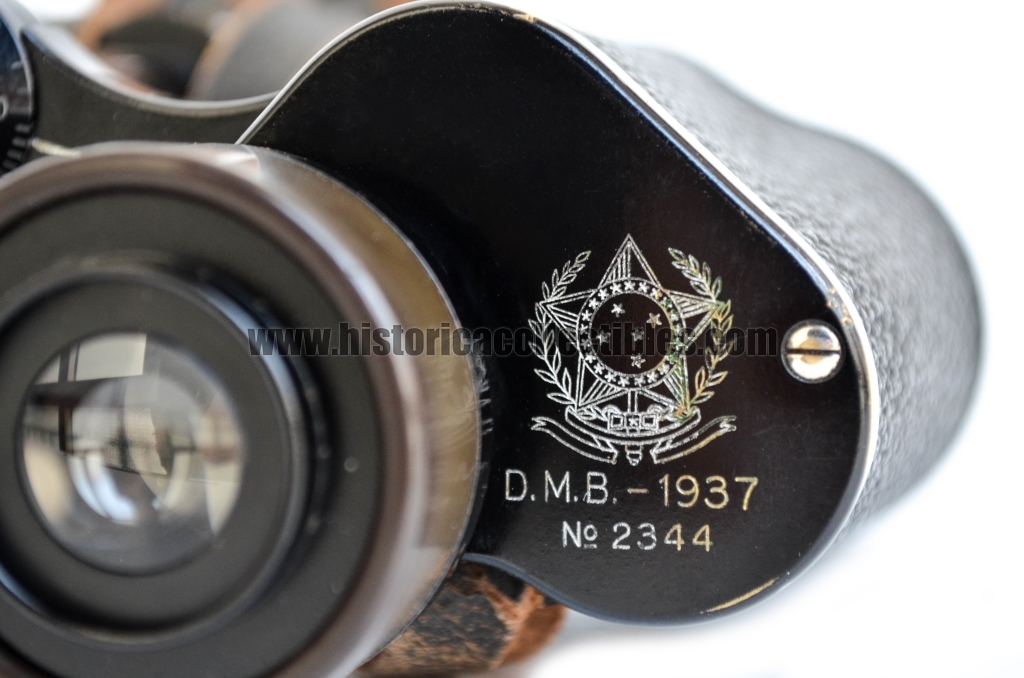
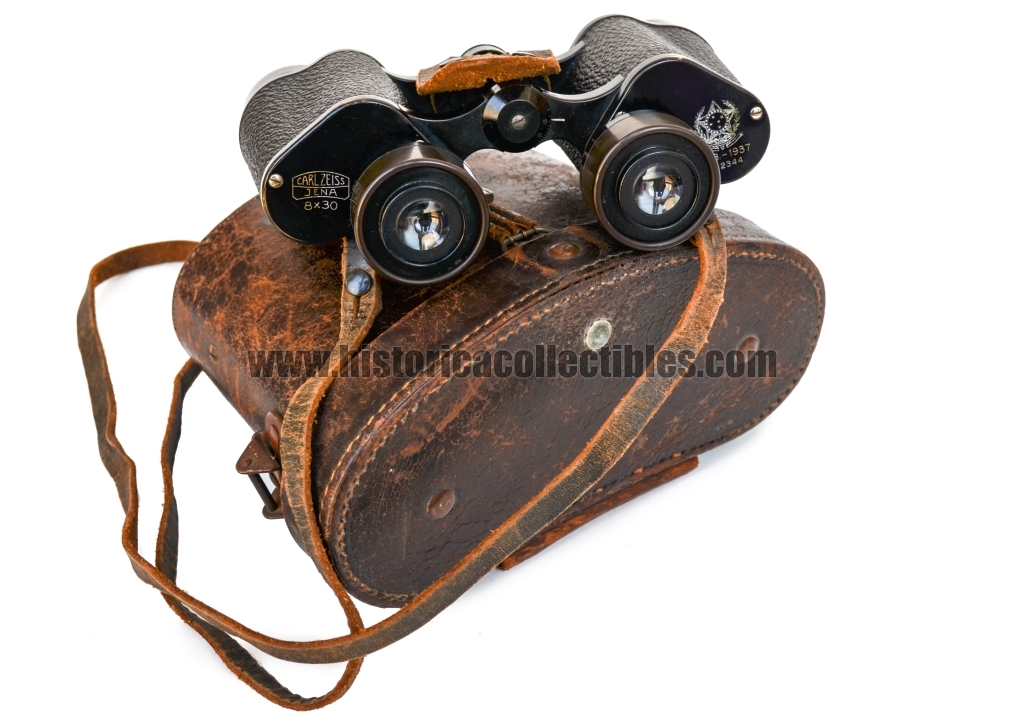
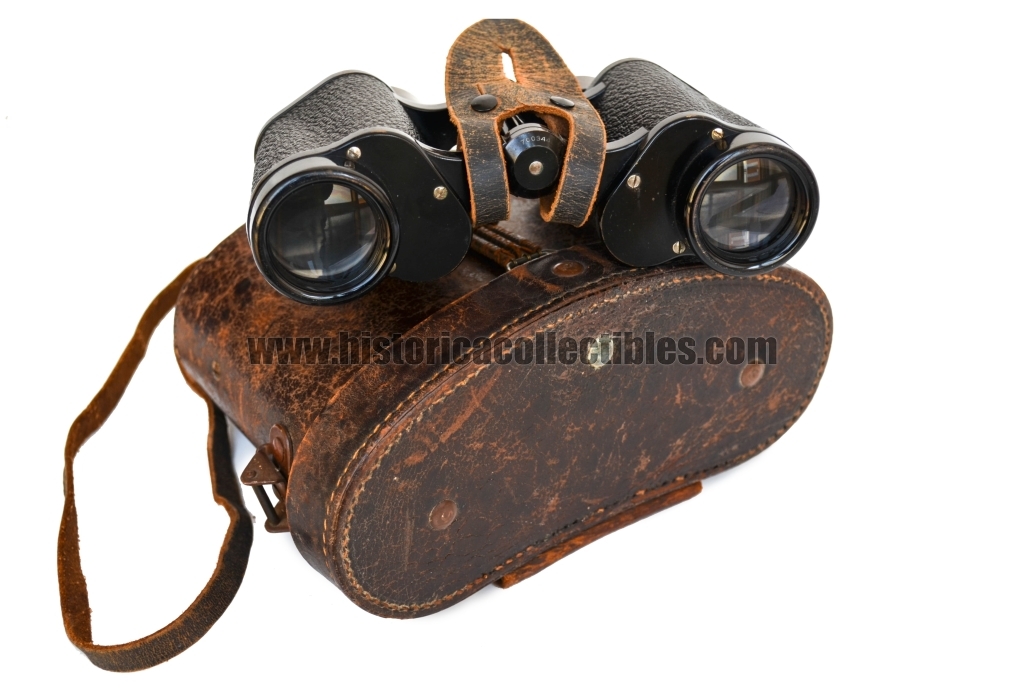


8x30 binoculars, produced by Carl Zeiss Jena, in 1936 and assigned to the Brazilian Army in 1937, as shown by the date shown on the right eyepiece plate and inside the lid of the case, located below the "D.M.B." logo. (Deposito de Materiais Bélicos), or the body of the Ministry responsible for the assignment, to the Brazilian Army, both with military assignment number "2344".
The binoculars have a particular cross reticle inside the right eyepiece with a scale from 0 to 100/6400 with multiples of 20°. There is a "Carl Zeiss Jena" logo on the left eyepiece plate.
These binoculars have a special feature, namely particular extensible Bakelite eye rests (Schiebeokulare), which allow the observer a comfortable and prolonged vision over time and allow the wide field of vision with which the binoculars are equipped to be fully exploited.
It is equipped with two relative anti-fog filters, designed to improve the definition of the images. It is also complete with its original and robust leather case, marked with the Carl Zeiss Jena logo and also bearing the same logo on the inside of the lid and information on the right eyepiece plate of the binoculars.
Inside the lid of the case, right above the Brazilian Army logo, there is a signature, which from some research appears to be that of Lieutenant Edgar Duarte Nunes, Officer of the Artilharia do Exército Brasileiro.
The storage conditions are excellent, the vision is perfectly collimated and all the mechanisms work precisely and correctly.
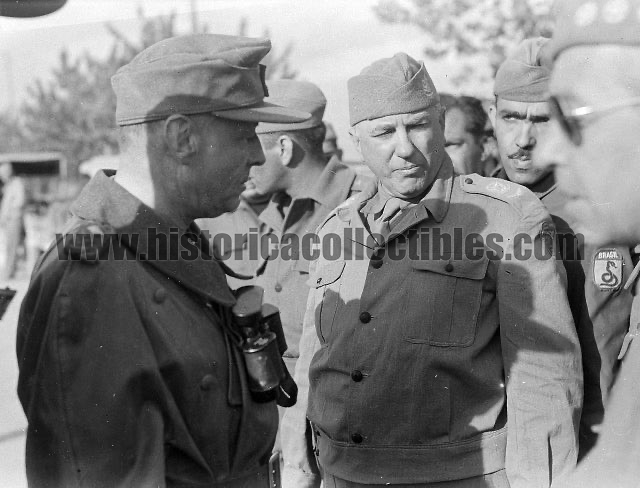
The Força Expedicionária Brasileira (in English "Brazilian Expeditionary Force"), known by the acronym FEB, was the Brazilian military force that fought alongside the Allies in Italy during the Second World War. Initially made up of an infantry division, other units of the Brazilian army also participated in it, such as armored departments and air units. The FEB adopted the motto and subsequent logo "The cobra is smoking", alluding to a speech by Getúlio Vargas, in which the president had stated: "it is easier for a snake to smoke than for Brazil to go to war".
The FEB was integrated into the US Army's IV Corps, under the command of General Willis D. Crittemberger, a Corps in turn assigned to the US Fifth Army commanded by General Mark Wayne Clark.
The FEB entered combat in September 1944 in the Serchio river valley, north of the city of Lucca. The first victories of the FEB were obtained with the conquests of Massarosa, Camaiore and Monte Prana. Only at the end of October, in the Barga region, did the FEB suffer its first setbacks. Given the success of the September and early October campaign, at the end of November the FEB, in a few days, was responsible for taking the area of Monte Castello and Monte Belvedere.
The FEB commander warned the US Fifth Army that such a mission could not be accomplished by a single division, as had already been demonstrated in failed attempts on other missions, and that success would require the joint attack of two divisions simultaneously at Mount Belvedere, Mount Torraccia, Mount Castello and Castelnuovo. These arguments were accepted only after the failure of two attempts, this time made by the Brazilians, one in November and the other in December.
During the harsh winter between 1944 and 1945, the FEB found temperatures as low as twenty degrees below zero in the Apennines. Lots of snow, humidity and continuous attacks by the enemy, who through small skirmishes tried on the one hand to undermine the physical and psychological resistance of the Brazilian troops not accustomed to the low temperatures and already tired from more than three months of uninterrupted campaign without recovery breaks , on the other to test possible weak points in the sector occupied by the Brazilians for a counter-offensive in the winter.
However, in this respect, the involuntarily aggressive attitude of the two attempts to take Monte Castello at the end of 1944 and the voluntary attitude of responding to the enemy's exploratory incursions into the territory occupied by the FEB with exploratory incursions of the FEB into enemy territory, meant that the Germans and their allies chose for their counteroffensive another sector of the Italian front, occupied by the 92nd US division.
Between the end of February and March 1945, as the FEB commander had suggested, Operation Encore began to break through the last Axis bastions on the Modena and Bologna Apennines together with the US 10th Mountain Division. arrived recently. The Brazilians captured some positions, including Monte Castello and Castelnuovo, while the Americans took Monte Belvedere and Monte Della Torraccia. From these positions it was possible to launch the final spring offensive, in which, in April, the FEB took the town of Montese.
The positions conquered by the Brazilian troops, added to those obtained by the US mountain division in this secondary but vital sector, gave the opportunity to the forces under the command of the British VIII Army, further east in the main sector of the Italian front, to finally see themselves free from the enemy artillery fire that started from those points and to move above Bologna, breaking the Gothic Line after eight months of combat.
It was the final phase of the spring offensive on the Italian front.
At Fornovo di Taro, with a perfect maneuver and a bold move by its commander, the FEB forces, in a state of numerical inferiority, surrounded the enemy and with a quick agreement managed to have the delivery of two enemy divisions, the 148th division of German infantry, commanded by General Otto Fretter-Pico, and the remaining members of the Bersaglieri division, commanded by General Mario Carloni.
When they were taken, these divisions were retreating from the area of La Spezia and Genoa, liberated by the US 92nd Division, to join the Italian-German forces in Liguria in order to counterattack the US 5th Army, which was advancing rapidly but in an uncoordinated manner, with large gashes especially in the left phalanx and in the rear. Many bridges over the Po river were left intact by the Nazi-fascists with this intent. In Caserta, the command of the German C Army, which had already been in a peace agreement for a couple of days with the Allied command in Italy, was hoping for a victory in order to obtain better conditions for surrender.
The final events in the Battle of the Fornovo Pocket, however, prevented the execution of these plans both due to the numerous losses and the delay caused and, together with the news of Hitler's death and the final capture of Berlin by the forces of Red Army, left the German command no option other than to accept the rapid delivery of their troops to Italy. At the end of its march, the FEB also arrived in Turin and on 2 May 1945 in the city of Susa, and then joined the French troops on the Franco-Italian border.
On June 6, 1945, Brazil's Ministry of War ordered that FEB units still in Italy subordinate themselves to the commander of the first military region (1st RM), located in the city of Rio de Janeiro: ultimately, this meant the dissolution of the contingent. Despite its rapid demobilization, the return of the FEB after the end of the war against fascism precipitated the fall of Getúlio Vargas and the end of the New State in Brazil.
Carl Zeiss takes its name from its founder, Carl Zeiss, who on November 17, 1846 chose the small town of Jena, in Thuringia, as the location for his precision optical equipment factory. Thanks to the severe quality control that Carl Zeiss imposed on his products, going so far as to personally destroy the microscopes that did not pass the tests, the newly formed Zeiss became the official supplier of the University of Jena and received the gold medal of the industrial exhibition in 1861 of Thuringia as the best research instrument produced in Germany, awarded to the Stand I microscope of 1857.
In 1866 the thousandth microscope was produced and the name Zeiss became known throughout European scientific circles. Thanks to studies on the Porro prism, in 1893 Abbe patented double prism binoculars, which accentuated the perception of depth. The mass production of Zeiss binoculars began in 1894, already at the beginning of the twentieth century more than 30,000 were made, at the beginning of the First World War the quota had risen to 500,000 and, at the end of the Second World War, as many as 2,260,000 were produced binoculars for the civil and military market.
Models were made starting from 4x11 mm to 12x40 mm, up to real giants such as the 80 mm and 100 mm.
Thanks to studies conducted on the perception of light in low light situations, it was demonstrated that the average dilation of the pupil in an adult is approximately 7 mm.
For this reason, the 7x50 mm model was introduced in 1910 and remained on the market until 1917 with few changes to the materials used. In 1926, following the post-war crisis of the First World War with the Treaty of Versailles which bankrupted many important German companies, Zeiss purchased "C.P. GOERZ" and founded Zeiss Ikon in 1926.
In 1937 Zeiss had commercial contacts and factories in more than 29 countries around the world. From '33 Zeiss acquired interest from the Nazi regime, which balanced production towards military instruments. It successfully produced binoculars with wide-angle optics for military use, pressure-resistant optical systems for U-boats, periscope binoculars for targeting tanks. Furthermore, Zeiss cameras were mounted on the V2s for remote sensing operations of the English coasts.
On 1 November 1935, Zeiss, in the figure of Alexander Smakula, patented a process for the treatment of optical glass with extraordinary results in terms of light transmission. Remained a military secret until 1939, it was adopted on binoculars to reduce ghost images and internal reflections. During the Second World War, there were numerous bombings against the Zeiss factories. Jena was bombed several times by the Allies starting in 1944. Stuttgart was razed to the ground, although the Contessa-Nettel factory suffered little damage.
The bombing of Dresden, in addition to devastating the city, also caused considerable damage to the Zeiss Ikon headquarters.
On April 13, 1945, American military forces entered Jena, surprising themselves that the bombing had not caused any significant damage. The main planetarium was in ruins, while the factories remained operational.