
Binoculars 6x30, Spindler&Hoyer-Göttingen, Royal Danish Navy, circa 1943
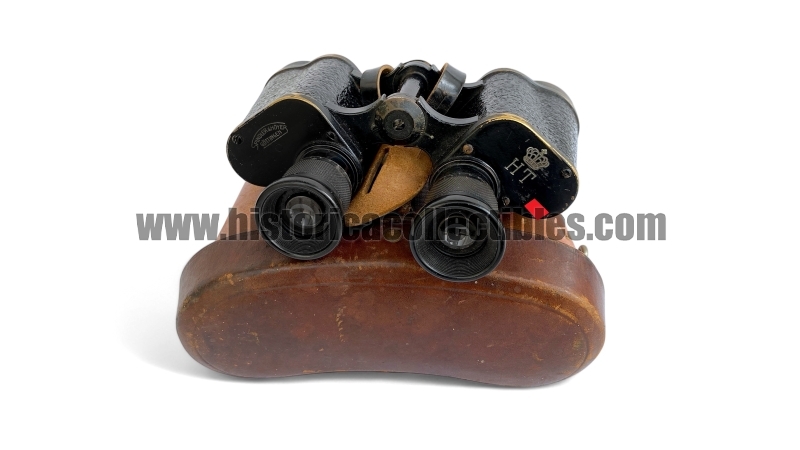
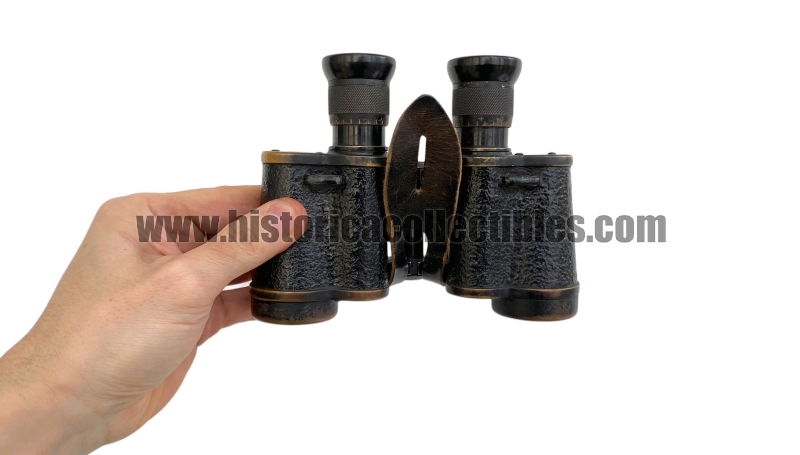
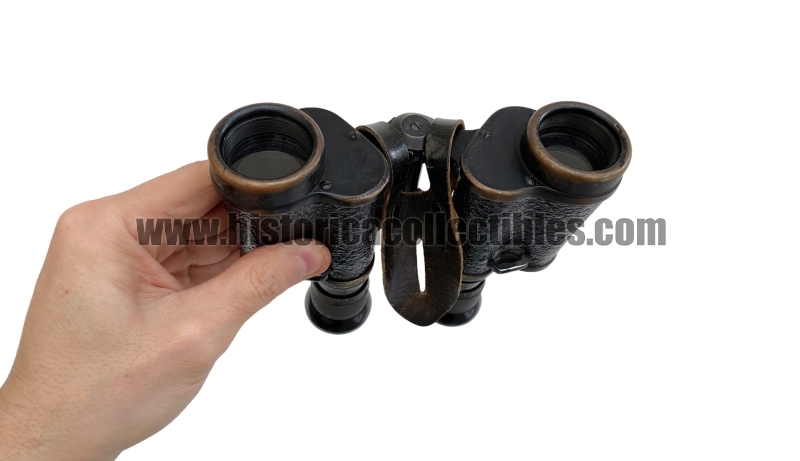

Marineglas 6x30 produced by Spindler&Hoyer-Göttingen, for the Royal Danish Navy, in 1943.
This binoculars are a model produced for export, which is part of a limited supply intended for the Danish Navy: in fact, on the right eyepiece plate it shows the "Royal Danish Crown" with the letters "HT" and the number "Nr. X" relating to the military assignment. On the left eyepiece plate there is also the manufacturer's logo "Spindler&Hoyer-Göttingen" with a "blue circle" underneath which indicates that a "bakuumfett" lubricating grease has been used for the gears which resists temperatures up to "-40°".
It comes complete with its original leather case and leather strap to attach it to the coat button.
The binoculars is collimated and all mechanisms work correctly. In the right eyepiece there is a numbered scale reticle.
In 1898 Julius Adolf Hoyer (1874-1943) joined August Spindler (1870-1927) to found the optical company "Spindler&Hoyer" based in Göttingen (Göttingen).
The product range of "Spindler&Hoyer" was extremely wide and included many types of instruments.
During the two world wars it was the main supplier of binoculars to the German army. This
The optical design and manufacturing company still exists today, but under a new name: Linos AG.
The Kongelige Danske Marine (Royal Danish Navy), commonly referred to as Søværnet (Marine Defence) is part of the Danish Armed Forces. It is responsible for Danish maritime defense and sovereignty and the territorial waters of the Faroes and Greenland. Other tasks are: surveillance, search and recovery, icebreaking, recovery and oil spill prevention. In the past, from 1509 to 1814, it was part of the Dano-Norwegian Navy, when Denmark and Norway were united, in fact, in the Kingdom of Denmark and Norway.
Denmark, with its strategic position, has had the function of guardian of the strait of the same name since the First World War when, despite its neutrality, the country decided to equip itself with two naval teams capable of controlling access from the north and south to the Belt; ships equipped with heavy 240mm guns were designed at the head of the two teams. A class of three ships was built to the design with two 240mm guns, named the Herluf Trolle class after the class leader, launched in 1899 and entered service in 1901; the second was Olfert Fischer and the third Peder Skram; another planned ship, the Niels Iuel, was completed with ten 150mm guns.
The two older ones were decommissioned in 1932 and 1936 respectively, while Peder Skram was still in service at the outbreak of the war. The Danish navy was blocked by the German invasion of 1940 during the Second World War but the units of the time were already hopelessly obsolete; the navy was entrusted with the task of minesweeping in the strait in an east-west direction to allow internal traffic, while the Germans swept in the south-north direction and this allowed the Danes to argue to the Allies that the fleet was not collaborating with the Germans. Despite this, in February 1941 the Germans requisitioned the six new motor torpedo boats Dragen, Hvalen, Laxen, Glenten, Hoegen and Ørnen, with the promise that they would pay in sufficient materials to build new ones.
The Peder Skram after being sunk in the Copenhagen arsenal
But the growing tensions within Denmark towards the occupiers and the war events led the Germans during the Safari operation on 29 August 1943 to proceed with the disarmament of the fleet and the army; in anticipation of this, not being able to oppose with force, the Danish navy had previously given orders to its ships to try to reach Sweden or scuttle themselves, and the hangar at the Holmen military base in Copenhagen which housed the seaplanes was set on fire ; in the end, only a few smaller units reached Sweden while the largest Danish unit, the Niels Juel, was put out of action by two airplane bombs that exploded very close and forced to run aground while trying to cross the strait.
After the war, its configuration was mainly designed to counter the Soviet fleet, which was stationed in traffic, as well as those of the Northern Fleet.
The Kongelige Danske Marine is a classic Nordic navy with numerous light anti-ship attack units, but lacking in terms of anti-submarine capability, but it also has an offshore component with some good units.
The Danish Navy is headquartered in Århus and has two operational teams, one based in Frederikshavn and the other in Korsør.