Binoculars Leitz 6x24 Amplivid, 212m/1000m Ultra-Wide Angle, 1956-1962

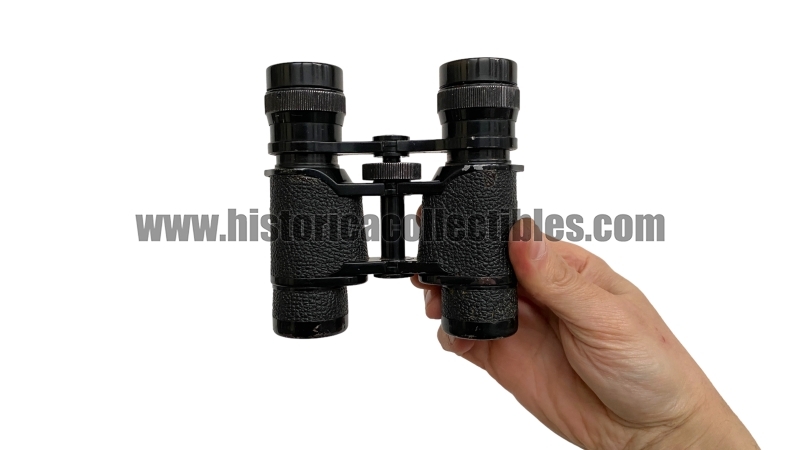
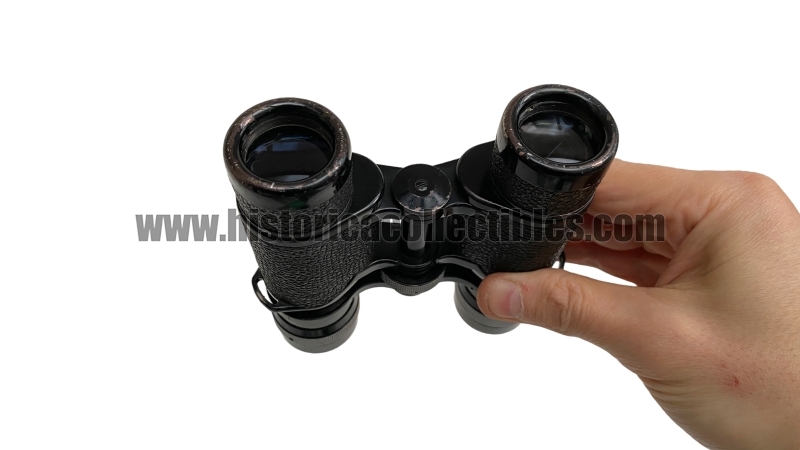
For the first time in the history of portable binoculars, E. Leitz has built an elegant, extremely versatile and compact ultra wide-angle binocularS with unsurpassed optical excellence.
The Amplivid 6x24 was produced for only 6 years, between 1956 and 1962. In this binoculars, with a size of only 11x11 cm and only 356 gr. in weight, a special prism system is installed which has a true viewing angle of 12.1° and creates a huge field of view of 212m/1000m.
The prism system consists of a single large roof prism and a surface mirror that reverses the image. This prism-mirror combination was originally invented by Max Ludewig in 1949, improved in 1951 by Daniel Schade and patented by E. Leitz.
Due to the high workload during maintenance work (readjustment) the binoculars were withdrawn from production after 6 years.
The image is distortion-free and very sharp, it also has a high contrast, which is slightly less sharp due to the edge.
The binoculars work perfectly in all its mechanisms, the vision is sharp and collimated and this is the most powerful compact and portable binoculars ever produced by E. Leitz.
History of Leitz:
Originally called the Optisches Institut, Leica was founded as a small optical workshop in Wetzlar, Germany in 1849. The founder, a German mechanic named Carl Kellner, was intrigued by the advent of microscopes at the time and wanted to establish a factory that produced devices better than its competition.
His hard work soon paid off when in 1851 his laboratory gained popularity for producing high-quality microscopes. Production and sales were severely affected in the years following the owner's sudden death in 1855.
Ernst Leitz joined the company in 1864 as an employee and assumed complete authority after the death of Frederic Belthle, an apprentice hired by Carl Kellner. He later added his full name to the company name in 1869. After immense success in the microscope business, the company opened its first international retail outlet in New York City in 1892. Under Leitz's rule, the small Wetzlar laboratory transformed into a large factory and annual production rose to 4,000 microscopes in 1890.
After establishing a loyal customer base, Ernst Leitz – Optisches Institut – Wetzlar began producing "Binocle 6x18" binoculars at its Wetzlar location in 1907, which laid the foundation for Leica Sport Optics. The binoculars were later followed by high-quality spotting scopes. By the 1960s, Leica binoculars had gained so much admiration that NASA decided to send the Leica Trinovid to the Moon aboard the Apollo mission in 1969.
An optical engineer named Oskar Barnack joined Leica in 1911 to work on binoculars. In his spare time and using company resources, he developed the first working model of a portable camera that used 35mm photographic film.
The device was called the Leitz Camera, named after the CEO, Dr. Ernst Leitz II. The camera became an instant hit among the masses, and Leitz officially added it to the company's product line. Considering the high popularity of the Leica camera range, the company was renamed Leica in 1986, using "Lei" from Leitz and "ca" from the camera.