Binoculars Revolver "URANUS" 12.20.40x80 Fratelli Koristka Milano, Royal Italian Navy, circa 1920
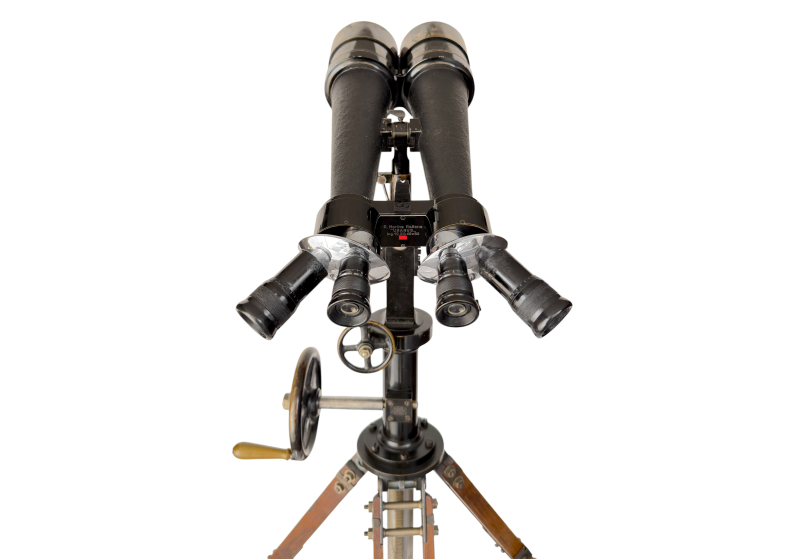
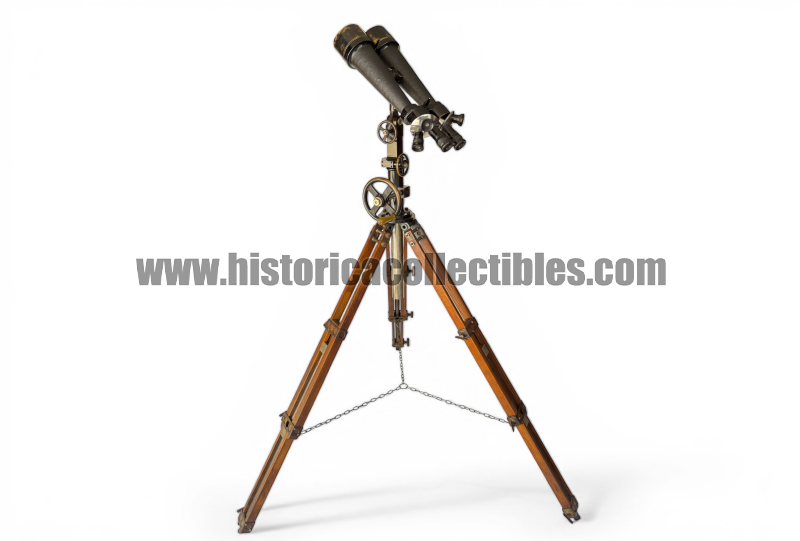
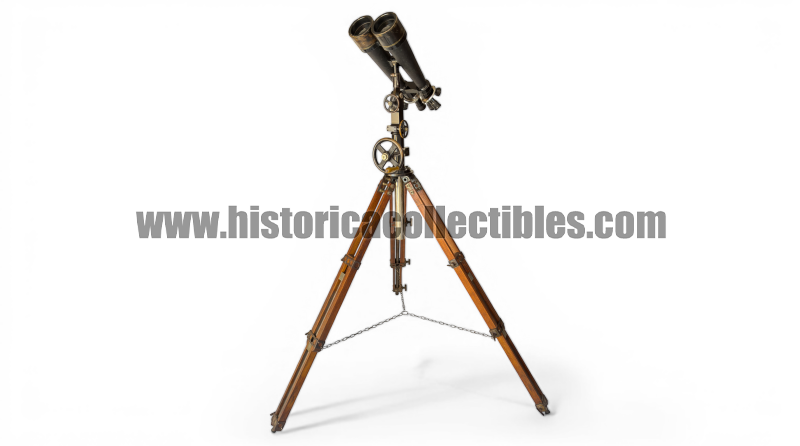
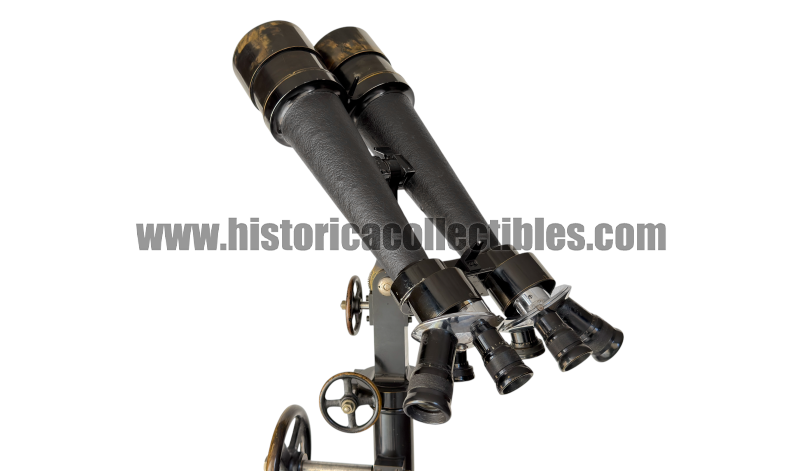
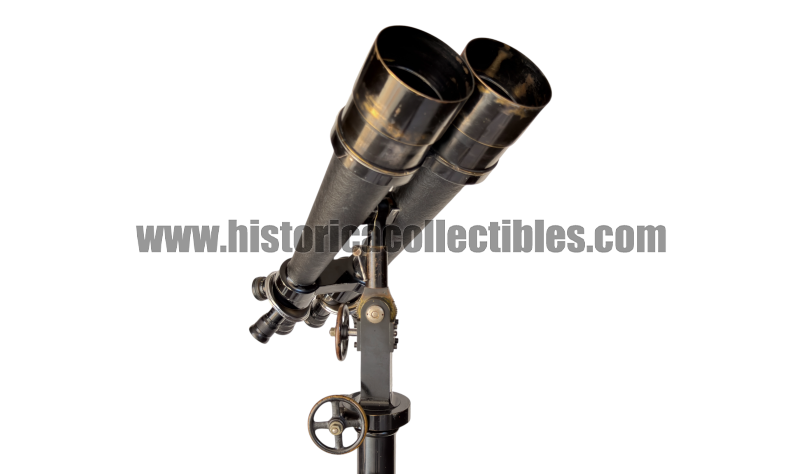
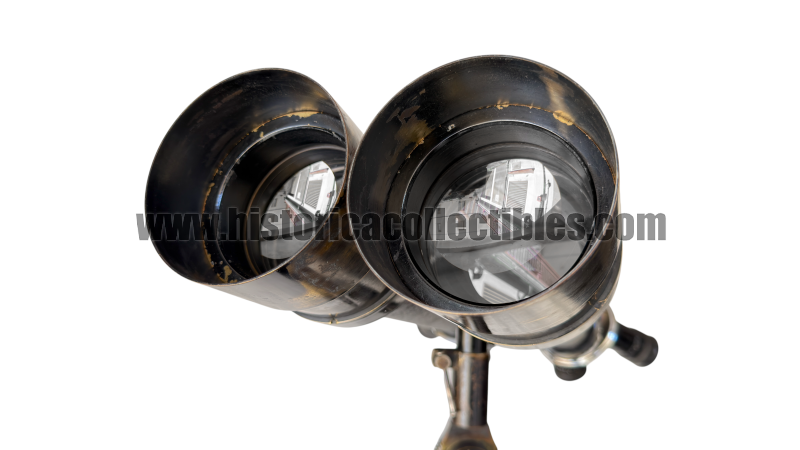
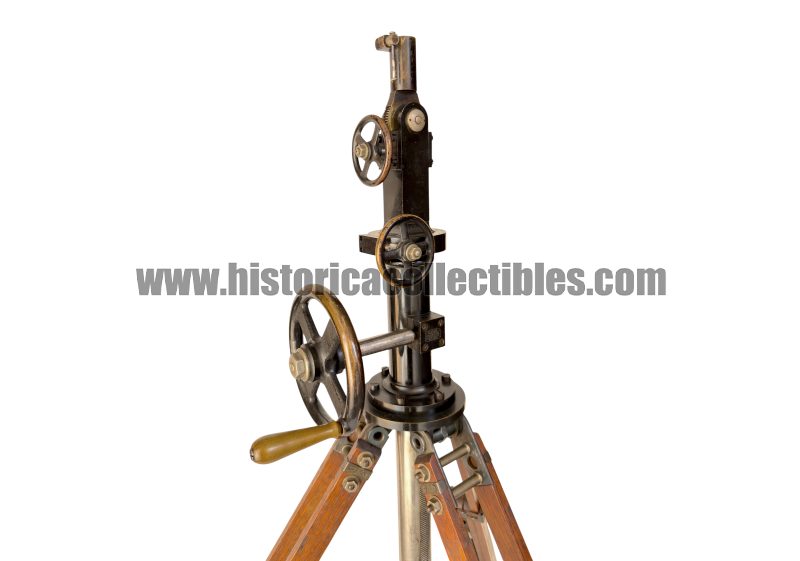
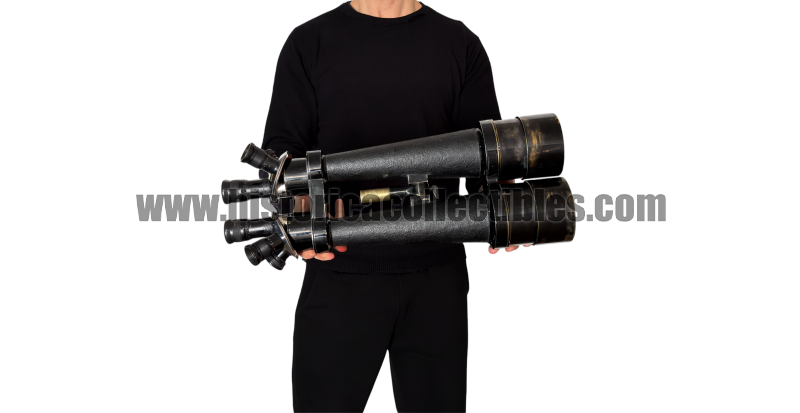
Binoculars with a double revolver turret and three eyepieces, with 12x, 20x, and 40x magnification respectively, equipped with 80mm air-spaced achromatic doublet objectives.
Manufactured for the Royal Italian Navy by the renowned Milanese company Fratelli Koristka around the 1920s, this model, called "URANUS," represents an excellent example of Italian Naval Military optical equipment from the post-World War I era.
The revolver turret system allows for rapid selection of the desired magnification, allowing the observer to instantly adapt to different operational needs, from broad survey of the maritime horizon to detailed observation of extremely distant targets.
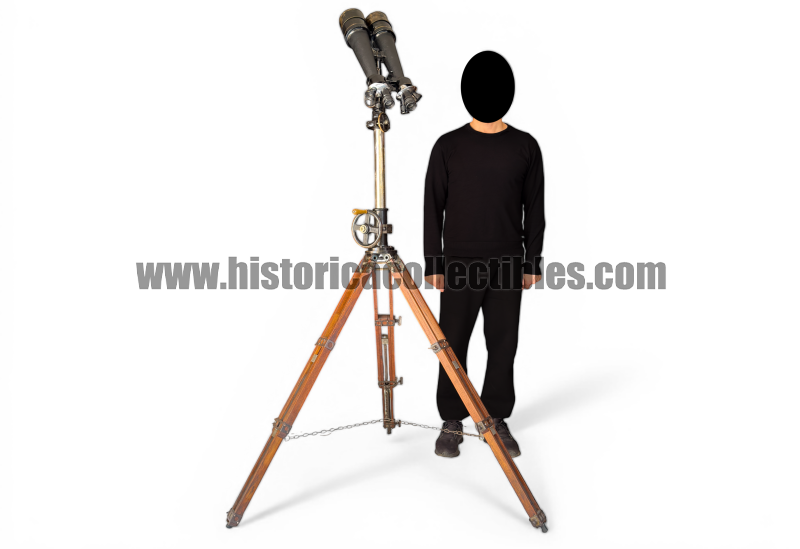
Particularly noteworthy is the original tripod, extremely functional, robust, and expertly designed to ensure extremely precise observations even at very long distances. The structure allows for complete adjustment on three axes: latitude, longitude, and altitude.
The main knob activates a rack-and-pinion mechanism for vertical adjustment of the binoculars' height, with an automatic locking system at the selected height. The central knob operates a complex gear system that allows for continuous 360-degree rotation of the base. The upper knob, located on the binoculars' support, allows for precise tilt adjustment. Further rapid tilt adjustment can be made by unscrewing the small knob located between the two optical tubes, directly on the support, by half a turn.
The tripod is also equipped with two telescopic extensions; each ferrous tube houses an additional support element with a double locking screw, ensuring maximum safety and stability at the selected observation height.
Despite its military purpose, it is an instrument of remarkable formal elegance. Compared to other contemporary revolver binoculars, such as those produced by Carl Zeiss or C. P. Goerz, this model stands out for its precision materials, refined construction details, and harmonious lines, combining military functionality and aesthetic sophistication, making it virtually unique.
The view is sensational: bright and perfectly collimated.
History of Koristka:
Francesco Koristka, of Polish origin (Silesian to be precise), after having worked in Vienna and being Salmoiraghi's assistant, set up his own business and founded it in Milan in 1881 (1880 is reported almost everywhere but in an old Koristka advertisement I found clearly written: F. Koristka S.A. (House founded in 1881) a company, Ottica Meccanica Flli. Koristka. It soon became one of the most important and appreciated producers of optical instruments (binoculars and microscopes), standing out for the high quality of the lenses mounted on their products.
During the First World War he produced binoculars intended for officers of the Royal Navy: the "Marenostrum". It also became the most important company in Italy for the construction of microscopes and one of the few Italian precision industries that exported both to Europe and America.
Thanks to his relationships with Ernst Abbe (1840-1905), Koristka had the opportunity to build microscopes and photographic lenses by exploiting the patents of the Zeiss company in the same way in which Krauss worked in Paris, but he also built lenses with original designs such as the telephoto lens Negri-Koristka, and subsequently the Ars, the Sideran, the Sagittal, the Meridian and the Proximar telephoto lens. In 1929 the F.lli Koristka company was absorbed by Officine Galileo Firenze, but continued to produce under its own brands for a few decades.