DF 7x40, Carl Zeiss Jena, NVA-Nationale Volksarmee, 1981
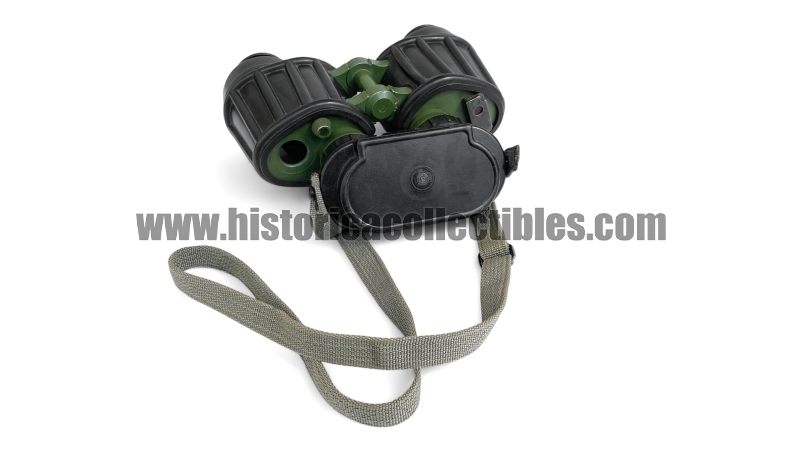
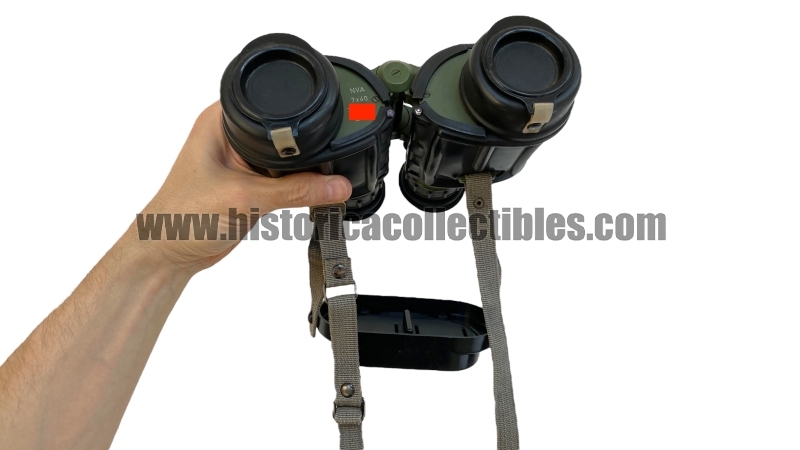
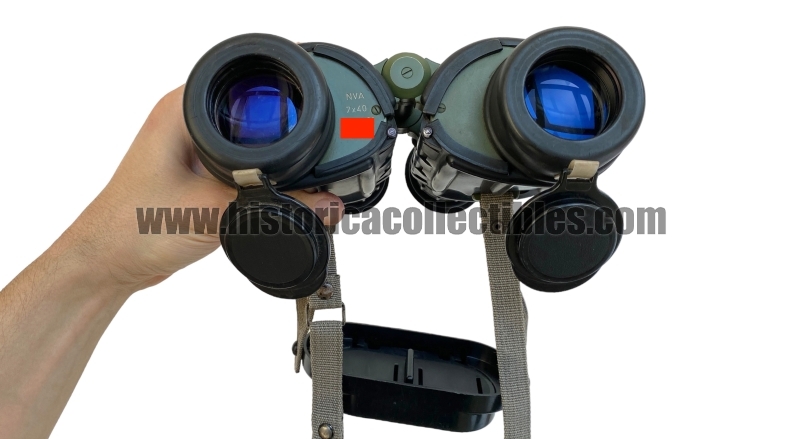

The 7x40 DF (Doppel-Fernrohr) of the NVA (Nationale Volksarmee), Armed Forces of the German Democratic Republic, was introduced in the 1960s and was the first binocular built by Carl Zeiss Jena from scratch since the Second World War.
This model of Doppelfernrohr DF 7x40 was a special development for the Army and Navy, and its characteristics are high twilight performance and a robust and lightweight design with small dimensions. Its soft rubber armor makes it protected from impacts and allows its very stable and safe handling.
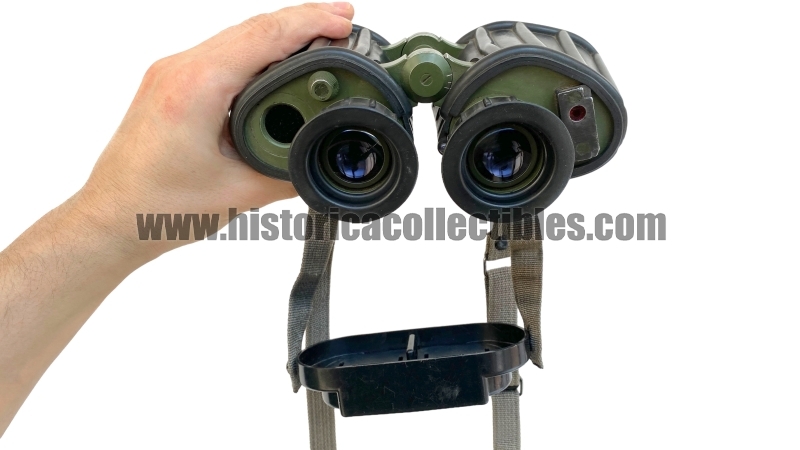
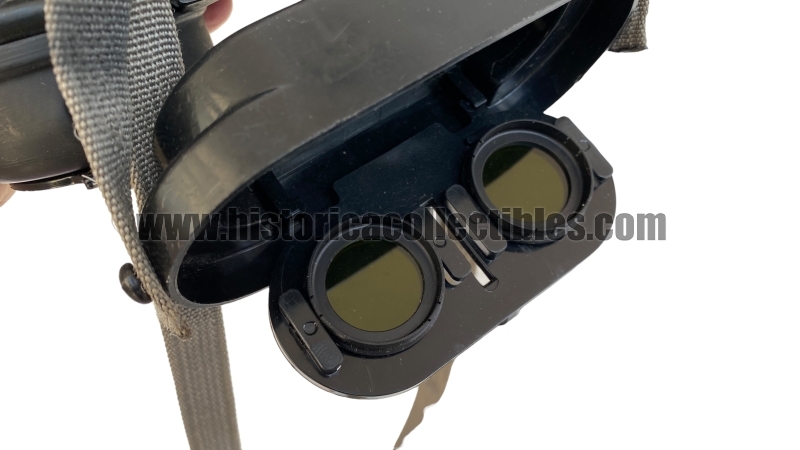
The binoculars are equipped with an illuminated reticle in the right eyepiece, while in the left eyepiece there is an adjustable filter with a layer that can be illuminated by infrared rays, so this can be used to detect emitters.
The binoculars have a field of view of 148.6 meters at a distance of 1000 m. Its weight is approximately 1180 gr.
This exact model, produced in March 1981, does not have the manufacturer's mark, probably because it was used by some special military formation of the German Democratic Republic, operating in foreign countries.
The focus is very precise, the inclusion of the IR filter works perfectly and the vision is magnificent.
With its thick rubber armor, its large eyepieces with long eye relief (suitable for use with the gas mask) and the eye-catching magazine "window" of its infrared detectors, the DF had become the classic example of military binoculars for all intents and purposes, the design of subsequent 7x40 clones which adopted the same design philosophy. In 1980 it was replaced with the 7x40 EDF, a more compact roof prism structure, but with a smaller field of view.
Zeiss Archive:
The DF 7x40 is a special development for the army and navy. Its features are high twilight performance, robust yet lightweight design and small dimensions. It is adapted to the needs of modern reconnaissance and combat and has the following special features: Line drawing with lighting.
The lighting is provided by a slide-on low-voltage lamp 2.5 V with a pressure switch and darkening device on the lamp housing. Lamp housing with cable and plug are packed in a leather bag. A 2.4 V rechargeable battery serves as the power source.
I-R Reconnaissance Aid
The left eyepiece houses a retractable filter with an infrared-illuminable layer. This allows I-R emitters to be clarified.
colored glasses
Green-yellow lenses that can be attached to the eyepieces.
Protective mask eyepiece with 20 mm A.P. distance
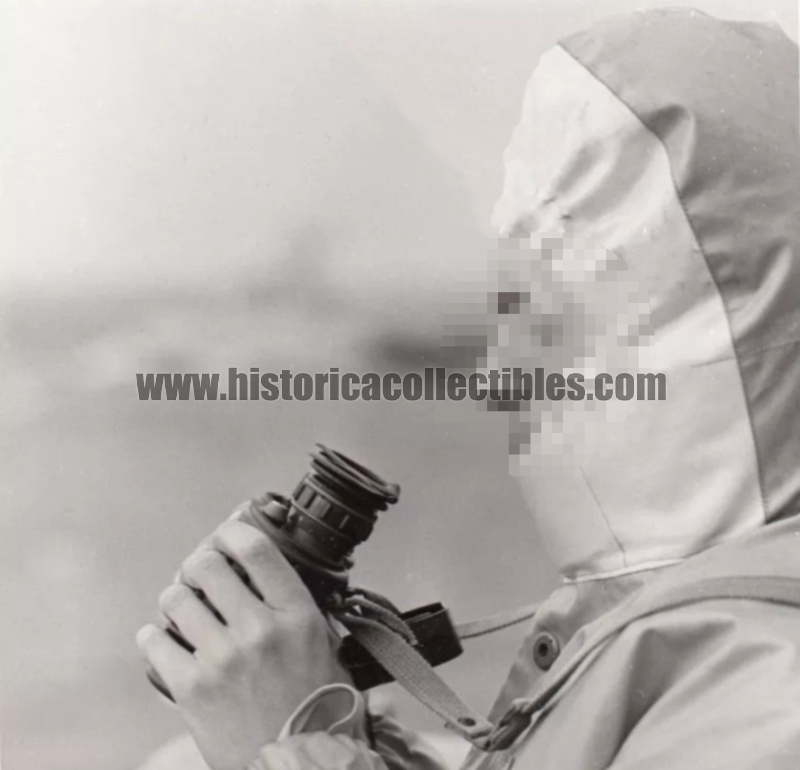
The soft rubber eyecups are reversible. The eyepieces can thus be attached directly to the windows of the protective mask so that the field of view can be overlooked due to the large A.P. distance. Even people who wear glasses can use the DF 7 x 40 without restricting their field of vision.
Shock protection
The usual container is not required. This resulted in a significant reduction in the overall weight. Soft rubber bead rings are attached to the lens mounts. The housing is protected with a rubber bead and also with a fold-out, bead-profiled soft rubber jacket. Lenses and eyepieces have plastic protective covers that can be folded away.
Increased tightness
The housing is only closed with a lid on the lens side. The conventional eyepiece-side cover is no longer required. As a result, the sealing surfaces have been reduced by half. The sockets of the external optical parts are each specially sealed.
surface
Vulcanized, grained covering. Color matt olive green.
Optical performance
Magnification - 7x
Exit pupil - 5.7 mm Ø
Field of view, objective - 8°30´ = 148.6 m at 1000 m distance
Carl Zeiss takes its name from its founder, Carl Zeiss, who on November 17, 1846 chose the small town of Jena, in Thuringia, as the location for his precision optical equipment factory. Thanks to the severe quality control that Carl Zeiss imposed on his products, going so far as to personally destroy the microscopes that did not pass the tests, the newly formed Zeiss became the official supplier of the University of Jena and received the gold medal of the industrial exhibition in 1861 of Thuringia as the best research instrument produced in Germany, awarded to the Stand I microscope of 1857.
In 1866 the thousandth microscope was produced and the name Zeiss became known throughout European scientific circles. Thanks to studies on the Porro prism, in 1893 Abbe patented double prism binoculars, which accentuated the perception of depth. The mass production of Zeiss binoculars began in 1894, already at the beginning of the twentieth century more than 30,000 were made, at the beginning of the First World War the quota had risen to 500,000 and, at the end of the Second World War, as many as 2,260,000 were produced binoculars for the civil and military market.
Thanks to studies conducted on the perception of light in low light situations, it was demonstrated that the average dilation of the pupil in an adult is approximately 7 mm. For this reason, the 7x50 mm model was introduced in 1910 and remained on the market until 1917 with few changes to the materials used. In 1926, following the post-war crisis of the First World War with the Treaty of Versailles which bankrupted many important German companies, Zeiss purchased "C.P. GOERZ" and founded Zeiss Ikon in 1926.
In 1937 Zeiss had commercial contacts and factories in more than 29 countries around the world. From '33 Zeiss acquired interest from the Nazi regime, which balanced production towards military instruments. It successfully produced binoculars with wide-angle optics for military use, pressure-resistant optical systems for U-boats, periscope binoculars for targeting tanks. Furthermore, Zeiss cameras were mounted on the V2s for remote sensing operations of the English coasts.
On 1 November 1935, Zeiss, in the figure of Alexander Smakula, patented a process for the treatment of optical glass with extraordinary results in terms of light transmission. Remained a military secret until 1939, it was adopted on binoculars to reduce ghost images and internal reflections. During the Second World War, there were numerous bombings against the Zeiss factories. Jena was bombed several times by the Allies starting in 1944. Stuttgart was razed to the ground, although the Contessa-Nettel factory suffered little damage. The bombing of Dresden, in addition to devastating the city, also caused considerable damage to the Zeiss Ikon headquarters.
On April 13, 1945, American military forces entered Jena, surprising themselves that the bombing had not caused any significant damage. The main planetarium was in ruins, while the factories remained operational.