Doppelfernrohr Beobachtungsfernrohr 12x60 BLC (Carl Zeiss), Kriegsmarine, about 1944

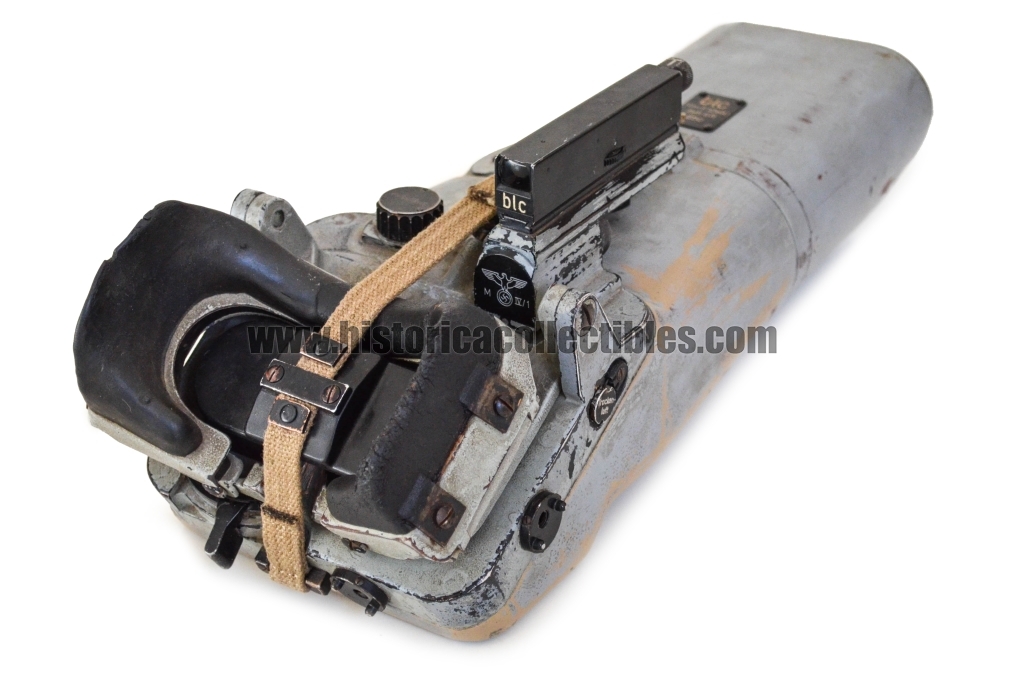


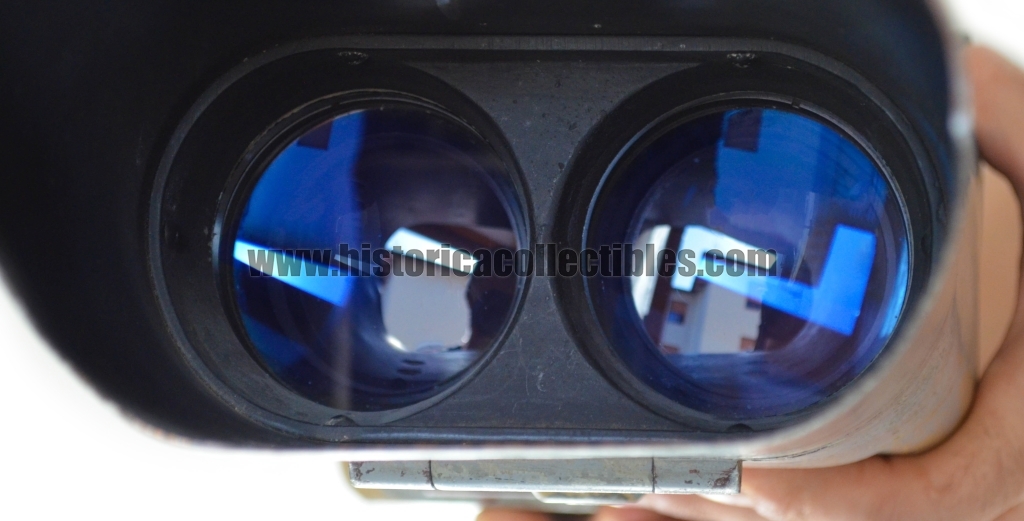
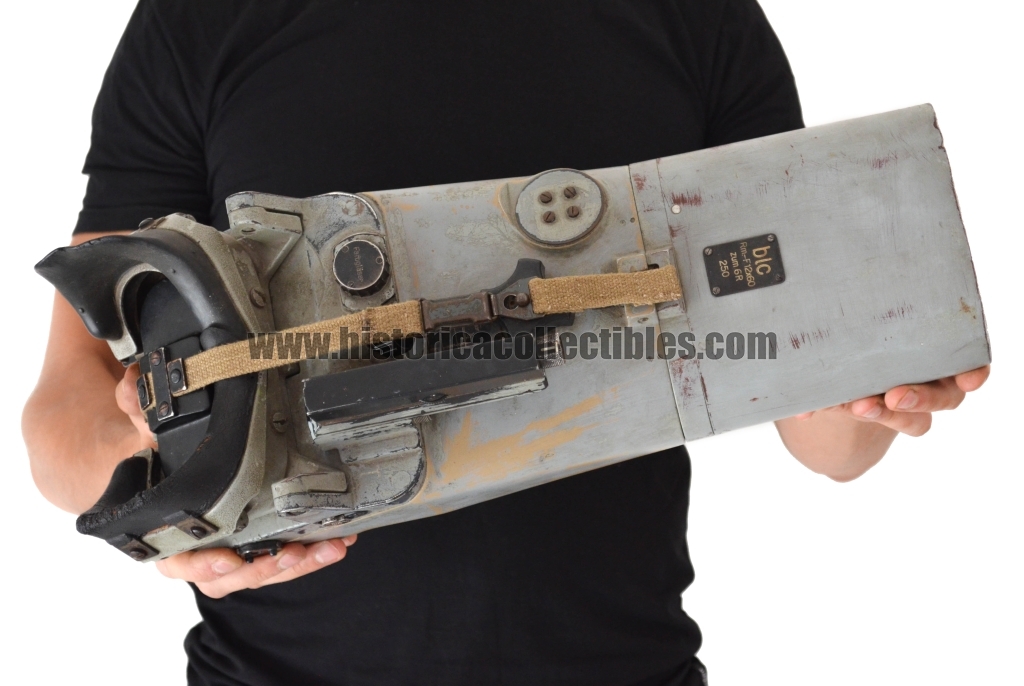


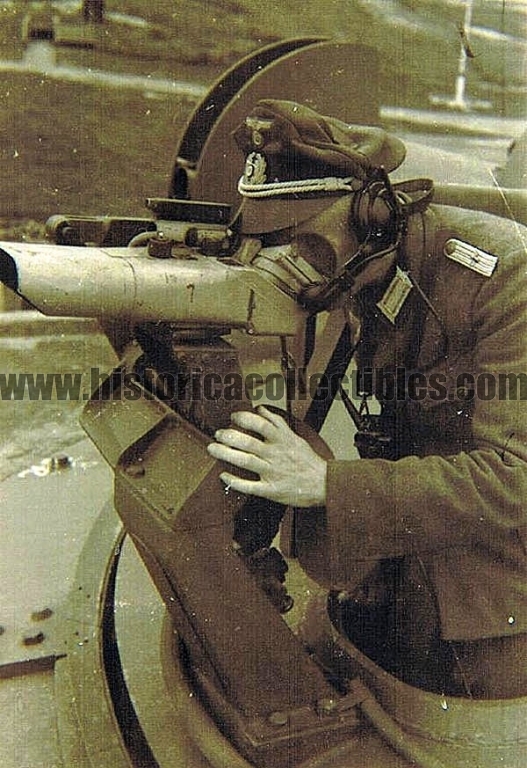
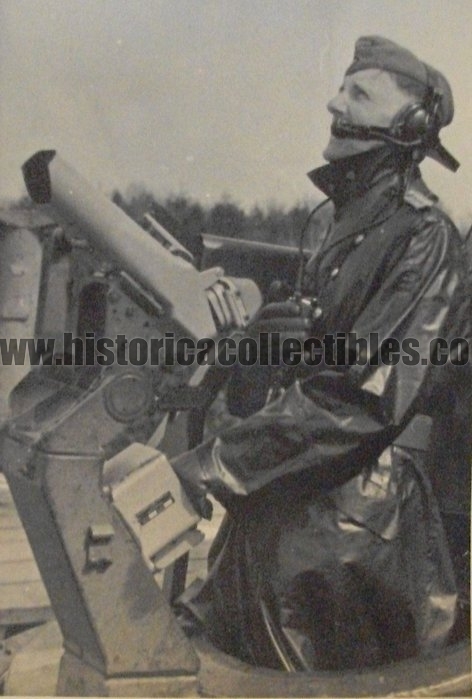

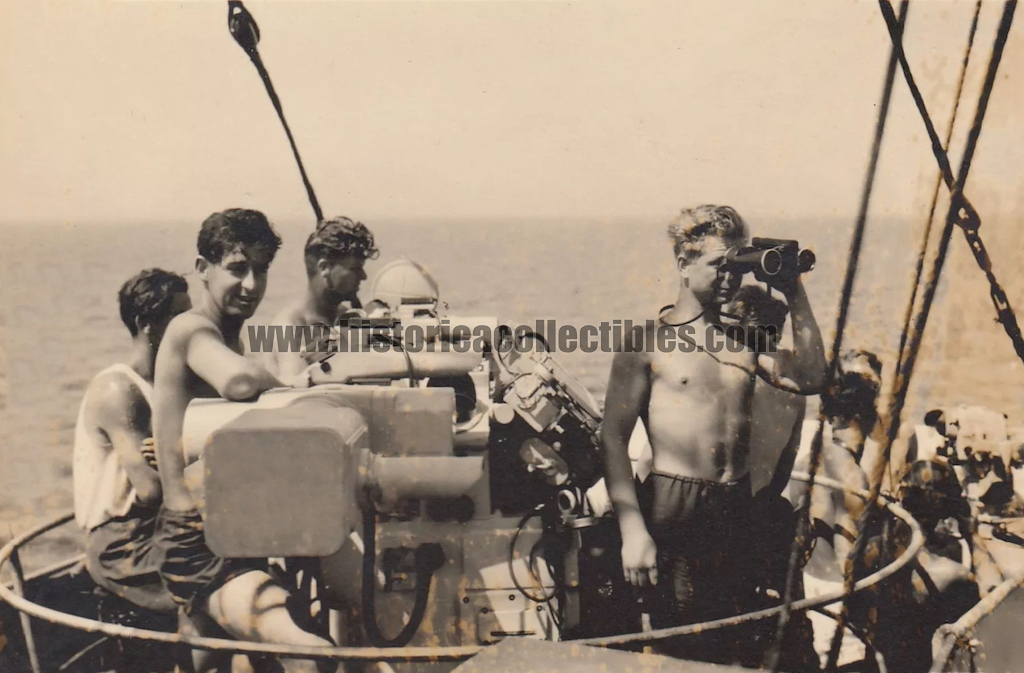
Doppelfernrohr 12x60 produced by "blc", code-named of Carl Zeiss Jena, produced for the Kriegsmarine in 1944. This Binoculars, with viewing angle of 60°, was installed on board ships and precisely on 6 R stereoscopic rangefinders, as it is reported on the label. These Doppelfernrohr were used for the trigonometric calculation useful for shooting against ships or against aircraft. This production specifically designed for the Kriegsmarine was equipped with a special viewfinder produced and marked "blc" (Carl Zeiss), through which it was possible to direct the optics toward the goal, which is grafted on a specific basis on which it is present the mark of acceptance of the Kriegsmarine or "M", "Eagle" and "IV/1". The optics are equipped with anti-reflective Blue treatment (Trasparentbelag). This system was developed and patented on November 1, 1935 by Aleksander Smakula, staff member of the Zeiss Jena since 1934.
This binoculars has some unusual and interesting features: the pupillary distance is adjusted by moving a lever under the left eye group (identical system also applied to 25x100 Zeiss) which eccentrically rotates the group itself. The prisms have a system of two reflective surfaces for the light having a brighter image.
There are 2 filters (a light gray and dark) by turning a small dial that says "farbgläser". There is the rubber mask (which can be raised, lowered and folded) to facilitate and enhance vision also staying more comfortable and more focused on the vision, having the resting face. A large knob on the front/top drives and tightens a clamp on the bottom for attaching to the rangefinder. The conditions of this Doppelfernrohr are excellent, the view is clear, crisp, collimated and all mechanisms work perfectly smoothly and correctly.
Carl Zeiss takes its name from its founder, Carl Zeiss, who on November 17, 1846 chose the small town of Jena, in Thuringia, as the location for his precision optical equipment factory. Thanks to the severe quality control that Carl Zeiss imposed on his products, going so far as to personally destroy the microscopes that did not pass the tests, the newly formed Zeiss became the official supplier of the University of Jena and received the gold medal of the industrial exhibition in 1861 of Thuringia as the best research instrument produced in Germany, awarded to the Stand I microscope of 1857.
In 1866 the thousandth microscope was produced and the name Zeiss became known throughout European scientific circles. Thanks to studies on the Porro prism, in 1893 Abbe patented double prism binoculars, which accentuated the perception of depth. The mass production of Zeiss binoculars began in 1894, already at the beginning of the twentieth century more than 30,000 were made, at the beginning of the First World War the quota had risen to 500,000 and, at the end of the Second World War, as many as 2,260,000 were produced binoculars for the civil and military market.
Thanks to studies conducted on the perception of light in low light situations, it was demonstrated that the average dilation of the pupil in an adult is approximately 7 mm. For this reason, the 7x50 mm model was introduced in 1910 and remained on the market until 1917 with few changes to the materials used. In 1926, following the post-war crisis of the First World War with the Treaty of Versailles which bankrupted many important German companies, Zeiss purchased "C.P. GOERZ" and founded Zeiss Ikon in 1926.
In 1937 Zeiss had commercial contacts and factories in more than 29 countries around the world. From '33 Zeiss acquired interest from the Nazi regime, which balanced production towards military instruments. It successfully produced binoculars with wide-angle optics for military use, pressure-resistant optical systems for U-boats, periscope binoculars for targeting tanks. Furthermore, Zeiss cameras were mounted on the V2s for remote sensing operations of the English coasts.
On 1 November 1935, Zeiss, in the figure of Alexander Smakula, patented a process for the treatment of optical glass with extraordinary results in terms of light transmission. Remained a military secret until 1939, it was adopted on binoculars to reduce ghost images and internal reflections. During the Second World War, there were numerous bombings against the Zeiss factories. Jena was bombed several times by the Allies starting in 1944. Stuttgart was razed to the ground, although the Contessa-Nettel factory suffered little damage. The bombing of Dresden, in addition to devastating the city, also caused considerable damage to the Zeiss Ikon headquarters.
On April 13, 1945, American military forces entered Jena, surprising themselves that the bombing had not caused any significant damage. The main planetarium was in ruins, while the factories remained operational.