
Doppelfernrohr C.P. Goerz Berlin 8x56 Marine-Nachtglas, Vice Admiral Hans Zenker, 1921
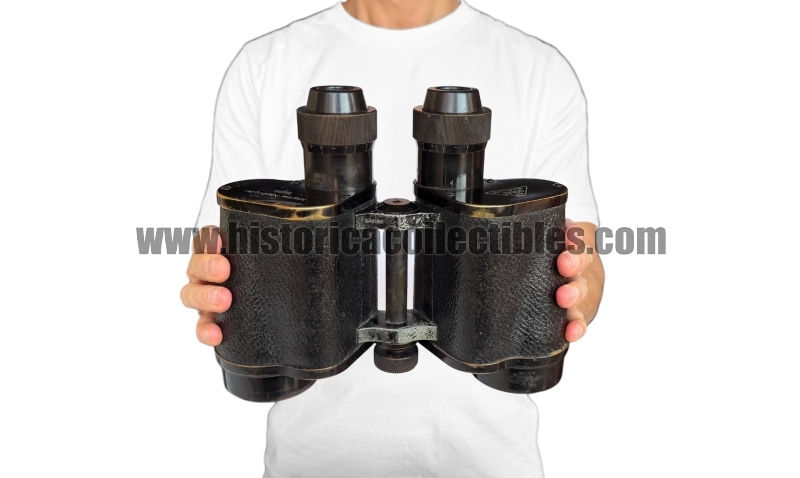

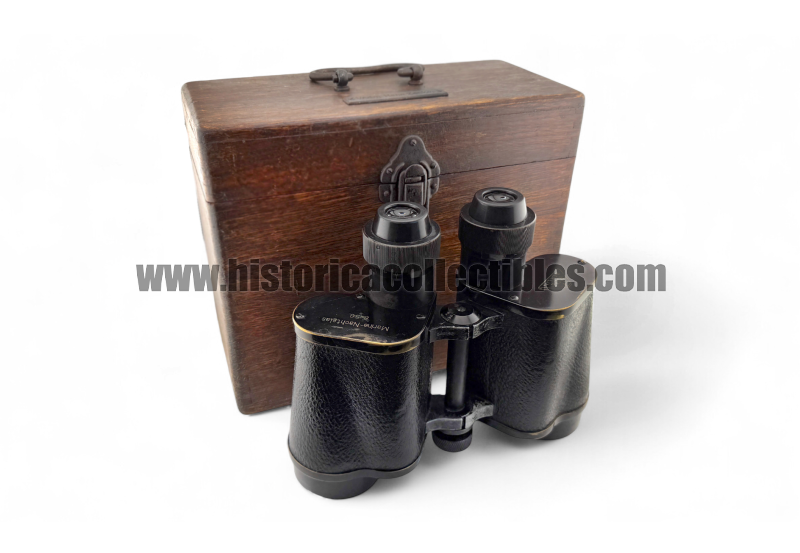
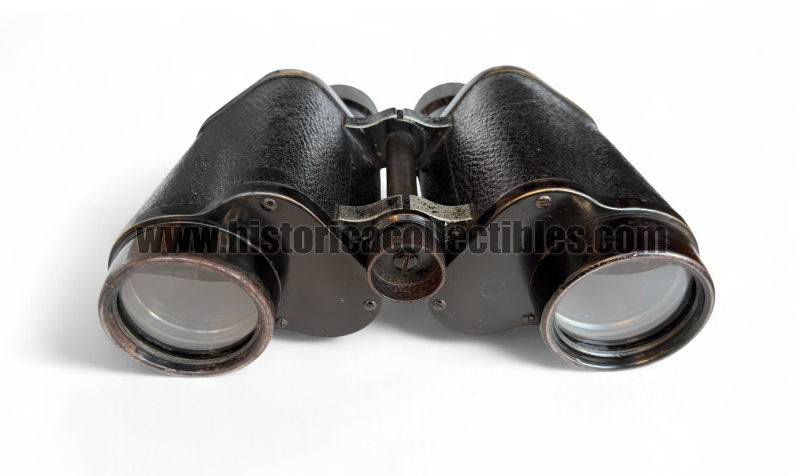
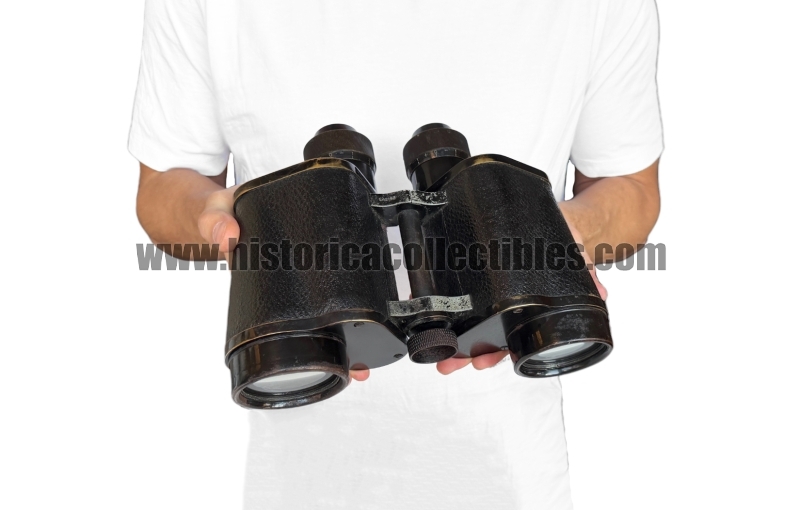
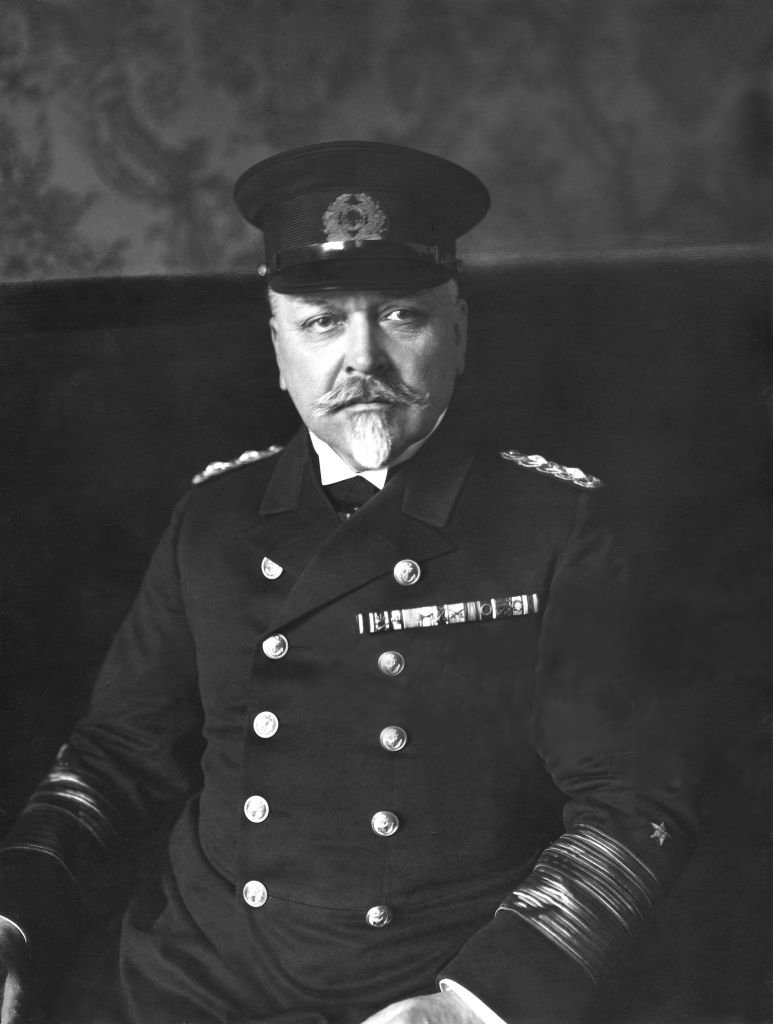
Doppelfernrohr 8x56 Marine-Nachtglas model, produced by C.P. Goerz Berlin in 1921, and owned by Vice Admiral Hans Zenker as Commander of the North Sea Naval Station, who became Commander-in-Chief of the Reichsmarine in 1924.
The history of this model, produced in a very limited number, began in August 1917 when the Ministry of War ordered Goerz, Zeiss, and Leitz to develop binoculars with a 70° field of view, 8x magnification, and a 7 mm exit pupil. Leitz built two prototypes, a 7x50 and an 8x56, weighing 2.565 kg, with an enormous field of view of 157 m at 1000 m (9", light intensity L=56). Zeiss also presented its own model: an 8x60 with a field of view of 153 m at 1000 m (8 3/4°) in 1918.
Goerz, on the other hand, debuted this model in February 1918, with exceptional dimensions (width = 25 cm, height 14.5 cm, and weight 3.130 kg).
The right eyepiece plate bears the inscription "Marine-Nachtglas" or "Marine Night Vision Binoculars", the meaning of which is attributable to the great versatility even in night-time use in poor light conditions, a prerogative made possible by the large Porro I prisms and wide-angle eyepieces, which provide a wide field of view (150 metres at 1000 metres).
The serial number 5421XX places it as having been produced in 1921, the year in which Hans Zenker was promoted from Rear Admiral to Vice Admiral (1 January 1921): this suggests that, although this Goerz 8x56 "Marine-Nachtglas" was produced in a very limited number of specimens, Hans Zenker was one of the recipients of this particular model, either as a gift from the navy's top brass upon his promotion or likely because he held a very important role in the Reichsmarine, namely Commander of the North Sea Naval Station.
Its large size and specific weight precluded the use of shoulder strap loops, but it was nevertheless supplied in a sturdy wooden case, protected internally by leather padding. It also features all the iron fittings, including the plaque certifying rank and affiliation with Vice Admiral Hans Zenker, all of which retain their original, untouched patina.
All mechanisms work properly, and the view is clear and collimated.
Admiral Hans Zenker (10 August 1870 in Bielitz, Schlesien – 18 August 1932 in Göttingen). Born in Bielitz (now Bielsko-Biała, Poland), he entered the Imperial German Navy on 13 April 1889. After serving as commander of several torpedo boats, he commanded the light cruisers Lübeck in 1911 and Cöln in 1912–13. As commander of the battlecruiser Von der Tann in 1916–17, Zenker saw action at the Battle of Jutland from 31 May to 1 June 1916. Zenker joined the Admiralty Staff in 1917. He was appointed to the North Sea Area Command in 1918, holding this post when the German war effort collapsed in November 1918. After the war, he was an officer in the Reichsmarine, serving as Inspekteur der Marineartillerie (Inspector of Naval Artillery) from 1920 to 1923 and the higher post of Chef der Marineleitung (Chief of the Naval Command) from 18 September 1924 to 30 September 1928. His tenure as Chief of the Reichsmarine saw the beginning of the reconstruction of the German fleet with the construction of light cruisers and torpedo boats and the design of battleships. Deutschland-class battleships, later built as "Deutschland," "Admiral Scheer," and "Admiral Graf Spee."
Promoted to Admiral: October 1, 1924.
Career:
-Commander of the North Sea Safety Units (8 October 1918 - 7 November 1918)
-Chief of the High Seas Forces Staff (10 November 1918 - 12 November 1918)
-Commander of the North Sea Safety Units (12 November 1918 - 29 November 1918)
-Acting Chief of the Admiralty Staff, Imperial Naval Office (3 January 1919 - 1 August 1919)
-Placed at the disposal of the Admiralty Chief of Staff (2 August 1919 - 9 November 1919)
-Inspector of Naval Artillery (10 November 1919 - 23 May 1920)
-Chief of the North Sea Naval Station (24 May 1920 - 30 September 1923)
-Commander in Chief of the Naval Forces (October 15, 1923 – September 17, 1924)
-Chief of the Naval Command (September 18, 1924 – September 30, 1928)
-Retired (September 30, 1928)
Decorations and honors:
- Order of the Prussian Crown, 2nd Class with Swords (February 1, 1918)
- Knight's Cross of the Royal House Order of Hohenzollern with Swords (June 5, 1916)
- Iron Cross, 1st Class (1914)
- Iron Cross, 2nd Class (1914)
- Prussian Centenary Medal, 1897
- South-West Africa Steel Medal (German Empire)
- Order of the Red Eagle, 4th Class with Crown
- Order of the Prussian Crown, 3rd Class
- Order of the Prussian Crown, 4th Class
- Prussian Long Service Cross (25 years)
-Commander's Cross 2nd Class of the Saxon Albert Order with Swords
-Commander's Cross 2nd Class of the Friedrich Order of Württemberg with Swords
-Officer's Cross of the Bavarian Order of Military Merit with Swords
-Knight's Cross 2nd Class of the Order of the Baden Zähringer Lion
-Knight's Cross 2nd Class of the Hessian Order of Philip the Magnanimous
-Frederick August of Oldenburg Cross 1st Class
-Frederick August of Oldenburg Cross 2nd Class
-Knight's Cross of the Austrian Imperial Order of Leopold with War Decoration (Austria-Hungary)
-Military Cross of Merit 3rd Class with War Decoration (Austria-Hungary)
-Golden Liakat Medal with Sabres (Ottoman Empire)
-Gallipoli Star (Ottoman War Medal)
References:
Dermot Bradley, Hans H. Hildebrand, Ernest Henriot: Deutschlands Admirale 1849–1945 Band 3: P-Z Biblio Verlag, Osnabrück 1990 (https://www.lexikon-der-wehrmacht.de/Personenregis...)