
Doppelfernrohr D.F. 6x42, Carl Zeiss Jena, Marinestation der Nordsee der Reichsmarine, circa 1919-1935
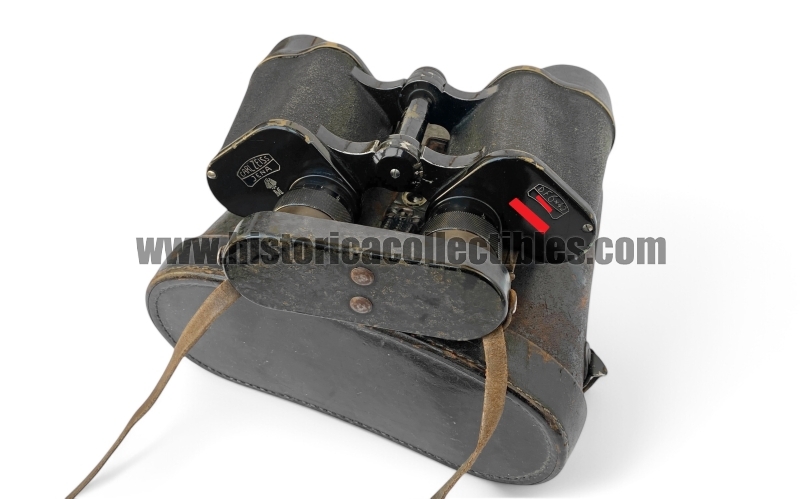
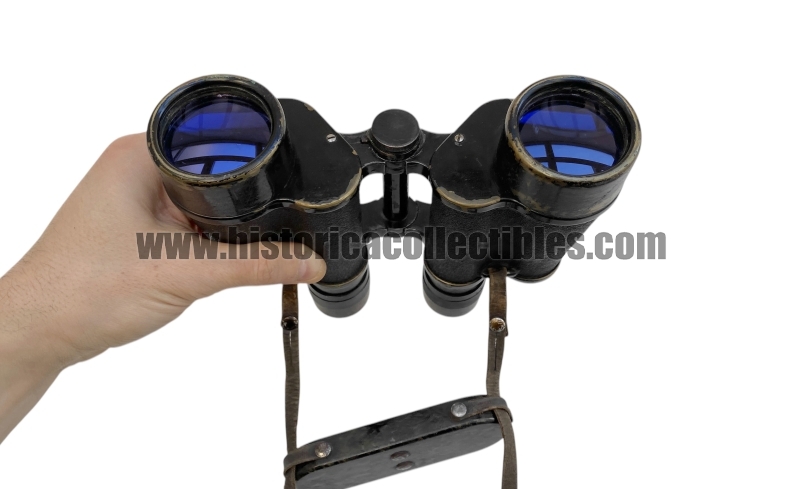
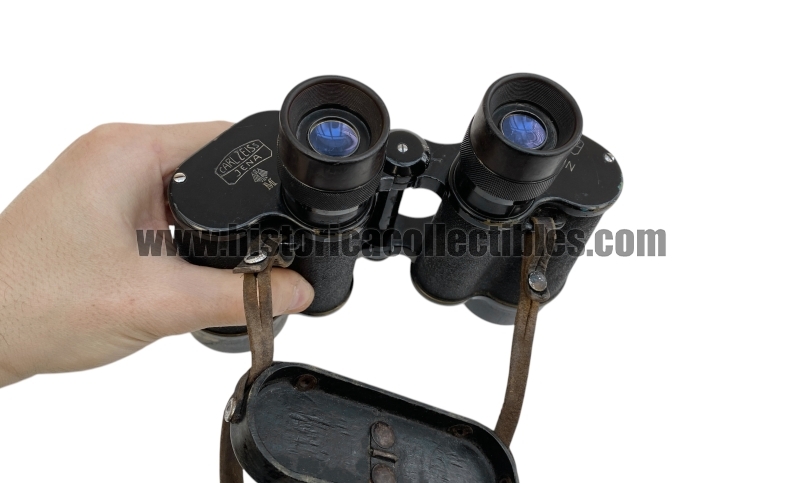
Binoculars 6x42 produced by Carl Zeiss Jena to be used, from 1919 to 1935, by one of the units under the control of the "Marinestation der Nordsee" of the "Reichsmarine" in the period involving the Weimar Republic, until 1935, the year in which Adolf Hitler announced the birth of the Kriegsmarine and the adoption of the eagle with swastika as a mark of acceptance by the "Oberkommando der Marine" or "OKM".
This is a pair of binoculars of extreme historical importance: in fact, if you compare the serial number of the binoculars 9914XX with the production benches reported by Dr. Hans Seeger in his book "Handferngläser von 1894-1919", you can see how this binocular is included as a product in a production batch of 420 examples of D.F. 7x50 made in 1918. Furthermore, if we consider the irrefutable technical characteristics reported on it such as the relative format and the 6x42 enlargements, it appears to have been produced, yes in 1918, but in a very limited production batch following the one indicated above of only 100 examples of D.F. 6x42.
Because of this discrepancy it is plausible to believe that the Zeiss documentation, especially on the final series of each production batch and especially for those produced at the end of the war, is not entirely clear and defined, as also suggested by the many cases found to support this thesis.
In light of this in fact, considering that this D.F. model was made in 1918, this error in the connection between the "serial number" and the "model" is to be considered plausible.
What is also most interesting is reported on the left plate of the binoculars: in fact, in addition to the "Carl Zeiss Jena" brand, there is the acceptance mark by the "Reichsmarine" consisting of an "M" surmounted by the "Reichsadler" of the type in use from 1919 to 1935.
This discrepancy, between the production date of the binoculars and the assignment to the "Reichsmarine" in a period between 1919 and 1935, is to be considered as a consequence of the imposing restrictions provided for in the "Treaty of Versailles" in which the allied states imposed limitations on Germany that provided for a drastic reduction in the production of war material such as weapons, optics, equipment and various instruments, etc. etc. to be allocated to the armed forces.
It is in fact in light of this that the high commands of the "Vorläufige Reichsmarine", in order to circumvent these heavy restrictions that limited the production of equipment and war material, ordered the reuse of existing technical equipment produced before such restrictions, thus reassigning it to the armed forces serving the "Weimar Republic" and beyond.
Furthermore, on the right eyepiece plate, in addition to the technical characteristics of the "D.F. 6x42" binoculars and the relative serial number "9914XX", there is the assignment number "XXXX43.N" attributable to the assignment to one of the active units operating in the "Nordsee" (North Sea) under the control of the "Marinestation der Nordsee der Reichsmarine".
All mechanisms work correctly. The state of conservation is excellent, as is the view, which is excellent and collimated.
Complete with its original leather case.
Reference:
Handferngläser von 1894-1919 Hans Seeger - Page 639 - Abb. 1670
Carl Zeiss takes its name from its founder, Carl Zeiss, who on November 17, 1846 chose the small city of Jena, in Thuringia, as the location for his precision optical equipment factory. Thanks to the strict quality control that Carl Zeiss imposed on its products, going so far as to personally destroy the microscopes that did not pass the tests, the newborn Zeiss became the official supplier of the University of Jena and received the gold medal of the industrial exhibition in 1861 of Thuringia as the best research instrument manufactured in Germany, awarded to the microscope Stand I of 1857.
In 1866, the thousandth microscope was produced and the Zeiss name became known in all European scientific circles. Thanks to the studies on the Porro prism, in 1893 Abbe patented a double prism binoculars, which accentuated the perception of depth.
The mass production of Zeiss binoculars began in 1894, already at the beginning of the twentieth century more than 30,000 were made, by the beginning of the First World War the figure had risen to 500,000 and, by the end of the Second World War, 2,260,000 were produced binoculars for the civilian and military market. Models were made starting from 4x11 mm to 12x40 mm, up to real giants such as 80 mm and 100 mm.
Thanks to studies conducted on the perception of light in low light situations, it was shown that the average dilation of the pupil in an adult is about 7 mm. For this reason, the 7x50 mm model was introduced in 1910 and remained on the market until 1917 with few changes to the materials used.
In 1926, following the post-war crisis of the First World War with the Treaty of Versailles which bankrupted many important German companies, Zeiss bought the "C.P. GOERZ" and founded the Zeiss Ikon in 1926.
In 1937, Zeiss had commercial contacts and factories spread over 29 countries around the world. From 1933 Zeiss acquired interest from the Nazi regime, which balanced production towards military instruments. It successfully produced binoculars with wide-angle optics for military use, pressure resistant optical systems for U-boats, periscope binoculars for targeting tanks. Furthermore Zeiss cameras were mounted on the V2 for remote sensing operations of the English coasts.
On November 1, 1935, Zeiss, in the person of Alexander Smakula, patented a process for the treatment of optical glasses with extraordinary results in terms of light transmission. Remained a military secret until 1939, it was adopted on binoculars to reduce ghost images and internal reflections. During the Second World War, there were numerous bombings against the Zeiss factories.
Jena was bombed several times by the Allies starting in 1944. Stuttgart was razed to the ground, although the Contessa-Nettel factory suffered little damage. The bombing of Dresden, in addition to devastating the city, also caused considerable damage to the Zeiss Ikon headquarters.
On April 13, 1945, American military forces entered Jena, surprising themselves as the bombings had not caused significant damage. The main planetarium was in ruins, while the factories remained operational.