Doppelfernrohr D.F. 7x50 Carl Zeiss "Flieger Schule" Luftwaffe, 1940
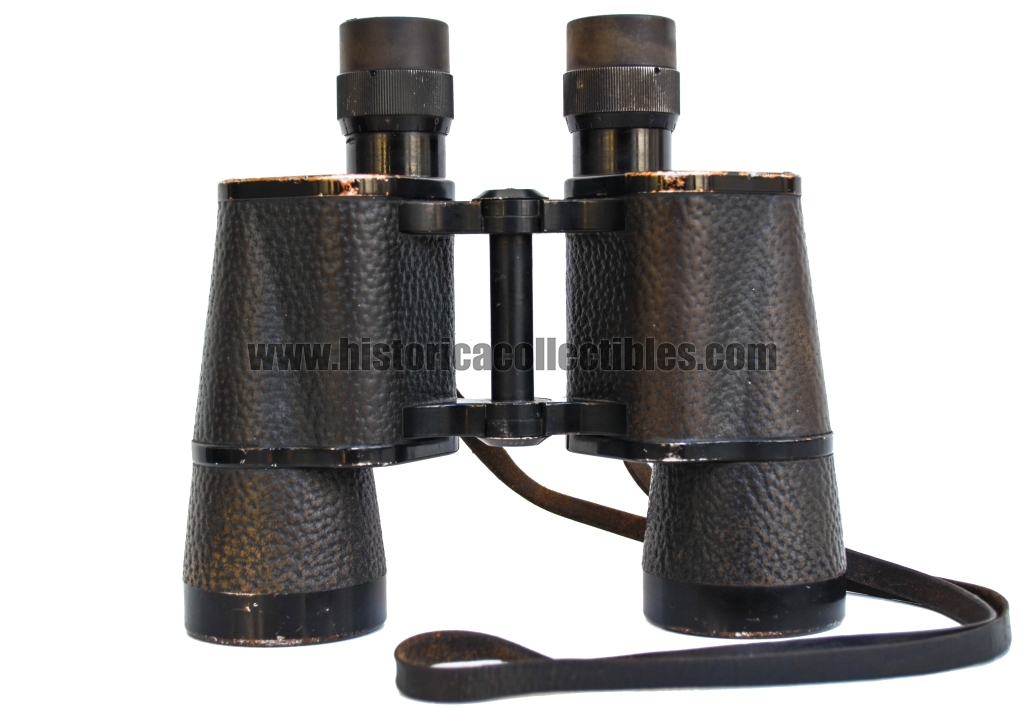
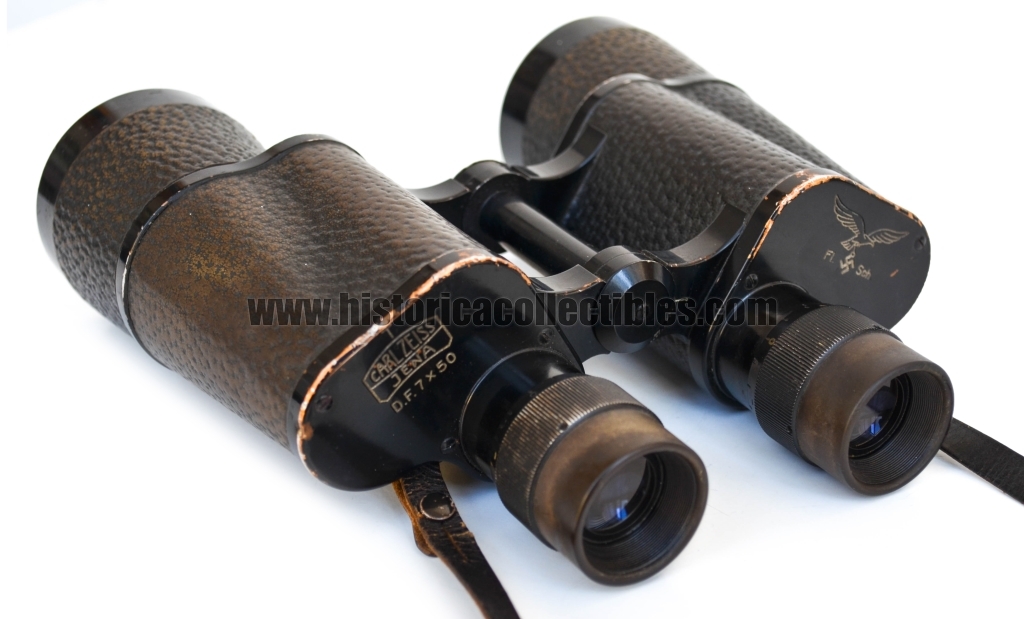


Doppelfernrohr D.F. 7x50, produced by Carl Zeiss Jena in December 1940, intended for the Flieger Schule (Aviator school), one of the 63 Luftwaffe Aviator Schools.
On the part of the left eyepiece there is the Carl Zeiss Jena manufacturer's mark, the D.F. magnifications. 7x50 and the letter (T), or "Transparenzbelag", which indicates that the lenses are coated with an anti-reflective treatment which improved the light transmission in the lenses by 80%. This system was developed and patented on November 1, 1935 by Aleksander Smakula, a member of the Zeiss staff in Jena since 1934.
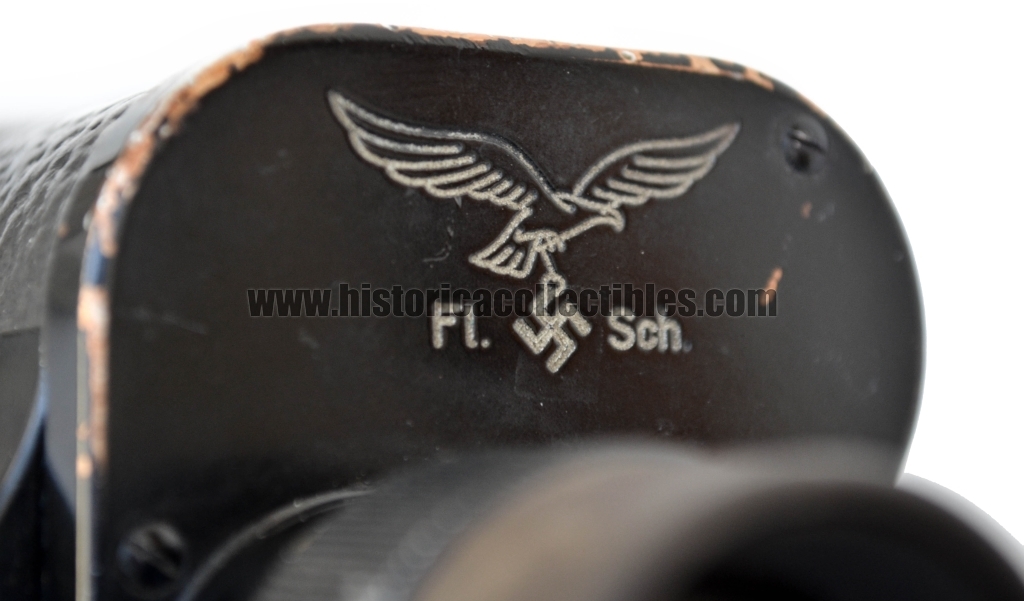
On the right eyepiece plate there is the Luftwaffe Eagle with the letters "Fl. Sch." or classic abbreviation of Flieger Schule (Aviator School).
Through the right eyepiece a cross-hair grating is visible that goes from -32° to +32°/16° in multiples of 8°.
All mechanisms work perfectly, smoothly and correctly.
In the last photo we can appreciate how, in all the training and specialization schools of the Kriegsmarine, as well as the Luftwaffe, cadets were taught the use of binoculars.
The view is sharp, clear and collimated and its field of view is very wide, thanks also to its large ocular lenses.
Following the defeat in the First World War and the signing of the Treaty of Versailles, Germany was forced to disband its air force (Luftstreitkräfte) and dismantle all remaining aircraft. Nonetheless, the German government managed to secretly maintain its own air force which grew stronger as the years passed. Clandestine pilot training began in 1926 thanks to private clubs and civilian airlines that provided trainers who were veterans of the First World War and military aircraft such as the Junkers Ju 86 and the Heinkel He 111 disguised as airliners or transport planes, gliders and ultralights on which the pilots of the future Luftwaffe could practice. In 1930 the Nazi party equipped itself with its own flying body, the Nationalsozialistisches Fliegerkorps, to give further impetus to pilot training, strengthened three years later by the newly established Deutsche Luftsportverband (German sports air association).
The real turning point came following Hitler's decision to rearm Germany. The Luftwaffe was founded clandestinely in 1933 with around 4,000 employees while various types of military aircraft had already been in production for some time; on 1 January 1934 the Bombengeschwader 1, the first bomber unit of the Luftwaffe, was born in Berlin-Tempelhof and a document of the same year proposed the construction of 4,021 aircraft by 30 September 1935.
On March 1, 1935, the creation of the new German air force was made public to the whole world. The former German aviation ace and aviation minister, Hermann Göring, was appointed head of the Oberkommando der Luftwaffe (OKL) in 1935, who surrounded himself with collaborators such as Erhard Milch (inspector general of the Luftwaffe), Hans Jeschonnek (responsible for supplies, training, telecommunications and warfare) and Ernst Udet (head of the technical office).
Attack strategies were still being tested; in particular, there were two distinct lines of thought: Walther Wever, commander of the general aviation staff until 1936, supported the importance of strategic bombing carried out by four-engined aircraft; Ernst Udet, on the other hand, was convinced that aviation should only be used to support troops on the ground and to counter enemy aircraft. Strengthened by the war experience in Spain where the dive bombers carried out their task very well, and thanks to Wever's accidental death in June 1936, Udet managed to convince the entire Luftwaffe command that his line of thought was the one to follow. Plans for large bomber aircraft, such as the Dornier Do 19 and Junkers Ju 89, were therefore abandoned.
The men enlisted in the Luftwaffe followed basic training that was the same for everyone, at the end of which they were directed towards a specific specialization chosen based on their personal skills and the needs of the armed force. Those who were capable of being a pilot followed a further course to then participate in another specialization school (heavy fighter, dive bomber, etc.), while those who were deemed unsuitable to cover this role were diverted to other courses including the schools responsible for flight crews (on-board mechanics, on-board radio operators, on-board machine gunners or observers). Often the various schools shared the same location with its airport and barracks, and not infrequently the training of the entire flight crew took place simultaneously in the same aircraft.
From what follows in the following paragraphs it must be taken into account that from mid-1942 the resources available to the training centers were reduced in favor of the units at the front. Consequently, from that moment the training programs were compressed and the pilots, but not only, were certified with fewer flight hours behind them and fatal accidents during the training phase increased.
Basic Training: At least at its origins, few men joined the Luftwaffe for ideological reasons linked to the Nazi party, seen rather as an institution capable of offering shelter from the economic hardships of the time or, above all, capable of offering the opportunity to becoming a pilot, a privilege for which, all things considered, joining the NSDAP was a small price to pay. During the first years of clandestinity, the pilot's license was granted by the Verkehrsfliegerschule (commercial aviation school) of Lufthansa in Berlin, which was extremely selective: around 90% of the candidates were rejected during the ten days of course necessary to enter; in 1932, for example, out of 4,000 people who applied for admission to the pilot course only 18 were admitted (including the future ace Adolf Galland). This deliberately severe policy ensured the Luftwaffe an initial core of extremely capable pilots around which to develop.
Already since 1935, the year in which the existence of the Luftwaffe was made public, the German air force had among its priorities the acquisition of new pilots, a priority which was reflected in the recruitment system. First of all, the recruit was placed in a Flieger-Ersatz-Abteilung (airmen replacement battalion, abbreviated to Fl.Ers.Abt) where, after having learned the use of the uniform and the structure of the base and having attended an entry ceremony, was vaccinated within a week or two against tetanus, smallpox, typhus, paratyphoid fever, dysentery and cholera. In addition to marches, the use of firearms and military discipline, the soldier also learned the rudiments of cartography and the use of radio equipment.
After this initial six-month period, all recruits were screened for possible advancement to the role of pilot. Those who met the characteristics were sent to a Flug-Anwärterkompanie (translated as "flying aspiring company") where they were subjected to basic flying instruction with related exams; those who were deemed unsuitable to be a pilot but still showed good characteristics to be a member of a flight crew moved to a Flieger-Ausbildungs-Regiment ("aviator training regiment", abbreviated Fl.AR.) to undergo two months of training concerning air navigation, radio communications, mechanics and the use of aerial armament, at the end of which he was selected for the specialization in which he had proven himself most capable.
Towards December 1940 the recruitment of these important groups of specialists and pilots was speeded up through a rationalization and compression of the system: the stage of the Fl.Ers.Abt was eliminated, whose functions were absorbed by the Fl.AR., to which after three months (increased to four in 1943) the stage of the Flug-Anwärterkompanie followed for pilots only; anyone who was otherwise deemed unsuitable to be a pilot was diverted to the Fl.Ers.Abt to complete basic training and choose another task within the Luftwaffe.
Selection and Specialization of Pilots: Before explaining the generic method of selecting pilots, it is important to clarify that each school had a program and types of aircraft supplied that were different from the others.
Once admitted to the Flug-Anwärterkompanie, the aspiring pilot received further theoretical instruction in flying and, if deserving, advanced to the Flugzeugführerschule-A/B (abbreviated F.Z.S-A/B but commonly called "A/B-Schule") as soon as a place became available in the latter (usually after two months) to begin actual flight training, divided into four levels, each with a final exam which conditioned entry to the higher level. If all went well, in a period varying from fourteen to seventeen months, the candidate entered the "A" levels (initiation to basic flying with an instructor in dual-control aircraft, take-off and landing, exit from stall situations, etc.), "A2" (theoretical concepts such as aerodynamics, meteorology, aeronautical laws and conventions and practical work in aeronautical engineering, navigation, use of radios and Morse code accompanied by further training flights on single-engine aircraft), "B" (advanced flights on single and twin engine) and "B2" (which ended after 100/150 hours of flight).
In the late 1940s, however, as happened with basic training, this system was also reformed to meet the needs of war: the access requirements to the Flug-Anwärterkompanie remained unchanged, the A2 level was instead merged into the other three levels , so that level A now lasted only three months, in B1 training was only on single-engine aircraft and B2 also included flying on twin-engine aircraft; the big news was the entry into the scene of the K1 level concerning the learning of acrobatics aimed at making known the main evasive techniques in combat. The K1 course also gave the instructors the opportunity to identify the most capable pilots, to whom more attention was paid.
At this point the pilots of single-engine aircraft were "sorted" towards the specialization school that would best enhance their skills.
Those suited to fighter planes entered the Jagdfliegerschule, while the Schlachtfliegerschule were reserved for those suited to fighter-bombers, with a further specialization for candidates to pilot dive fighter-bombers: the Sturzkampffliegerschule were dedicated to the latter which, with various and severe methods that diverged from school to school, tested the physical and mental abilities of the pilots over a period varying from four months to a year, eventually rejecting those who were unsuitable from the air transport schools (Transportfliegerschule), sometimes ending up serving in "flocks battleships with special tasks" (Kampfgeschwadern zur besonderen Verwendungs – including transport).
Pilots of twin-engine aircraft were instead required to undergo an additional training period (from two to six months) to be carried out in the Flugzeugführerschule-C (also called "C-Schule"), often located in airports with other flight schools. The C-Schules provided advanced instruction in onboard instruments, astronomical navigation, and the use of onboard radar to spot other aircraft. Flight hours were typically 50/60, increased to 70 in 1941, and involved rotating duties of the two crew members. Once the C-Schule was completed, the aviators moved on to a Blindfliegerschule (blind flight school) to undergo four-six weeks (35-60 hours of flight) of intensive courses on navigation based only on on-board instruments and dead reckoning. At this point these pilots were the most trained in the Luftwaffe and were ready to move on to a specific flight school for a specific discipline (bombing, transport, reconnaissance or heavy fighter).
Selection and Specialization of the other members of the flight crew: As already mentioned, those who were unsuitable to cover the role of the pilot were sent to the Flieger-Ersatz-Abteilung to complete basic training and choose another role, in accordance with the personal abilities and expressed preferences, which were often relegated to the background compared to the needs of the Luftwaffe, which sent most of the men to the FlaK, the anti-aircraft. Those who, however, still had the characteristics to fly, such as those excluded from the A/B-Schule, were sent to the Flieger-Ausbildungs-Regiment to undergo two months of specific teaching, at the end of which they were selected for specialization in which he had proven himself most capable of. Towards the middle of the war the lack of men gave the opportunity for those who were members of another branch to apply to join the flight crews.
Bordfunker (on-board radio operator) To become a Bordfunker it was necessary to complete a nine-month course at a Luftnachrichtenschule (air communications school) together with personnel assigned to other roles, with whom he studied radio communication, Morse code and rudiments of navigation and on-board instrumentation; the practical teaching took place in another school with access to an airport.
Beobachter (observer) The men selected for the role of observer attended an Aufklärungsschule (reconnaissance school) until four Kampfbeobachterschule (translated as "battle observer schools) were created in the autumn of 1942. The course lasted nine to twelve months and aimed to make his students understand navigation, cartography and the study of photographs taken for reconnaissance, as well as basic elements of air tactics and notes on the use of on-board machine guns, as well as the use of all the tools of navigation and bomb-dropping pointers.The great importance of the role meant that in 1937 the Beobachters were appointed commanders of the aircraft in which they would fly and generally held the rank of Feldwebel (Marshal) or Leutnant (Second Lieutenant). Bordmechanik (on-board mechanic) The on-board mechanic learned his trade in a Fliegertechnischeschule over nine months. In addition to in-depth studies on numerous internal combustion engines and hints on aerodynamics, the student was sometimes sent directly to the factories, where he had the opportunity to receive advice from the engineers and test first-hand the notions learned in theory.
Bordschütze (ship's machine gunner) The ship's machine gunners attended a five-month course at the Fliegerschützenschule (from January 1942 renamed Bordschützenschule). During this time they became familiar with a wide variety of firearms, including the Mauser Karabiner 98K rifle, the MG13 machine gun and 9x19 caliber pistols, while simultaneously carrying out practical flight tests with the aircraft's machine guns against towed targets, aided by the 'use of tracer ammunition; fake attacks by fighters were also planned to teach the machine gunners the probable maneuvers that the opposing pilots would have performed. As was the case with other specializations, the machine gunner also received knowledge not strictly inherent to his role: radiocommunication, navigation and engine technology, to ensure that in the event of losses during the flight each man could carry out the functions of his fallen comrade.
Bordmechanik, Bordfunker and Bordschütze were typically Gefreiter (choice airmen) or Unteroffizier (sergeants). Once training was finished, each specialist received the relevant badge, as was the case for pilots, and moved on to one of the five Große Kampffliegerschule (translated as "high bombing school") based in Tutow, Horsching, Greifswald, Thorn and Parow, except made for radio operators who could be sent to a Sturzkampffliegerschule.
Carl Zeiss takes its name from its founder, Carl Zeiss, who on November 17, 1846 chose the small town of Jena, in Thuringia, as the location for his precision optical equipment factory. Thanks to the severe quality control that Carl Zeiss imposed on his products, going so far as to personally destroy the microscopes that did not pass the tests, the newly formed Zeiss became the official supplier of the University of Jena and received the gold medal of the industrial exhibition in 1861 of Thuringia as the best research instrument produced in Germany, awarded to the Stand I microscope of 1857.
In 1866 the thousandth microscope was produced and the name Zeiss became known throughout European scientific circles. Thanks to studies on the Porro prism, in 1893 Abbe patented double prism binoculars, which accentuated the perception of depth. The mass production of Zeiss binoculars began in 1894, already at the beginning of the twentieth century more than 30,000 were made, at the beginning of the First World War the quota had risen to 500,000 and, at the end of the Second World War, as many as 2,260,000 were produced binoculars for the civil and military market. Models were made starting from 4x11 mm to 12x40 mm, up to real giants such as the 80 mm and 100 mm. Thanks to studies conducted on the perception of light in low light situations, it was demonstrated that the average dilation of the pupil in an adult is approximately 7 mm. For this reason, the 7x50 mm model was introduced in 1910 and remained on the market until 1917 with few changes to the materials used.
In 1926, following the post-war crisis of the First World War with the Treaty of Versailles which bankrupted many important German companies, Zeiss purchased "C.P. GOERZ" and founded Zeiss Ikon in 1926. In 1937 Zeiss had commercial contacts and factories in more than 29 countries around the world. From '33 Zeiss acquired interest from the Nazi regime, which balanced production towards military instruments. It successfully produced binoculars with wide-angle optics for military use, pressure-resistant optical systems for U-boats, periscope binoculars for targeting tanks. Furthermore, Zeiss cameras were mounted on the V2s for remote sensing operations of the English coasts.
On 1 November 1935, Zeiss, in the figure of Alexander Smakula, patented a process for the treatment of optical glass with extraordinary results in terms of light transmission. Remained a military secret until 1939, it was adopted on binoculars to reduce ghost images and internal reflections.
During the Second World War, there were numerous bombings against the Zeiss factories. Jena was bombed several times by the Allies starting in 1944. Stuttgart was razed to the ground, although the Contessa-Nettel factory suffered little damage. The bombing of Dresden, in addition to devastating the city, also caused considerable damage to the Zeiss Ikon headquarters.
On April 13, 1945, American military forces entered Jena, surprising themselves that the bombing had not caused any significant damage. The main planetarium was in ruins, while the factories remained operational.