Doppelfernrohr Ducati Bimar “Sirio” 10x80-20°, circa 1943

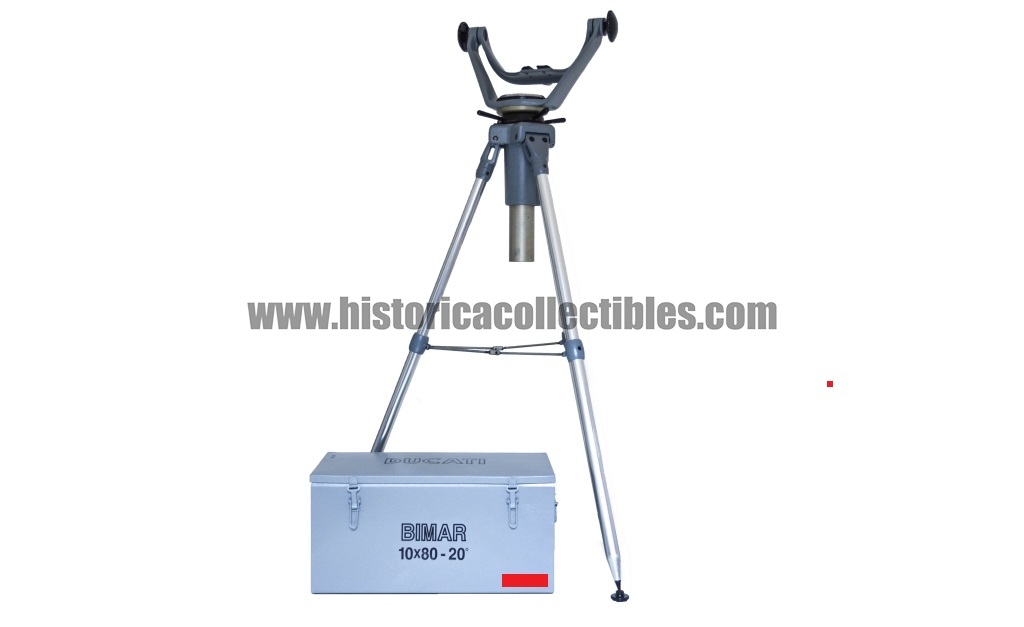
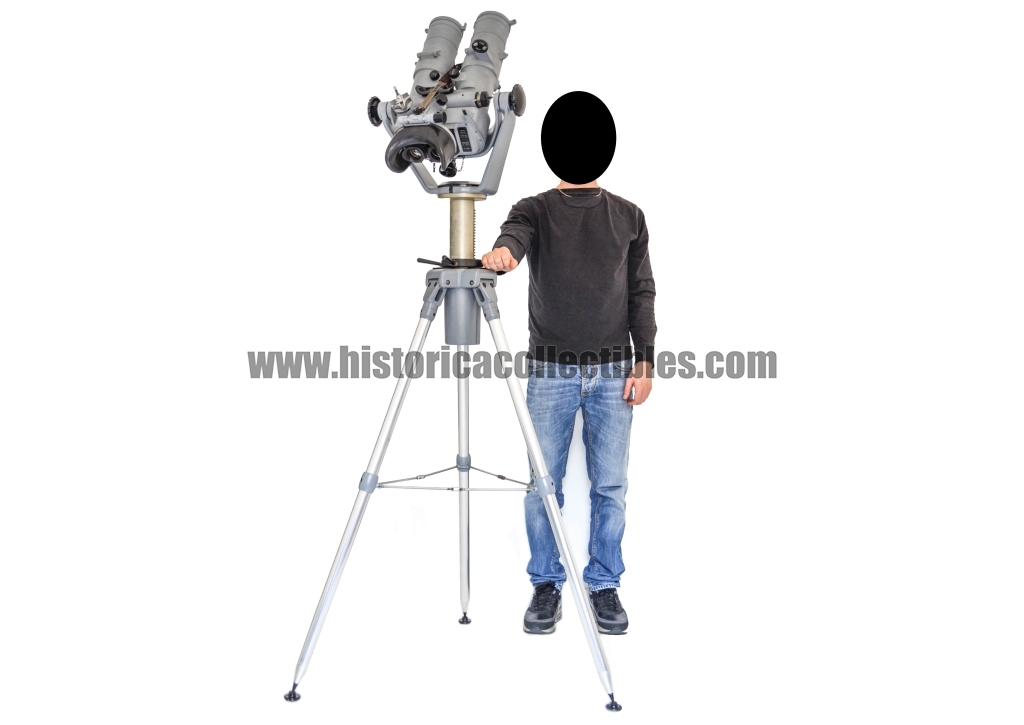

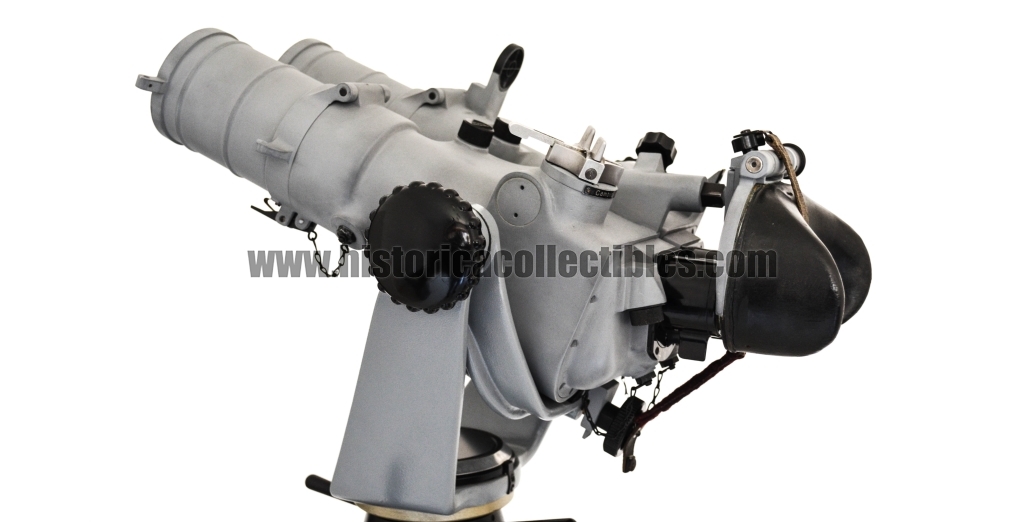


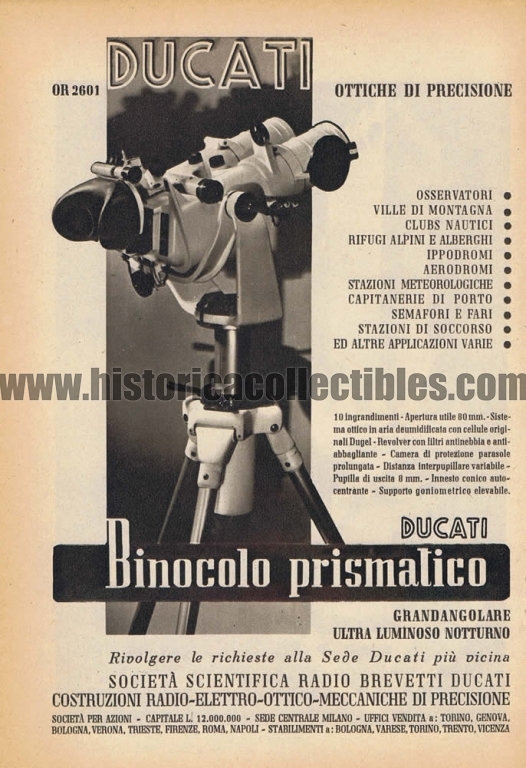
The project for the construction of this naval Doppelfernrohr was born in 1940 from the pressing German military needs of having an optic available that could fulfill sighting and detection tasks without problems arising from it, due to the structural technical quality, which would compromise its full functionality under conditions of war use.
It was essential to use binoculars on board the ships which, in addition to having very high brightness and image definition, had a perfect seal against infiltration and consequent fogging of the optics and which complied with the excessive inclination of 80° which had the one already in use, Flakfernrohr 10x80, which did not allow a quick overview of the airspace occupied by aircraft in flight.
Thus the Doppelfernrohr 10x80 - 20° was put into production by Zeiss.
The remarkable qualities of the binoculars given by the gradual viewing angle and the wide and extremely bright view were immediately noted. Likewise, after a brief use on board Kriegsmarine ships, the first problems arose with Zeiss production relating to their resistance to humidity, which caused them to fog up so much that they could no longer be used efficiently.
It was precisely for the reasons mentioned above that the Kriegsmarine decided to entrust the project, under Zeiss license, for the creation of the Doppelfernrohr 10x80 - 20° field of view 7° 122 meters at 1000 meters, to three other companies, in order to better optimize the held: "Voigtländer & Sohn A.-G Braunschweig" (ddx), "Optische Praezisions-Werke of Warsaw" (eug) and the Italian "Ducati" of Bologna were contacted and assigned the code "mlr".
On 22 February 1942, Ducati asked the Supreme Defense Command, headed by Benito Mussolini, to be able to enlarge the Borgo Panigale factory, to cope with the production of 1900 examples of D.F. 10x80 - 20° commissioned by the Kriegsmarine.
On 22 August of the same year, Bruno Cavalieri Ducati wrote to the Royal National Institute of Optics to request the advice of Professor Engineer Vasco Ronchi and two specialized technicians (Engineer Mario di Jorio and Professor Giuseppina Bocchino). On September 18th, Marcello Cavalieri Ducati held the first meeting for the design of the "BIMAR".
On September 30, all personnel responsible for developing the project were placed under secrecy order. In the following days, 500 optical components were ordered by Ducati from a company controlled by Zeiss, Schott Glass Werke, the world's leading manufacturer. On 8 January 1943, in a meeting held at Ducati, the first production calendar was established: 2 examples in the month of March, 7 in April, 15 in May, 20 in the month of June, 30 in the month of July and 45 in month of August, for a total of 119 BIMARs.
After a first visit which took place in the early months of 1942, Professor Ronchi, between 20 and 27 May 1943, headed a team of technicians to the Zeiss factory in Jena, this time to test the D.F. BIMAR, in the presence of the O.K.M. soldiers. (Oberkommando der Marine).
On June 3, Marcello Cavalieri Ducati complimented Professor Ronchi because the first BIMAR passed the test at Zeiss in Jena with flying colours.
After 20 July, another 5 BIMARs were handed over to the Kriegsmarine. Once the disastrous events occurred that followed the armistice of 8 September 1943, Ducati remained under the control of the Italian Social Republic, but the reality of the facts saw the Germans financially subsidize Ducati in order to obtain all the commissioned models and production continued incessantly until, in a letter dated 20 January 1944, written by Bruno Cavalieri Ducati and addressed to Professor Ronchi, it is communicated that there were great difficulties in transport as some BIMARs arrived damaged at the Jena factory, following a bombing by enemy aircraft.
On March 1st, Ducati workers went on strike in protest. On October 12, 38 B-24 heavy bombers of the USAAF 455th Bombardment Group destroyed the Ducati factory in Borgo Panigale. However, the production of BIMAR continued, as the optical department was previously transferred to Crespellano, a town located on the western outskirts of Bologna. This data is in fact confirmed by a letter dated 10 March 1945, written by Bruno Cavalieri Ducati and addressed to Professor Ronchi, in which it is communicated that a total of 450 examples of BIMAR were actually delivered to the Kriegsmarine, but at the end of the war, it will be found that, in the Ducati warehouse of the Crespellano factory, some BIMARs were still lying around, which, immediately after the war, were sold on the civilian market with only the following modifications: replacement of the data reported on it by the German and then in Italian, of the "mlr" identification plate with Ducati and construction of the stand.
History of Ducati:
DUCATI was born on 4 July 1926 when the three Ducati brothers Bruno, Adriano and Marcello Cavalieri decided to found the Scientific Society Radiobrevetti Ducati (SSRD) in Bologna. The first product was a capacitor for radio receivers called "Manens" which was exported to 45 countries around the world. In 1928 the production of variable capacitors began, and electrolytic capacitors followed in 1932.
All these products are based on patents of Adriano Cavalieri Ducati director of the Research Division, Marcello was the Production Director and Bruno was the General Director (sales, advertising, management and finance). In 1935 SSR Ducati moved to Borgo Panigale, a town west of Bologna, to a very modern factory designed with the most advanced work organization.
On 16 July it was declared an "auxiliary factory" for the war effort by the Ministry of War. In fact the growth of the Ducati workforce was explosive: 100 in 1932, 400 in 1934, 1,500 in 1938 and 7,000 in 1940 when Italy entered the war, it reached a peak of 11,000 employees in 1943. In 1939 the Ducati brothers decided to create an optical department to produce small telescopes and devices for field telegraphy called Faini - Triulzi for the Italian Army.
The Optical Department could count on Professor Vasco Ronchi, founder and director of the National Institute of Optics based in Arcetri in Florence and from the beginning, supplies of optical components from Officine Galileo in Florence.
The calculation office was entrusted to Professor Giuliano Toraldo di Francia by the National Institute of Optics and the research work by the engineer Raffaello Bruscaglioni of the San Giorgio company in Genoa, famous Italian researchers in the field of optics. We also remember the engineer Silvio Guidarelli who would become head of the Optical Department. During the war, Ducati also produced fuses, machine gun parts, telephones and radio direction finders.