
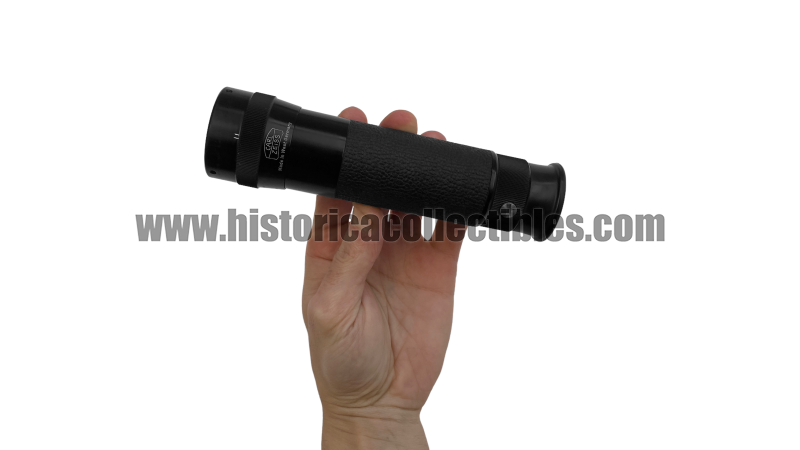
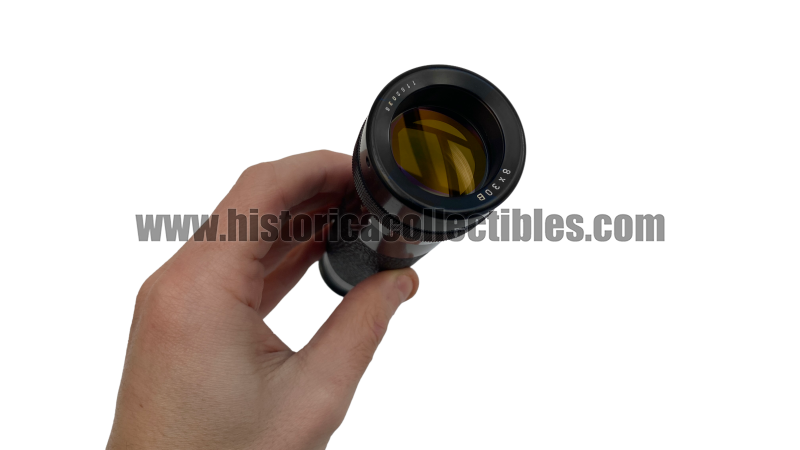
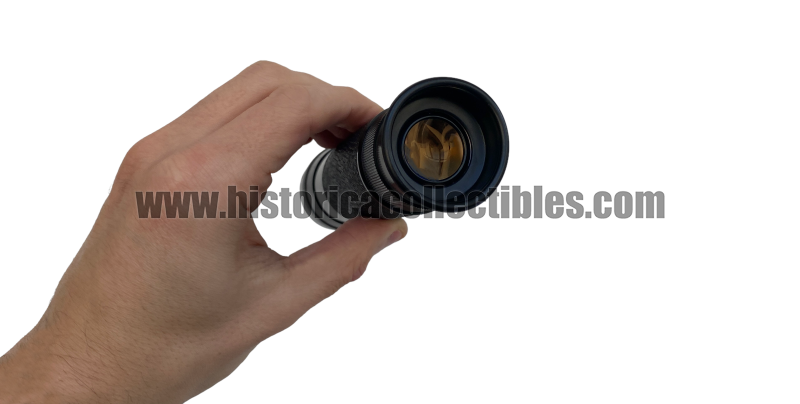
Fernrohrvorsatz Carl Zeiss 8x30b Dialyt (11.206), Third Type, 1969


Source Zeiss IKON:
The Carl Zeiss 8x30b Dialyt (with roof prisms), is an 8x magnification monocular which constitutes the latest evolution of a model which, starting from 1959, was also prepared for direct application to the normal lenses of various Zeiss Ikon cameras, giving life to a curious combination that generated a 400mm super telephoto lens (418mm effective) with a fixed aperture of f/16 (effective: f/13.4) which allowed amateur customers to satisfy the occasional needs of a super telephoto lens without investing too much money and without carrying explosives of significant size and weight in your bag; the use of lenses in combination with additional lenses that modified the focal length was well rooted in the Zeiss Ikon DNA and allowed the widespread Contaflex reflex to achieve wide-angle and telephoto focal lengths despite the fact that the Tessar lens was not interchangeable due to the central shutter and its mechanisms; throughout the 1950s, Carl Zeiss lavished a lot of energy on the calculation of numerous optical add-ons dedicated to the Tessar but also to the Planar or the Pantar triplet contracted to third parties, often employing the head of the Rechensbuero himself and all his experience and creating also many prototypes which did not see mass production, not so much for qualitative reasons (preliminary tests actually provided excellent performance) but for dimensions, weights and production costs which were often irreconcilable with the intended machine, often of medium range (the prototypes were very famous aborted whose optical scheme was so cumbersome that the lenses were cut into a rectangular shape, to the limit of the necessary coverage, in an attempt to lighten them).
This characteristic legacy returned to the surface in 1959, when the very prestigious Contarex reflex was laboriously arriving on the market to complement the already established Contaflex, a more affordable and less demanding camera; at Zeiss they had the idea, perhaps subversive for their absolute standards but certainly cheeky and intelligent, of applying a service thread to a Zeiss 8x30 monocular at the height of the eyepiece which would allow it to be screwed in front of the camera lens: ensuring guaranteeing the correct distance between the rear lens of the monocular and the front one of the objective to satisfy the dimensions of the entrance pupil, a complex with approximately 400mm focal length was obtained with weights, dimensions and costs not even remotely comparable to those of a hypothetical telephoto lens of equal power (which in any case, in the Carl Zeiss range, would not arrive until 1970).
The very concept of an object for amateur use is inherent in its characteristics: in fact the "photographic" version was equipped right from the start with a 27mm threaded frame which corresponds to the front filter pitch of the fixed lens of the Contaflex reflex cameras, thus suggesting that the primary destination of this accessory was this range of devices, certainly more popular and intended for a less savvy and sophisticated public; This, however, did not prevent the creation of the appropriate fittings for the very prestigious Carl Zeiss lenses of Contarex right away, thus trying to make up for the initial essentiality of its optical equipment, which in the meantime had been constantly developed over the years.