Lodbasmätare M/13, Carl Zeiss/Carlsson & Österberg Instrumentm. Göteborg, 1922
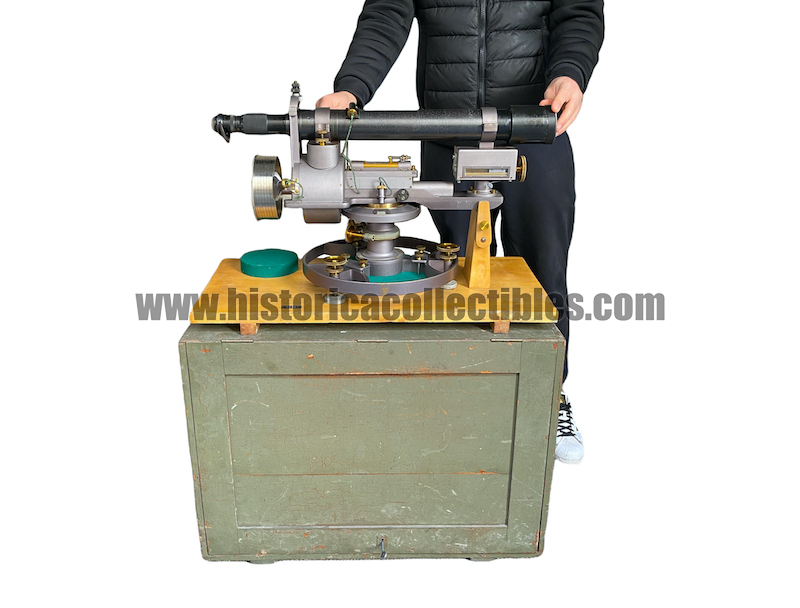


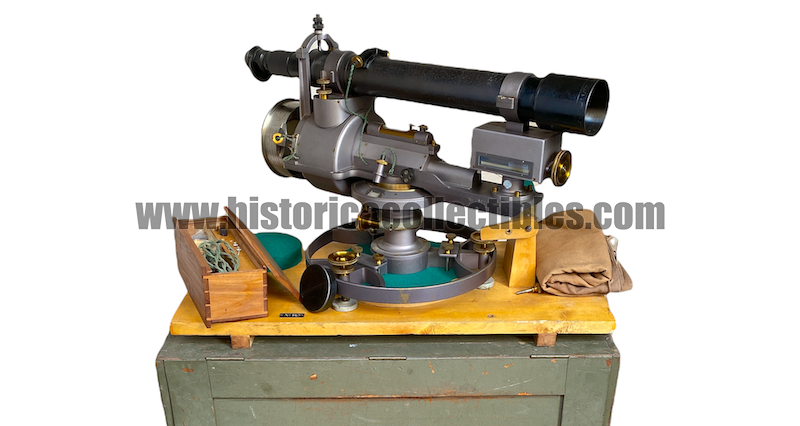

Lodbasmätare M/13 or Distance Meter, based on sea level, produced by Carl Zeiss Jena, as regards the optics and by Carlsson & Österberg Instrumentm. Gothenburg (Sweden), regarding the mechanical part of the instrument.
Distance meters of this type were used in the coastal artillery positions of the Swedish Navy, in the so-called fire direction towers, where it was essential to know at what height the distance meter was from sea level in order to be able to carry out the exact calculation of the distance of the target.
Therefore, steel plates were cast into the positions which ensured that the height was always exactly known. Low or high tides could influence the measurement and therefore the instrument had to be adjusted accordingly through micrometric mechanisms with manually operated levers and sliders.
The base of the Measurer was set at sea level so, when the crosshair was aimed and adjusted on the waterline of the enemy ship, it was only necessary to read the numbers on the spiral scale of the large flywheel placed on the instrument to know at what distance the meter was located. target.
The theoretically possible measuring range was from 750 meters to 17,000 meters, but to achieve precise artillery fire, the personnel in charge were limited to measuring targets at a maximum distance of 5,000 meters.
The knowledge of mathematics had to be of a good level on the part of the gunners assigned to these high precision instruments.
This instrument was designed by Carlsson & Österberg Instruntm. in Gothenburg (Sweden) in 1913 (in fact the model is defined as Lodbasmätare m/13) which made use of a telescope specially made for this purpose by Carl Zeiss Jena, which at the time was certainly the best manufacturer of military optics in the world.
This precise instrument was made in 1922, while the date 1916 is shown on the telescope, as are the telescopes present on other identical instruments built after 1916, which are preserved in some museums.
We can hypothesize the reason why the production dates differ between the instrument itself and the telescope. Probably the Ministry of Defense, anticipating a possible attack by enemy ships in an attempted invasion (the First World War was already raging in Europe), ordered Carlsson & Österberg Instruntm starting from 1916. a quantity of these instruments.
So Carlsson & Österberg itself ordered the telescopes from Carl Zeiss, probably in excess so much so that they were subsequently used on instruments built after 1916.
All the mechanical parts that make up the instrument are made of painted bronze, while the optical tube is made of steel.
Instrument and optics in exceptional condition, everything works perfectly including the graduated scale lighting system, complete with its original transport case and various accessories.
The measurements are: Instrument length 75 cm, height 45 cm, depth 37 cm. Weight: 34kg.
Telescope magnification: Variable 8-24x - Field of view 1.6 degrees - 5 degrees.
Case measurements: 80x60x40 cm. - Weight approximately 30 kg.
Reference:
"Vaxholms Fästnings Museum" Identification Number VFM.004079 (Prezzo KASTELLET 1, 185 99 Vaxholm, Svezia)
"Statens Maritima och Transporthistoriska Museer" Identification Number MM 25 326.a-f. (371 21 Karlskrona ------ Box 27131 - 102 52 Stockholm).
"https://www.marinmuseum.se/" Link: https://www.marinmuseum.se/utforska/samlingarna/fo...
"https://kringla.nu/" Link: https://kringla.nu/kringla/objekt?referens=vax%2Fo...
https://digitaltmuseum.se/ Identification Number GFM.001976 (https://digitaltmuseum.se/021027448127/lodbasmatar...)