
Refracting Telescope Luigi Filagrana-Bologna, King Umberto I & Queen Margherita of Savoy, 1878
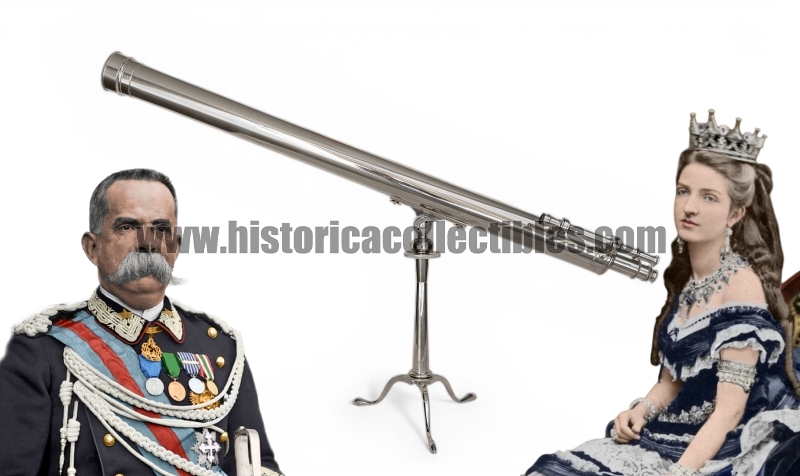
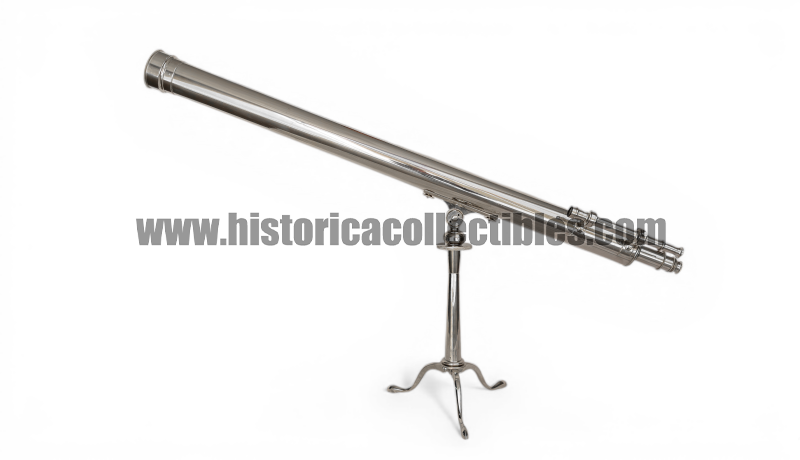
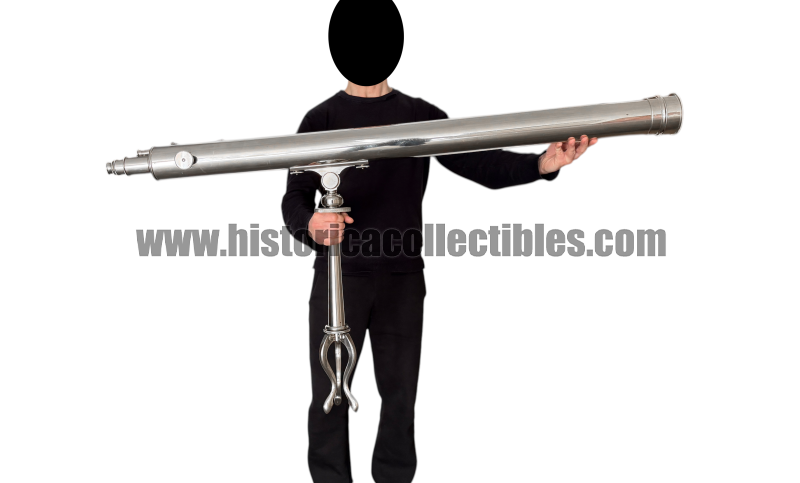
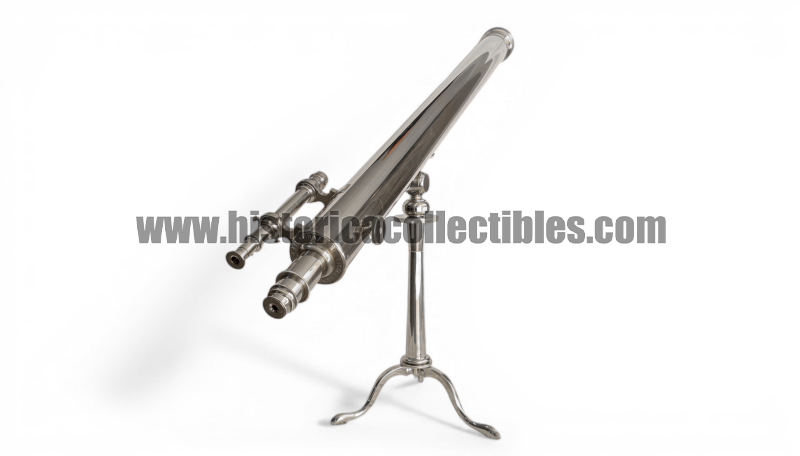
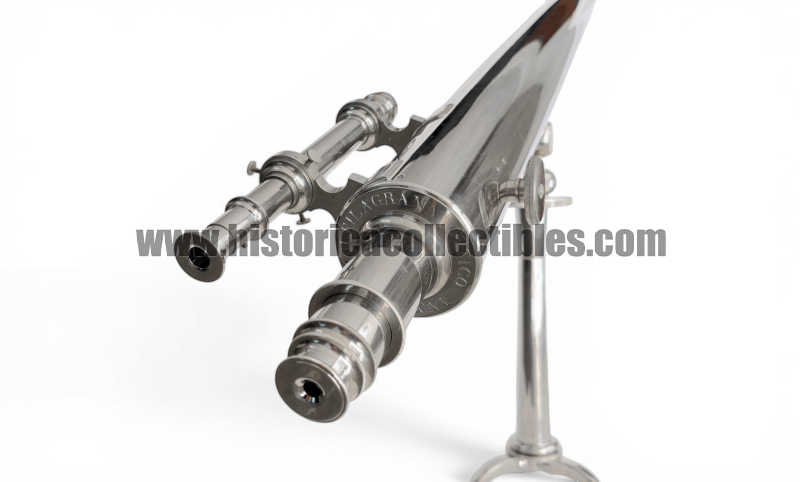
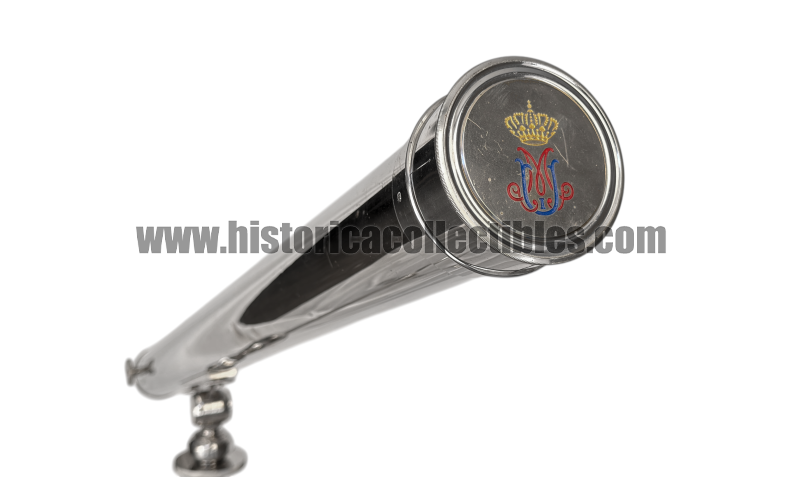
Large nickel-plated refracting telescope with finder and tabletop tripod, built by the optician Luigi Filagrana of Bologna as a gift to King Umberto I of Savoy and his wife Queen Margherita, on the occasion of their honeymoon through Italian cities, including Bologna, in November 1878. Filagrana carefully engraved and enameled the large objective lens cap with the royal crowned monogram, composed of the initials of King Umberto I of Savoy and his wife Queen Margherita. As reported in some newspapers of the time, the sovereigns stopped in Bologna, and the city hosted a luncheon for sixty distinguished guests, likely including the renowned optician Luigi Filagrana, who wished to present one of his exclusive creations.
The telescope is 153 cm long and is fully functional. It also includes an original dark eyepiece filter for the sun.
Umberto I and Margherita of Savoy are guests in Bologna during their honeymoon through Italian cities.
Upon arrival at the station, on the afternoon of November 5, the King reviews the Workers' Associations (42) with their banners. In the city, "Their Majesties" are welcomed by an "impressive mass of people" who accompany them to Piazza Maggiore.
"The balconies are all decked with flags, the streets adorned with antennas, banners, and festoons." Marching bands march through the streets lit by torches, followed by a cheering crowd.
The Municipality offers the sovereigns a lunch with sixty distinguished guests. The menu includes neither regional dishes nor wines: the menu ranges from trout to mushroom cutlet, from Roman punch to Viennese cake; French wines, including champagne.
A portion of the population shows a certain indifference to the presence of the Royals, an indifference that sometimes borders on hostility. Cardinal Archbishop Parocchi is accused of intentionally absenting himself from the city to avoid meeting with them.
The Zanichelli bookshop in Pavaglione is one of the few shops to display the Italian flag, daring potential offenders to vent their discontent "with all ease."
Carducci's ode "To the Queen of Italy" causes a scandal in radical left-wing circles. The poet of the "Odi barbare" seems bewitched by the young sovereign, "prominent, gentle, in white, blonde, and bejeweled."
Arcangelo Ghisleri (1855-1938) ironically wonders in the pages of the "Rivista Repubblicana" whether the poet of Satan might have become a monk:
"In line with Carducci, who teaches us the Salve Regina, let us all form a procession behind the royal carriage. It is the new path to heaven."
The poet responded to the accusations in 1882 by writing Eterno feminino regale, in which he identified Margherita as the feminine ideal.
Further reading:
- Margherita Bianchini, 101 Stories About Bologna That They've Never Told You, Rome, Newton Compton, 2010, pp. 213-215
- Bologna. Words and Images Through the Centuries, edited by Valeria Roncuzzi and Mauro Roversi Monaco, Argelato (BO), Minerva, 2010, pp. 104-105, 174-175
- Bologna in the Nineteenth Century, edited by Giancarlo Roversi, Rome, Editalia, 1992, pp. 29-30
- Luigi Bortolotti, The Suburbs of Bologna. The Municipality of Bologna Outside the Walls in History and Art, Bologna, La Grafica emiliana, 1972, p. 116
- Marina Calore, Bologna at the Theater. The Nineteenth Century, Bologna, Guidicini and Rosa, 1982, p. 104
- Alfredo Comandini, Italy in the Hundred Years of the Nineteenth Century, 1801-1900, Day by Day Illustrated, Continued by Antonio Monti, Milan, Vallardi, 1900-1942, vol. 5: 1871-1900, pp. 768-770
- Tiziano Costa, Great Book of Bologna's Characters. 420 Stories, Bologna, Costa, 2019, p. 64
- Tiziano Costa, The Great Book of the Walls of Bologna, Bologna, Costa, 2010, p. 134
- F.I.L.D.I.S., Last Suppers in Bologna, Bologna, L. Parma, 1988, p. 105
- Angiolo Silvio Ori, Bologna Told: A Guide to the Monuments, History, and Art of the City, Bologna, Tamari, printed 1976, p. 372
- Filippo Raffaelli, The Secrets of Bologna, Bologna, Poligrafici, 1992, p. 139
- Up, comrades, in dense ranks. Socialism in Emilia-Romagna from 1864 to 1915, edited by Luigi Arbizzani, Pietro Bonfiglioli, and Renzo Renzi, Bologna, Cappelli, 1966, p. 83 (illustrated)
- Marco Veglia, True Life. Carducci in Bologna, Bologna, Bononia University Press, 2007, p. 218
- Giampaolo Venturi, Episcopate, Catholics, and the Municipality in Bologna, 1870-1904, Bologna, Institute for the History of Bologna, printed 1976, p. 109