
Elephant's Foot Jewelry Box, Oberstleutnant Lothar Von Trotha - German East Africa, 1895
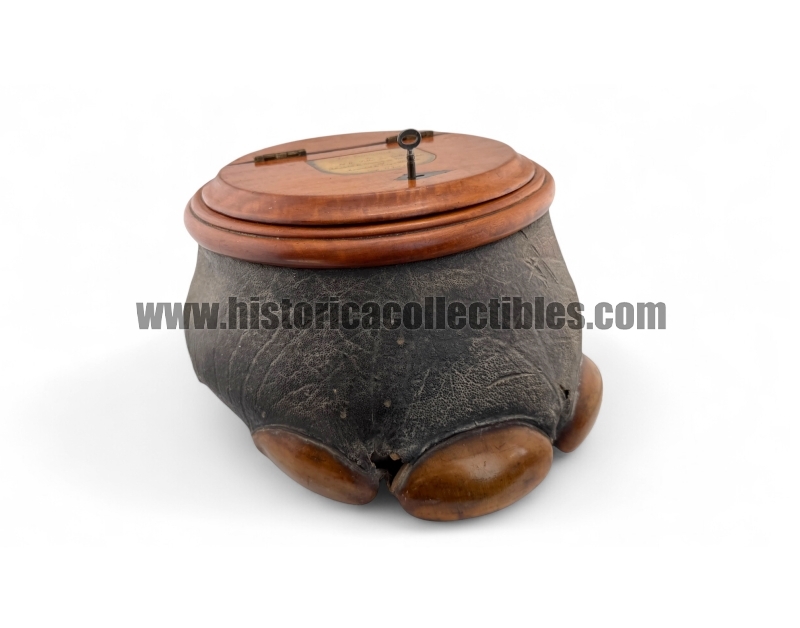
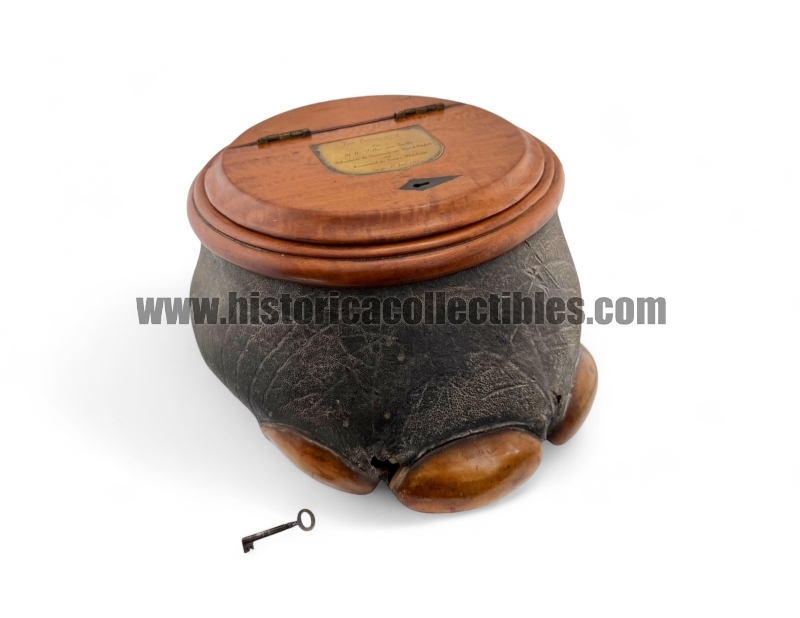
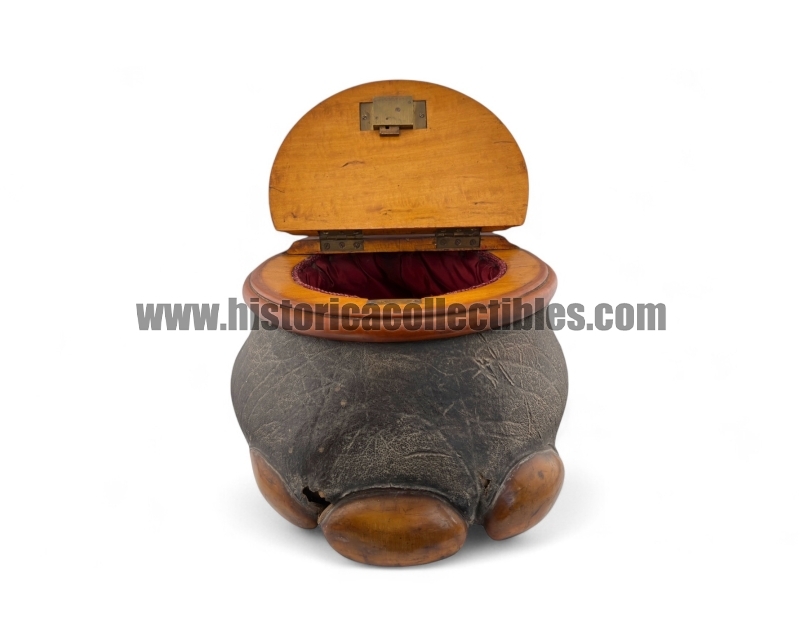
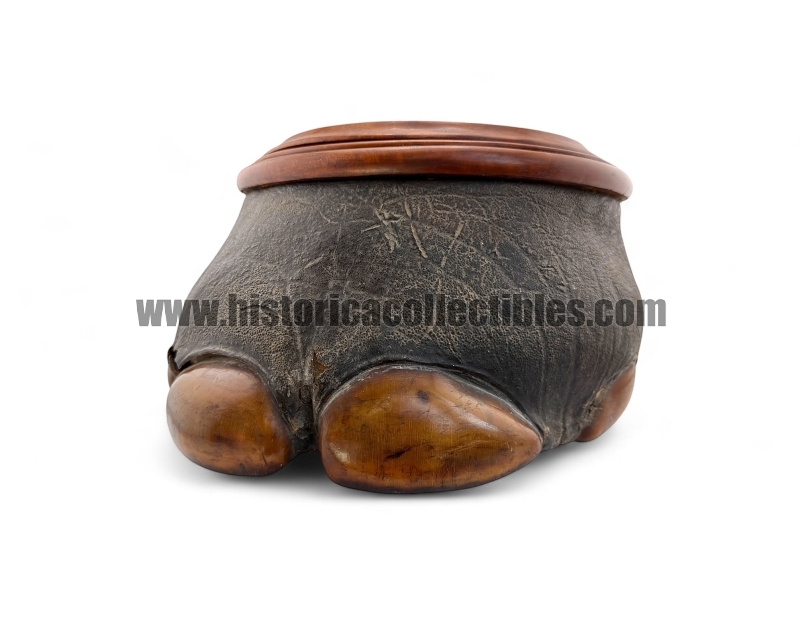
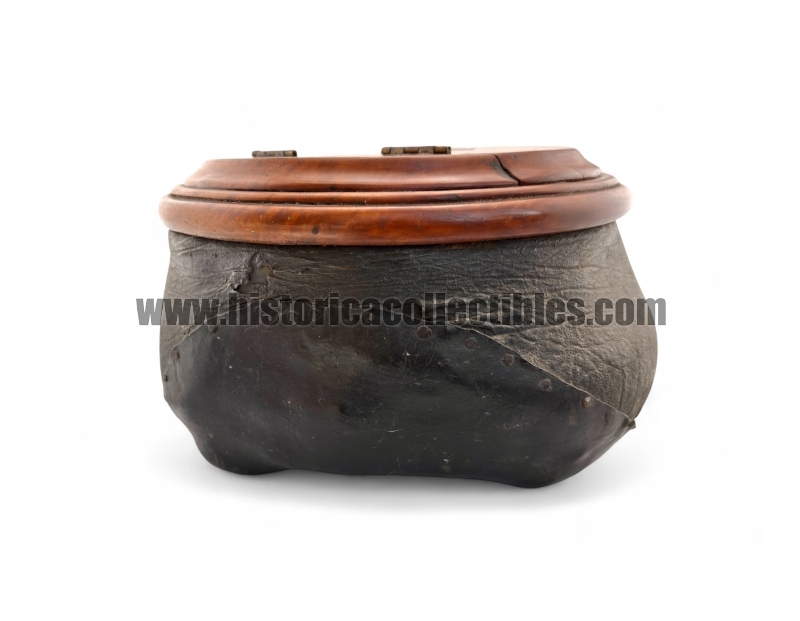
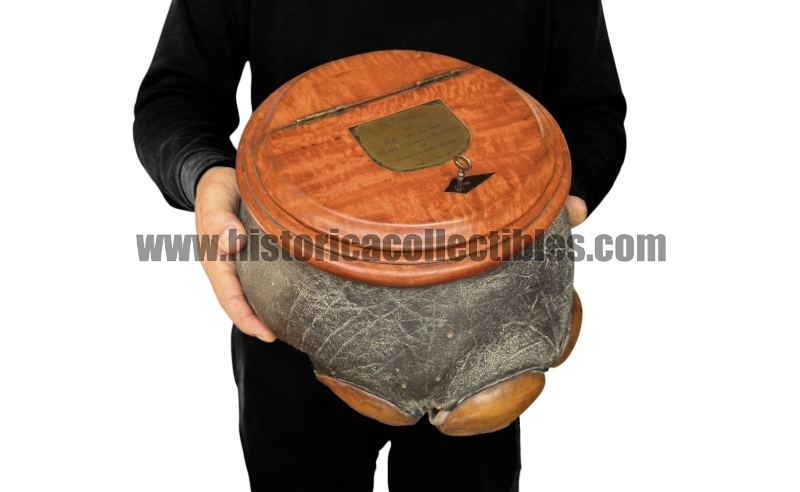
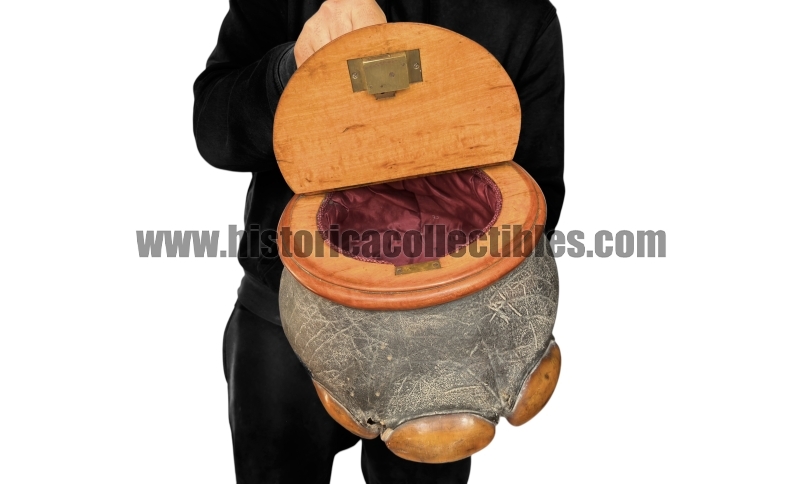
A small chest in typical Art Nouveau or Liberty style, carved from an elephant's foot, donated by Oberstleutnant Lothar von Trotha, Commander of the Protection Forces and Lieutenant Governor of German East Africa, in 1895.
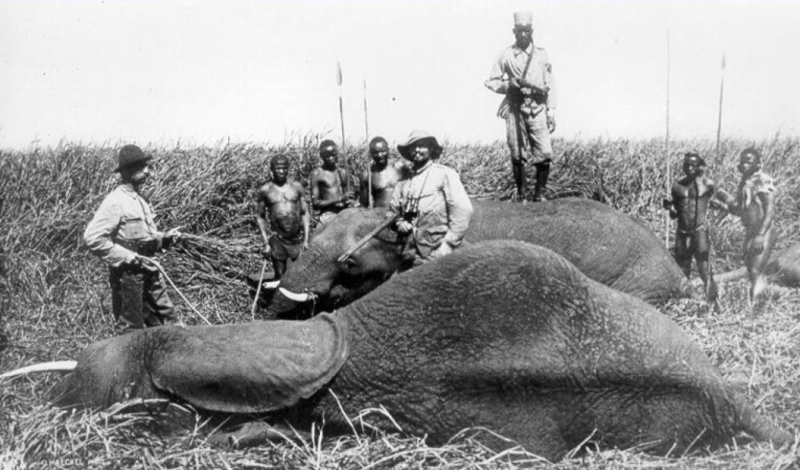
The lid of the chest bears a plaque inscribed with the date of its presentation. It states that Oberstleutnant Lothar von Trotha donated it as a memento on June 15, 1895, from the city of Tanga, where a district office for German East Africa was located, to a person who was likely a woman, who was probably in Germany. This is deduced from the fact that this chest, aesthetically and functionally designed as a true jewelry box, contains a purple velvet interior. Supporting the hypothesis that this chest was made from a leg of one of the elephants killed by Lothar von Trotha is the fact that Tanzania boasted one of the highest concentrations of elephants in Africa, particularly in the Serengeti, Tarangire, and Ngorongoro plains, areas that were extensively hunted by European hunters starting in the late 19th century.
Dimensions: Height 150-180 mm, base approximately 280-320 mm.
Condition: Old repair on the back of the leg, some small losses, otherwise excellent condition.
It is accompanied with an expert's document and CITES certification of year 2025.
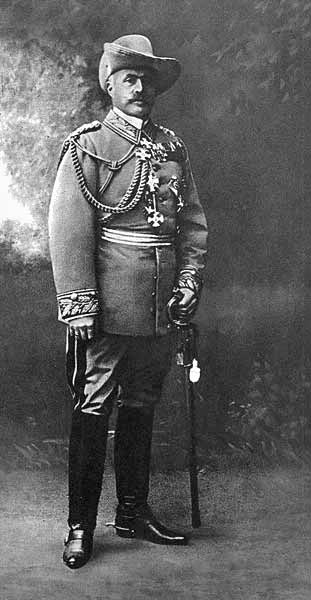
Adrian Dietrich Lothar von Trotha (July 3, 1848, Magdeburg – March 31, 1920, Bonn) was a German general renowned for his harsh conduct during the Herero Wars in Southwest Africa, particularly for the events that led to the near-extermination of the Herero.
Born in Magdeburg, Trotha joined the Prussian Army in 1865 and took part in the Austro-Prussian and Franco-Prussian Wars, for which he was awarded the Iron Cross, Second Class. He married Bertha Neumann on October 15, 1872.
In 1894, he was appointed commander of the colonial forces in German East Africa, where he successfully suppressed insurrections, including that of the Wahehe. While temporarily seconded to Imperial China as Brigade Commander of the East Asia Expeditionary Force, he took part in the suppression of the Boxer Rebellion. So it was no surprise when, on May 3, 1904, he was appointed Commander of the Schutztruppe in German Southwest Africa and sent to quell the Herero uprising. Von Trotha arrived in Southwest Africa on June 11, 1904, while the war against the Herero had been raging for five months. The German command had thus far had not had much success against the Herero's guerrilla tactics. Initially, he too suffered losses.
In August 1904, General von Trotha developed a new battle plan to put down the uprising. At the Battle of Waterberg, he gave the order to encircle the Herero on three sides, leaving their only escape route to the arid Omaheke Steppe, the western edge of the Kalahari Desert. The Herero fled into the desert, and von Trotha ordered his troops to poison the few water wells, set up guard posts along a 150-mile line, and shoot every Herero on sight, man, woman, or child. To make his stance toward the Herero even clearer, on October 2, von Trotha issued the Vernichtungsbefehl, or extermination order:
"I, General of the German Army, am sending this letter to the Herero. They are no longer German subjects. They have killed, robbed, cut off the ears and other body parts of wounded soldiers, and now they are too cowardly to continue fighting. I announce to the people that whoever delivers one of their chiefs to me will receive 1,000 marks, and 5,000 marks for Samuel Maharero. The Herero people must leave the country. If they do not, I will force them with cannon. Any Herero found within German borders, with or without a weapon, with or without cattle, will be killed. I will no longer welcome women or children: I will drive them back to their people or have them shot. These are my words to the Herero people."
He also gave his soldiers this explanation:
"This proclamation will be read to the troops during roll call, adding that the soldier who captures a chief will be entitled to an appropriate reward, and that shooting women and children is to be understood as shooting over their heads, to force them to flee. I am convinced that this proclamation will result in no more male prisoners being taken, but it will not degenerate into atrocities against women and children. As for the latter, they will certainly escape if a couple of shots are fired over their heads." The troops will not lose sight of the good reputation of the German soldier."
Von Trotha always defended his political line throughout his life: "It has been and is my policy to use force against terrorism, and even brutality." An anonymous German soldier was quoted as saying of the massacres, "...the rattle of the dying and the screams of the mad...are echoes in the sublime silence of infinity."
Von Trotha's tactics differed markedly from those of the Herero leaders, who were, by and large, careful to ensure that only soldiers were attacked. Von Trotha was recalled to his homeland on November 11, 1905, and died of typhoid fever on March 31, 1920, in Bonn.
References:
Wikipedia: https://it.wikipedia.org/wiki/Lothar_von_Trotha
Isabell V. Hull, Absolute Destruction: Military Culture And the Practices of War in Imperial Germany, p. 56.
cf. Drechsler, Horst: Let Us Die Fighting: The Struggle of the Herero and Nama Against German Imperialism, 1884-1915 (London: Zed Press, 1980), 150.