Honor Cup for Special Achievement in the Air War, Luftwaffe 1942

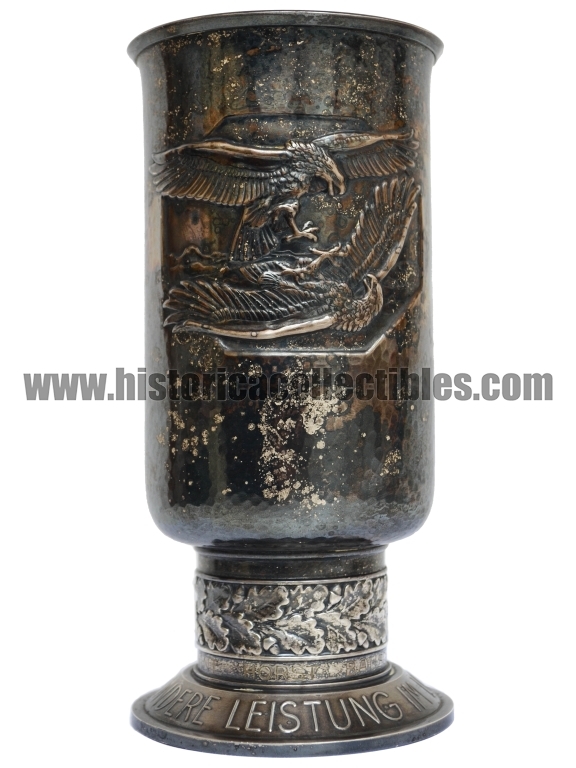
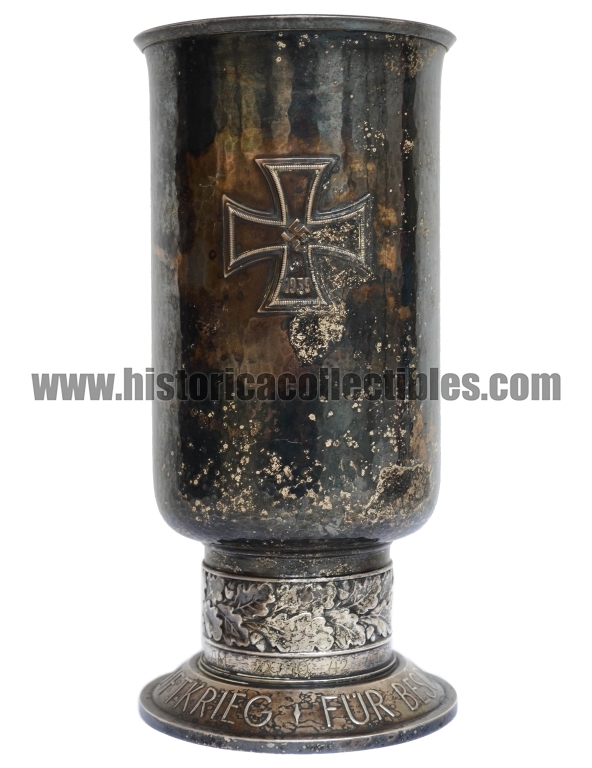
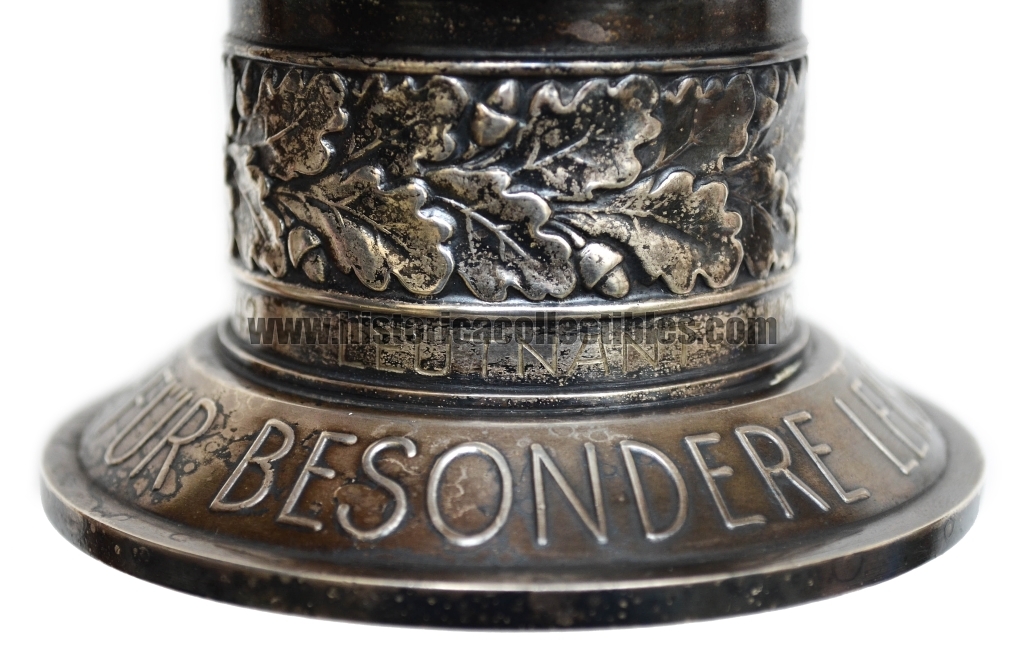
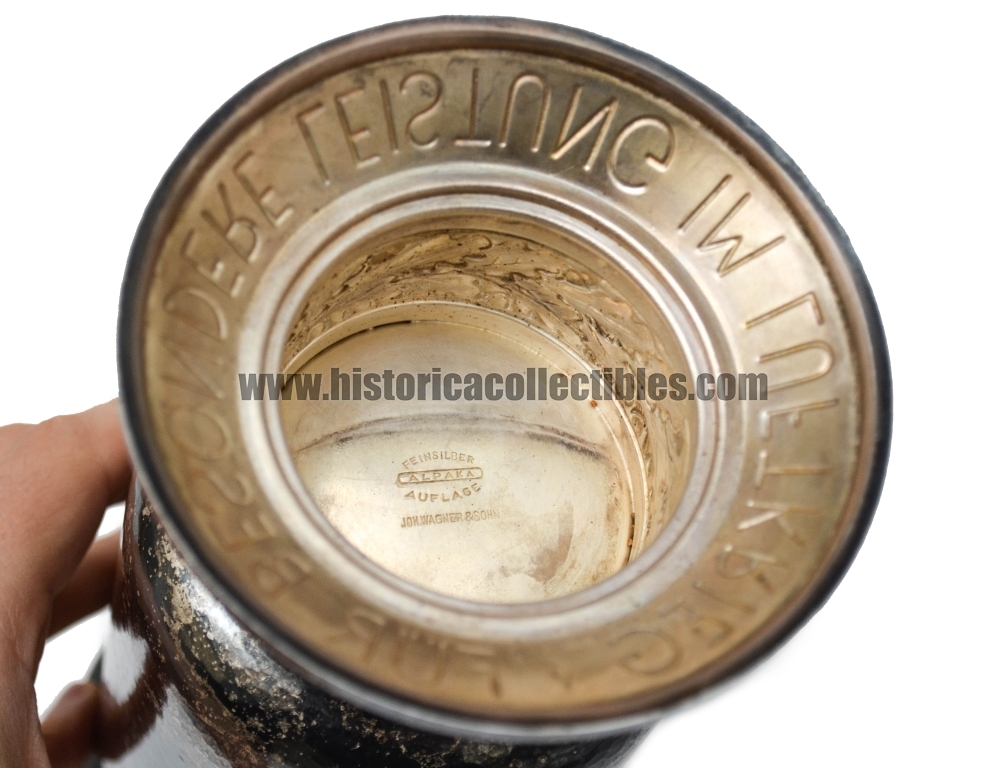



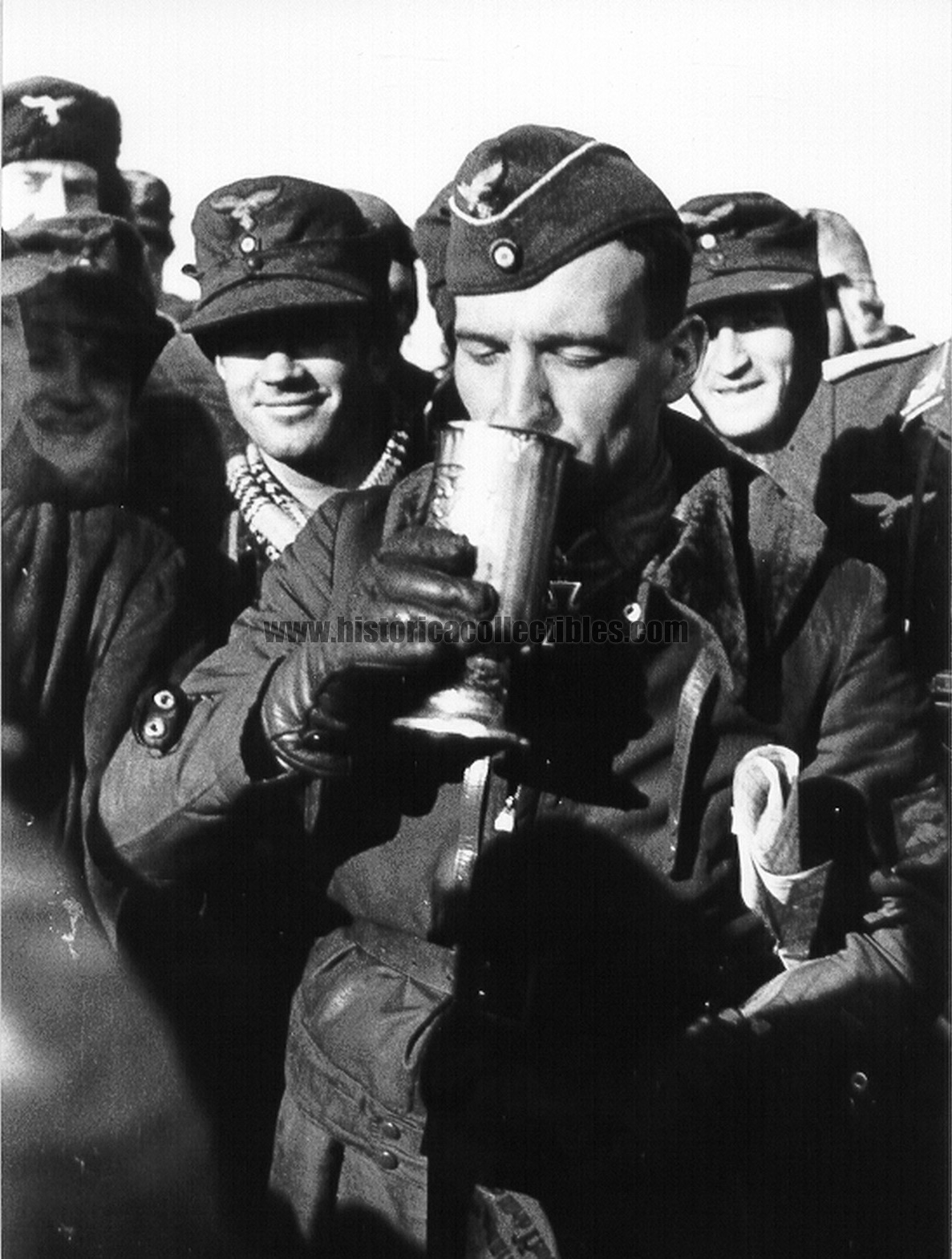


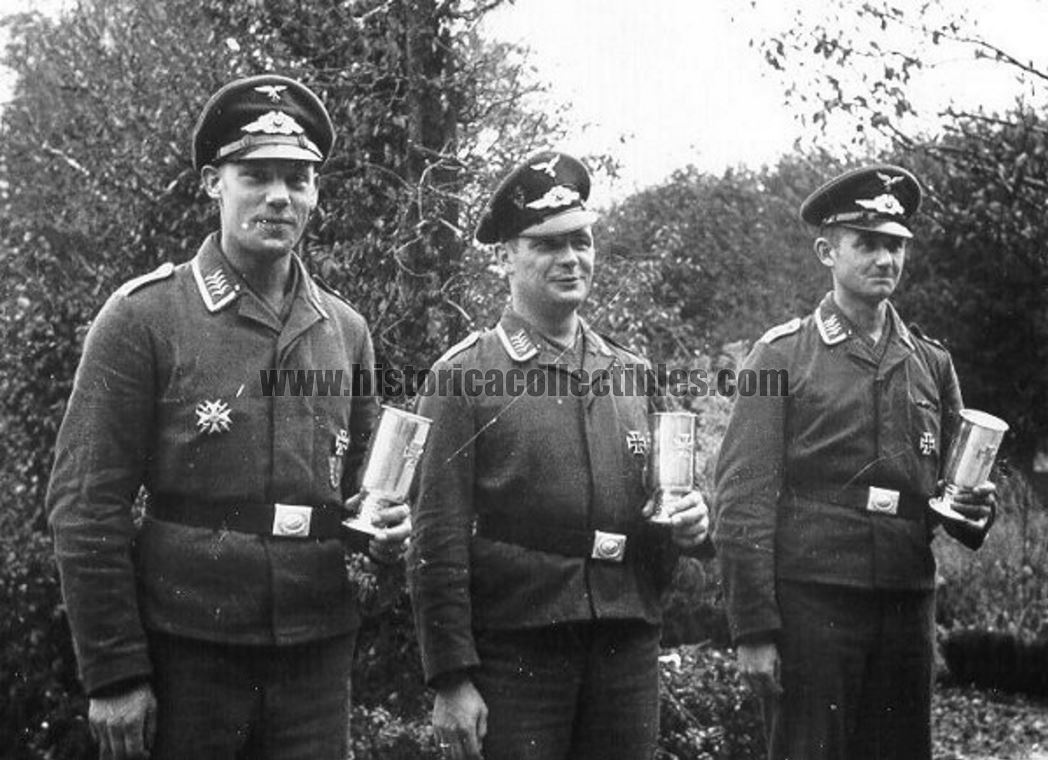

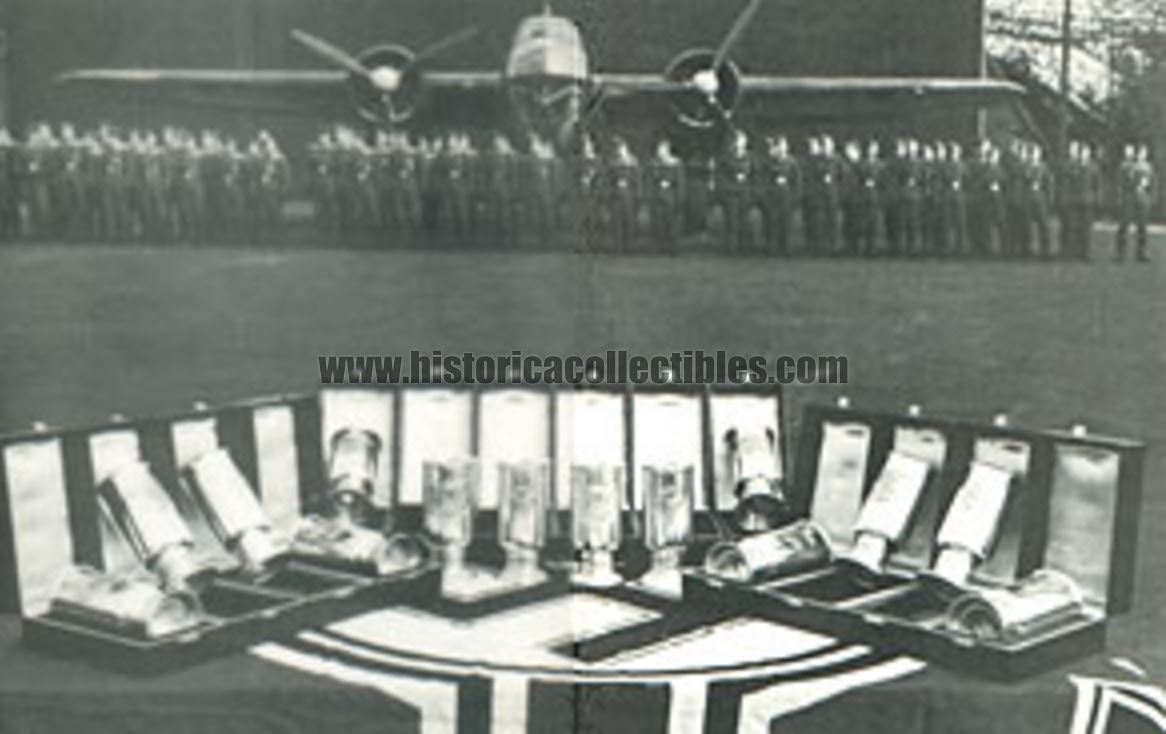
Ehrenpokal für Besondere Leistung im Luftkrieg or Luftwaffe Honor Cup awarded to the Luftwaffe Pilot Lieutenant "Horst Bauschke" on 22 October 1942. In fact, on the appropriate ring of the Ehrenpokal, as per the regulations, the engraving "Leutnant Horst" is shown Bauschke AM 22. 10. 42".
The Honor Cup in feinsilber alpaka was made by Joh. Wagner & Sohn of Berlin, and is in its original untouched patina condition.
Pilot Horst Bauschke was born in Berlin on 20 August 1920 in the Neukölln district, he was a highly decorated Luftwaffe officer and awarded the Iron Cross 1st and 2nd class on 22 October 1942.
On 22 October 1942 he was awarded the "Ehrenpokal für Besondere Leistung im Luftkrieg" (Luftwaffe Honor Cup) obtained for the heroic actions carried out in the skies of Russia when he was part of the 2. (H)/Aufkl.Gr.
On 16 August 1943 he was awarded the German Cross in Gold.
In May 1944 he was promoted to the rank of Hauptman (Captain).
He was pilot, among other things, of the Hs 126B aircraft and the legendary Messerschmitt Bf 109G.
This was the pilot's military career:
Bauscke Horst (DOB: 08.06.20 in Berlin). (DKG). 1941 with JFl.Vorschule 1. 21.07.41attended Lehrgang 10 at Aufkl.Fl.Schule 2 Brieg. 05.42 with Stab/Aufkl.Gr. 11. 24.05.42 trf toErgAufkl.Gr. Ob.d.H.? Jüterbog-Damm. 20.10.42 trf to 2.(H)/Aufkl.Gr. 21 as a pilot. 02.11.42 Lt.,awarded the Ehrenpokal. 28.05.43 trf to I./NAG 102. 01.06.43 in Führer-Reserve/Ob.d.L., promo toOblt. (Ing.)(RDA 01.04.43). 01.06.43 from Führerreserve /R.d.L. to temporary duty with Ausb.Stelle f.Ing.d.Lw. Bad Blankenberg (cancelled 04.06.43). 04.06.43 trf to 2.(H)/Aufkl.Gr. 21. 15.06.43 trf to1./NAGr. 5 due to unit renaming. 16.08.43 Oblt. in 2.(H)/Aufkl.Gr. 21, awarded the DKG. 10.01.44 trf toTechn.Akademie d.Lw. Berlin-Gatow. 05.44 with 6.(H)/Aufkl.Gr. 12. 05.44 Hptm., trf to 8./NAGr. 8 (to05.45).
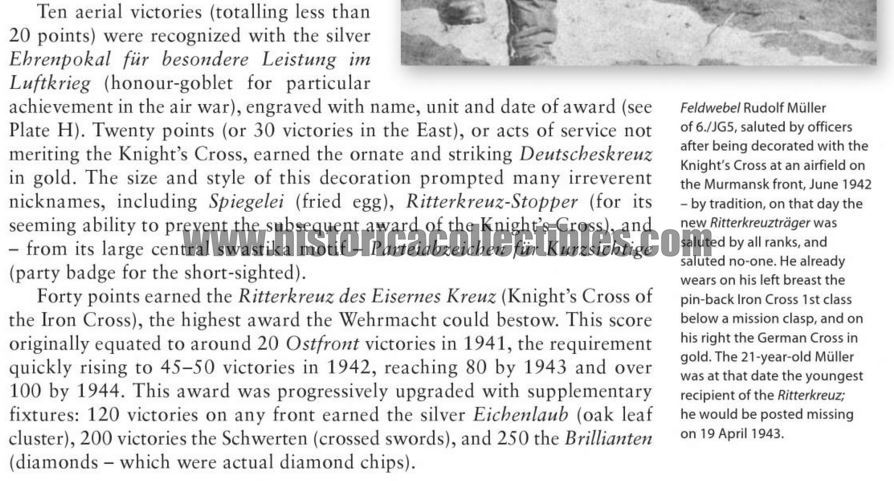
The Luftwaffe Honor Cup was a decoration for valor and merit of the Third Reich, awarded to Luftwaffe air personnel who had distinguished themselves exceptionally during the war.
In 1915, an anonymous group of German "supporters of the air forces" made a large sum of money available to the commander of the imperial air force (Chef des Feldflugwesens) Hermann von der Lieth-Thomsen in order to create an honorary cup for victories in air combat. Under the supervision of Thomsen and the German Kaiser himself, the "Cup of Honor for the winner in air combat" (Ehrenbecher für den Sieger im Luftkampf) was therefore designed and produced, which was awarded for the first time on 27 January 1916 to a group of riders for their first victory. Later the criteria for the award were changed: the cup would be awarded upon achieving five aerial victories (in the Second War they rose to 20 aerial victories).
The documents relating to the military decorations of the Imperial Air Force were largely lost during the heavy bombing of Potsdam in 1945, so the information on this type of cup and other similar ones is due to difficult searches in private archives in recent years : following the discovery of a cup of different workmanship, it was consequently possible to deduce that in addition to the cup for the winners of air combat, a very small number of silver cups were also awarded to the participants in some aerial bombings (Cup of honor for successful attacks from the air - Ehrenbecher für erfolgreiche Angriffe aus der Luft).
The Cup of Honor (1st type) for the winner of an air combat had the shape of a cylindrical mug in hammered silver, on which two eagles in the act of fighting were embossed inside an octagon. At the base of the cup, a cylinder with the inscription Dem Sieger in Luftkampf (To the winner in air combat) in Gothic characters. The cylinder in turn rested on four silver spheres, which constituted the base of the artifact.
On the occasion of his 47th birthday (12 January 1940) the then Generalfeldmarschall Hermann Göring (aviation ace during the First World War) received a gift from Rear Admiral Rudolf Lahs (former president of the League of German Aeronautical Industries - Reichsverband der Deutschen Luftfahrt -Industries) two cup models which - referring directly to the 1916 Honor Cup - were proposed as an honor for the members of the Luftwaffe air crews. At the same time, the League of German Aeronautical Industries made 50,000 Reichsmarks available to Goering for the production of the award.
Thus it was that Göring, on 27 February of the same year, had the document with which he established the "Cup of Honor for exceptional conduct in air warfare" (Ehrenpokal für besondere Leistung im Luftkrieg) published in the Order Sheet of the Oberkommando der Luftwaffe, establishing that his contribution was reserved for him personally. Starting from 26 August 1941, the names of those decorated with the Luftwaffe Cup of Honor were published in a special Honor List (Ehren-Liste), to be read publicly during the roll calls of the air troops of the Third Reich.
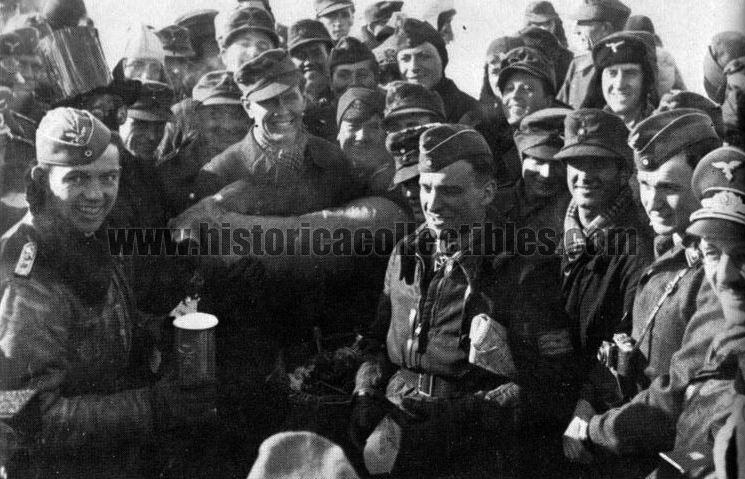
Hans Ulrich Rudel, the most decorated German pilot of the Second World War, drinks from the Luftwaffe Cup of Honor, awarded to him on 20 October 1941.
On 6 July 1944 the Oberkommando der Luftwaffe established that due to the damage that the artefact could receive during transport, the latter could be delivered directly to the relatives of the decorated person.
The last document relating to the Cup dates back to an order dated 10 December 1944 from the then Luftwaffe Chief of Staff, Generaloberst Bruno Loerzer, according to which by determination of Hermann Göring the Luftwaffe Honor Cup was no longer to be awarded, being been replaced by the Barretta for citation in the roll of honour, a decoration common to all Wehrmacht corps.
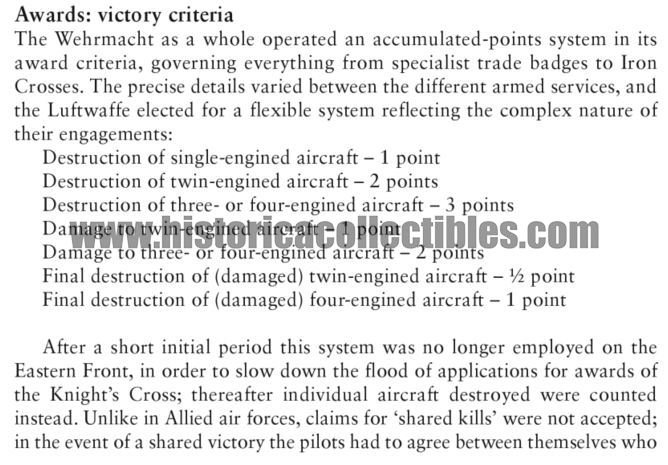
In a general sense it can be said that it was an award of both merit and valor, intermediate between the Iron Cross First Class and the German Cross or the even superior Knight's Cross of the Iron Cross. Not only Luftwaffe pilots were decorated, but all deserving aircrew members.
The Cup of Honor looks very similar to the 1st model awarded in 1916-1918: on the opposite side of the two eagles, however, it has the obverse of an Iron Cross dated 1939 as well as having the mouth flared outwards by a few millimetres.
The major difference between the two artefacts can be seen above all in the lower part of the cup: the cone joining the base is higher and has no writing, but an elaborate crown of oak leaves embossed between two rings. On the lower ring there are engraved - in capital Latin characters - the name, the rank of the decorated person and the date of award. In place of the four spheres at the base, there is a truncated cone with the writing in relief in Latin capital letters FÜR BESONDERE LEISTUNG IN LUFTKRIEG (For exceptional merits in air warfare).
The Cup of Honor was created in two versions, both by the firm Johann Wagner & Sohn of Berlin: the first - older and more precious - in solid silver, the second - more recent - in nickel silver, due to the scarcity of the most precious metal as the war operations progressed. Both cups have on the outside on the bottom the initials of the company in Latin capital letters - JOH.WAGNER & SOHN - and respectively for the silver artefact the fineness of the metal - 835 - and three other trademarks of the company, or for the artefact in nickel silver written in ellipsoidal form in Latin capital letters FEINSILBER ALPAKA AUFLAGE.
The Cup of Honor was delivered together with a diploma signed by Hermann Göring (almost always in copy) and/or by the commander of the department to which the decorated person belonged. In various cases the artefact was contained in an elegant case/box with snap closure, externally in blue imitation leather. In this case, the cup rested in a recess made in the lower part of the case lined in blue velvet, while the upper internal part was lined in white satin.
The total number of Luftwaffe Cup of Honor recipients during the war is not known, but is estimated at between 13,000 and 15,000.