
Left Hand "parade" in Damascus steel, Milan or Venice, Court of France, 1498-1547
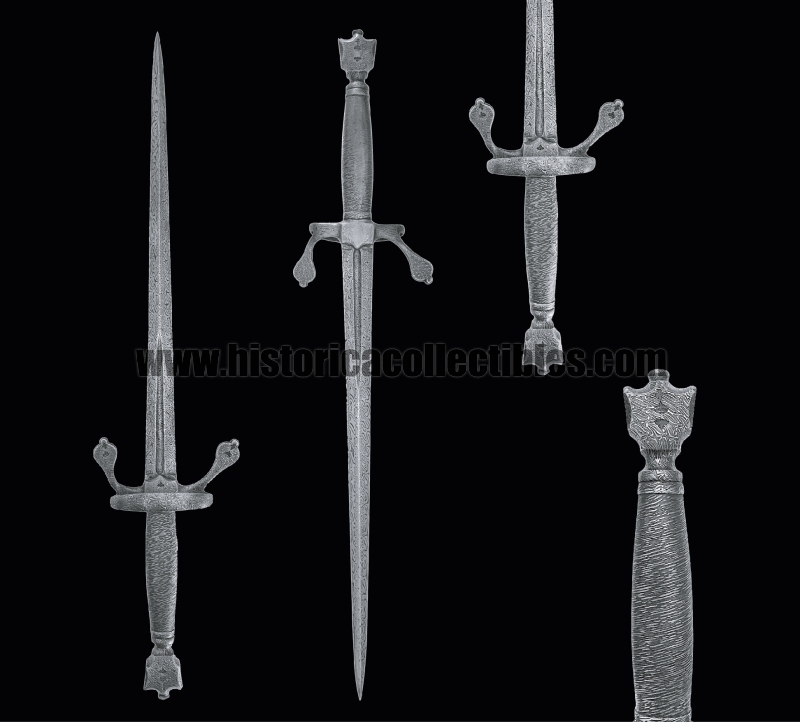
Left Hand "parade", Left-Handed Dagger or "Main Gauche" made of forged Damascus steel, in the territory of Northern Italy (Duchy of Milan or the Republic of Venice) dating back to the first half of the 16th century.
While all European production used the traditional technique of forged iron for the creation of its cutting weapons, and although this dagger displays characteristics and shapes in use at that time for this type of weapon, this Left-Handed Dagger is made unique by the implementation of an extraordinary steel processing process, by which each element that composes it was created, namely the Damascus steel.
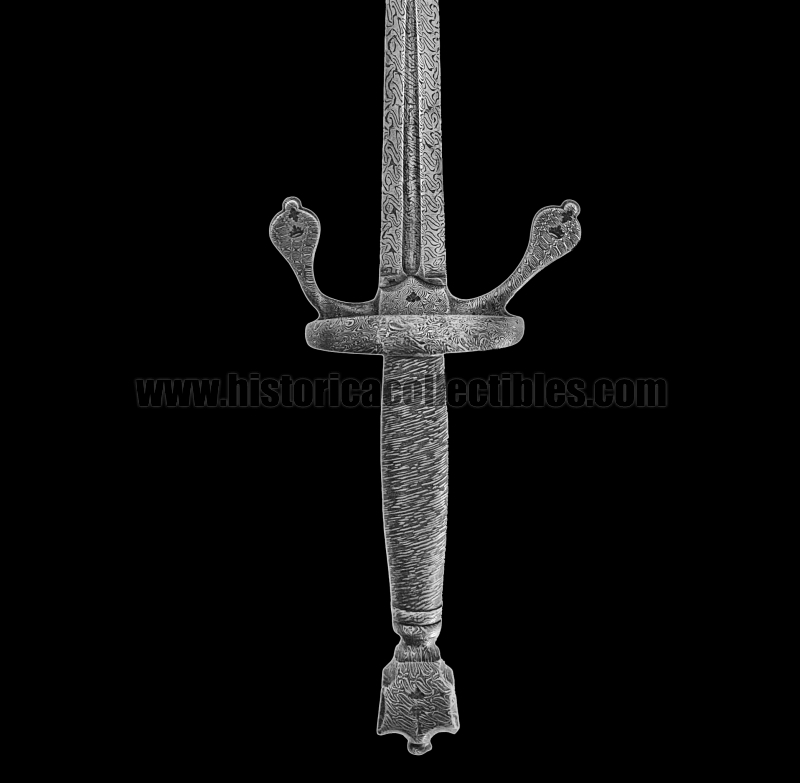
In fact, all the elements that compose this "Left Hand" are made unique by the diversification of the preparatory schemes of the "packages" which allowed the "Magister armorum" to obtain a unique "damascus" design in the steel based on the proportion of each element it is composed of. For the blade, double-edged with a double groove, a Damascus pattern was adopted which visually favors the extension of its entire length.
For the curved-arm hilt and its large parade bridge, incredibly made in a single element, a more concentrated schematization of the "package" was used. For the grip, on the other hand, a composition was preferred that visually recalls the "braided iron wire" commonly used for the covering of the wooden handles of most edged weapons of the time. Finally, the pommel, with the typical "cat's head" shape elegantly modeled and attributable to northern Italy, is made exclusive by the movement of the damask according to its appropriately smoothed profiles.
Each "weave" is therefore consistent with the shape and movement of each individual part, providing the observer with an image that makes it perfectly proportioned.
The technique of working Damascus steel, widely forgotten in Europe from the 5th to the 15th century due to the extremely high difficulties of execution and practicable only by the most authoritative and prestigious "Magister armorum", was rediscovered during the Renaissance, a period in which the technique of working iron reached its highest peak, also driven by the incessant demand from the most sumptuous European courts, which aspired to increasingly refined artefacts in order to equip themselves with unique and prestigious weapons.
Confirming the technical ability of the "Magister armorum" active in northern Italy to produce "package" damascus steel, there is a reference that is reflected in the dagger with a blade in damascus steel made in the 16th century, preserved at the Hermitage Museum in St. Petersburg, and purchased in Milan by Tsar Peter the Great between 1682 and 1721.
In light of this, in fact, despite the typical Italian shape also highlighted by the Venetian stylistic influence expressed in the shape of the pommel, there are two distinct punches on all the elements that constitute it, referable to the Court of France, namely a "Crown" and a "Fleur de Lys".
In this case, the "diadem crown" punch associated with the "Fleur de Lys" is of the type in use on French coins issued in the period consistent with the established dating. In fact, after the reigns of (*)Louis XII of Valois-Orléans (1498-1515) and his successor (*)Francis I (1515-1547), who were also Dukes of Milan, starting from the reign of Henry II (1547) the diadem crown was added to the arches which remained in place until the reign of Napoleon III.
It is also appropriate to consider the presence of a third "stamp" in the shape of a leaf placed just below the first 2 and for which there is, compared to the others, a greater distance than that between the "Fleur de Lys" and the "Crown", and furthermore on the hilt it was made separately from the other 2 which are located at the top of the guard. This therefore suggests that it is the stamp attributable to the "Magister armorum", or the person who created it as "Magister armorum" or "master armorer" in the service of the Court of France. It is historically known that the Royal Court of France turned to the craftsmen of northern Italy on many occasions for the supply of prestigious weapons and armor since the fifteenth century: already in the spring of 1466 Francesco Missaglia, universally considered one of the greatest European armorers, was introduced to King Louis XI of France by Giovanni Pietro Panicharola, agent of the Duke of Milan in Paris, for the commission of an extraordinary armor. In addition, it should be considered that the Lombard "Magister armorum" were so appreciated in France that, at the end of the fifteenth century, there were as many as 24 active ones. In addition, the Duchy of Milan was considered the most important and prestigious forge in Europe for the production of bladed weapons, so much so that the major European royal courts addressed their commissions to the best Milanese manufacturers such as Missaglia, Negroli, Modrone, Merate and many others still present in the territory of the Duchy.To support the second theory, which suggests the production of this Left-Handed Dagger within the territories under the control of the Republic of Venice, is the "cat's head" shape given to the pommel, whose singular shape was in use to represent on swords, daggers and daggers by the gunsmiths active in that very territorial area, among other things bordering the Duchy of Milan. It is therefore not to be excluded that the Court of France may have commissioned this masterpiece to a "Magister armorum" active in the Republic of Venice also in light of the fact that traditionally, the territories of Belluno, Feltre or Brescia, boasted prestigious and ancient manufacturing traditions in the production of weapons for the most important courts of Europe. They are known as the Daggers and Swords produced for French Dignitaries: Gian Giacomo Trivulzio, first Marquis of Vigevano appointed Marshal of France on 29 September 1499, included among his weapons a splendid Venetian "horse sword" finely engraved by Ercole dei Fedeli.
In addition, in the Republic of Venice, due to the trade routes that had been in existence for centuries, it was not unusual to see Saracen emissaries or merchants equipped with "blades" made of Damascus steel: in fact, although the process for obtaining the Persian damascus called Wootz, used for the creation of the blades used on scimitars, yataghan, Shamshir, Talwar etc. etc. had different technical manufacturing principles, it cannot be excluded that these artifacts influenced the creation of this left hand in order to obtain a prestigious and exclusive weapon.
Overall length: 44 cm
Length: 30,5 cm
Width of the hilt: 9,5 cm
Weight: 295 gr.
Luigi XI: King of France from 1461 to 1483
Carlo VIII: King of France from 1483 to 1498
(*) Louis XII of Valois-Orléans: King of France from 1498 to 1515 - Duke of Milan from 1499 to 1512
(*) Francis I: King of France from 1515 to 1547 - Duke of Milan from 1515 to 1521