
Left Hand "parade" in Damascus steel, Milan or Venice, Court of France, 1498-1547
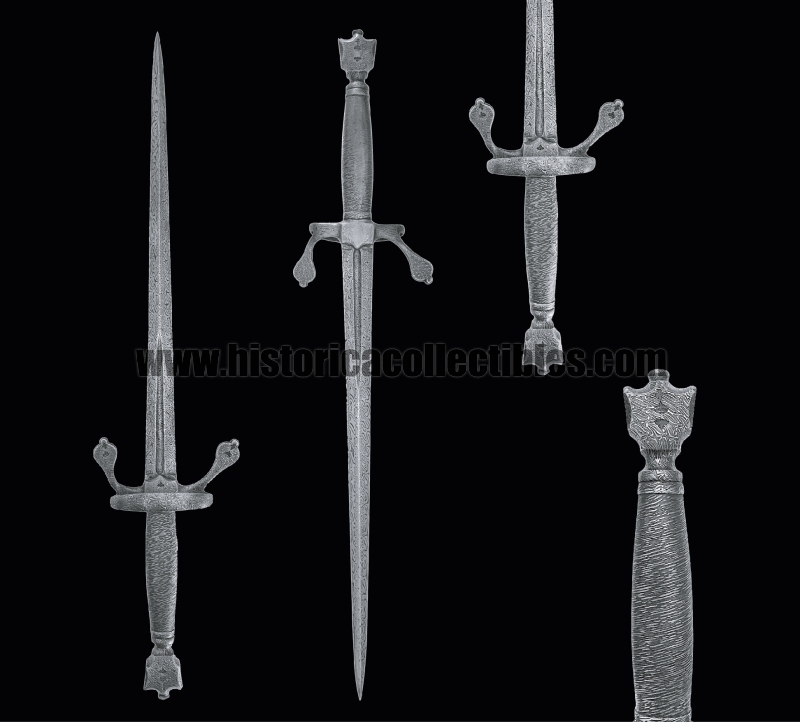
A parade dagger, known as the mano sinistra or main gauche, made in northern Italy (Duchy of Milan or Republic of Venice) in the first half of the 16th century, it represents an extraordinary example of Italian Renaissance weaponry. While it fits within the formal typologies common in the 16th century, it is distinguished by its use of forged Damascus steel throughout, a complex and prestigious technique employed here for every single element of the weapon.
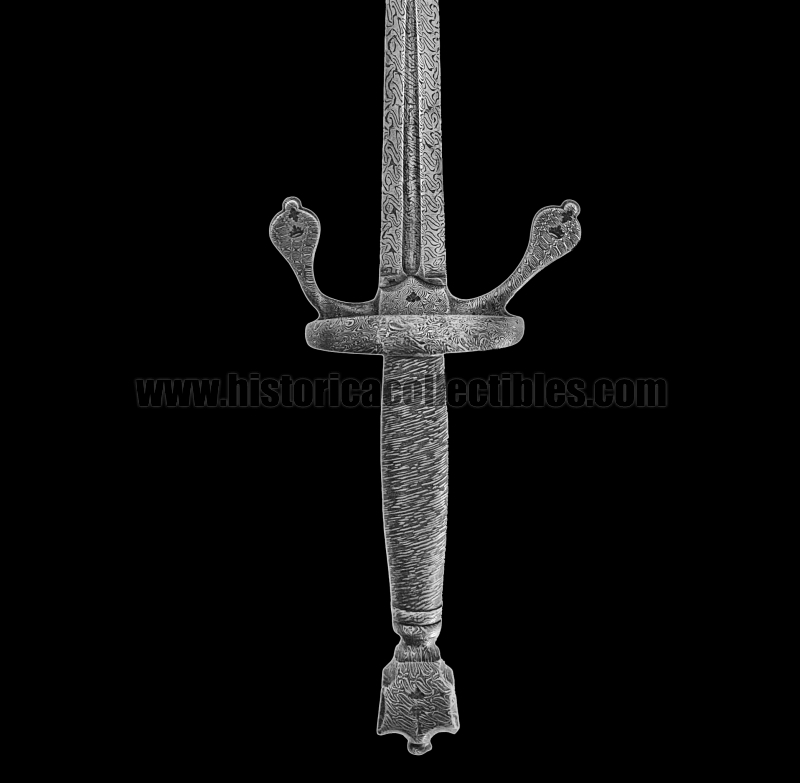
The entire object reveals an exceptionally refined design in the arrangement of the so-called “packages” of pattern-welded steel, differentiated for each element in order to achieve decorative effects perfectly aligned with form and function: Blade: double-edged, with a double fuller, displaying a patterned structure that emphasizes its longitudinal development. Hilt: with curved arms and a broad knuckle-guard, remarkably forged as a single piece, exhibiting a denser and more compact pattern. Grip: the motif recalls the twisted metal wire typical of contemporary coverings. Pommel: of the characteristic “cat’s head” type associated with Northern Italy, enhanced by a pattern oriented along its smoothed contours.
The whole demonstrates exceptional technical and aesthetic control, in which each pattern harmonizes with the geometry of the individual components, resulting in a perfectly balanced object.
The technique of forged pattern-welded steel, largely forgotten in Europe between the 5th and 15th centuries due to its technical difficulty, experienced a significant revival during the Renaissance, when demand from European courts drove armourers toward ever higher levels of technical and decorative excellence.
An important point of comparison is provided by a 16th-century dagger preserved in the Hermitage Museum, acquired in Milan by Tsar Peter the Great around 1680, which attests to the ability of Northern Italian workshops to produce exceptional pattern-welded steel.
Particularly significant is the presence of three maker’s marks: a diadem crown, a fleur-de-lys, and a third mark in the form of a leaf.
The first two can be associated with the French court and find parallels in the coinage of the reigns of Louis XII and Francis I of France, both also Dukes of Milan. The third, isolated mark may identify the magister armorum responsible for the work, possibly active in the service of the French court.
The connections between France and Lombard workshops are well documented: as early as 1466, the armourer Francesco Missaglia was presented to Louis XI for important commissions, and by the late 15th century numerous Lombard masters were working permanently in France. The Duchy of Milan was indeed regarded as one of Europe’s principal centres for the production of luxury arms.
However, production within the sphere of the Republic of Venice cannot be ruled out, as suggested by the form of the pommel and the manufacturing traditions of areas such as Brescia, Feltre, and Belluno. In these regions worked renowned masters such as Ercole dei Fedeli, and weapons were produced for prominent French dignitaries, including Gian Giacomo Trivulzio, Italian nobleman, soldier and politician and Marshal of France.
Finally, Venetian trade contacts with the East may have encouraged the influence of Middle Eastern Damascus blades—such as shamshir and yatagan—although based on techniques distinct from European pattern welding.
The state of preservation is exceptional.
Overall length: 44 cm
Length: 30,5 cm
Width of the hilt: 9,5 cm
Weight: 295 gr.
Luigi XI: King of France from 1461 to 1483
Carlo VIII: King of France from 1483 to 1498
(*) Louis XII of Valois-Orléans: King of France from 1498 to 1515 - Duke of Milan from 1499 to 1512
(*) Francis I: King of France from 1515 to 1547 - Duke of Milan from 1515 to 1521