
Monumental Cathedral Clock, in wrought iron, Flamboyant Gothic period - France, 1480-1520
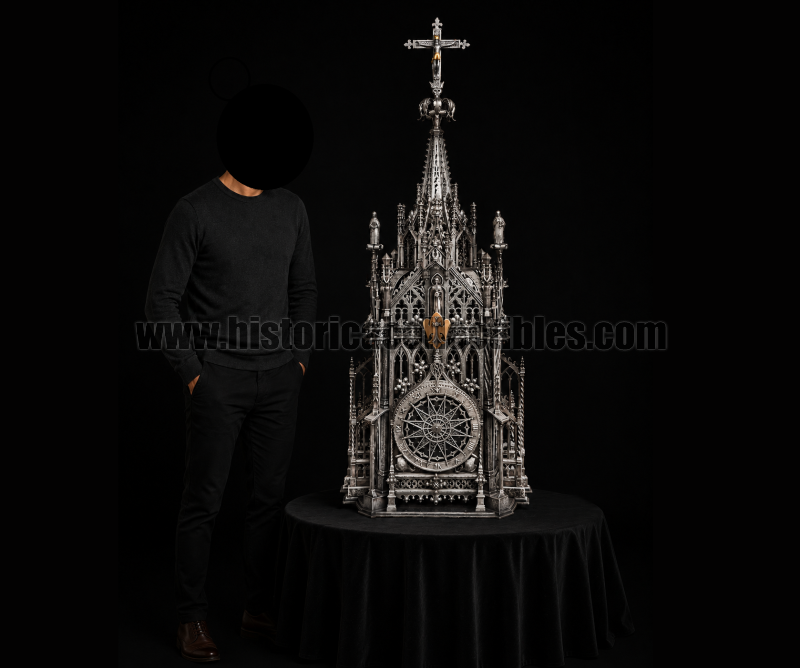
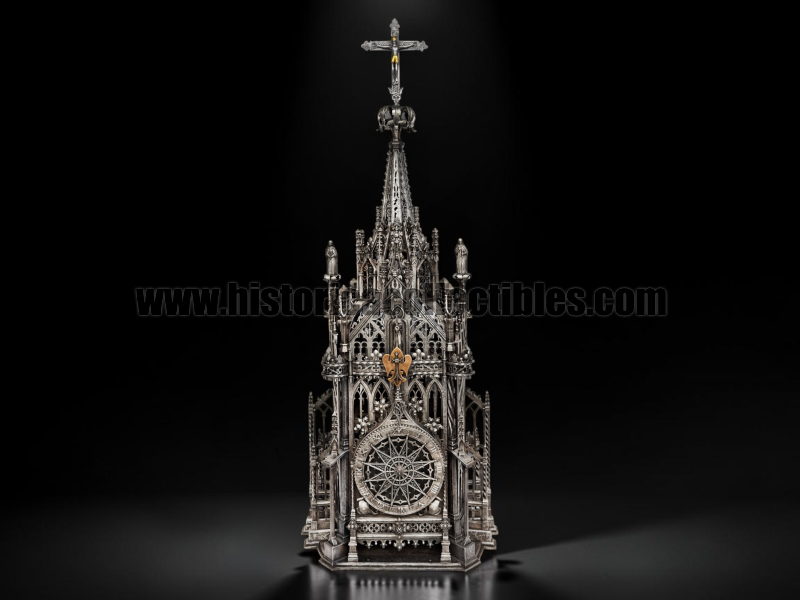
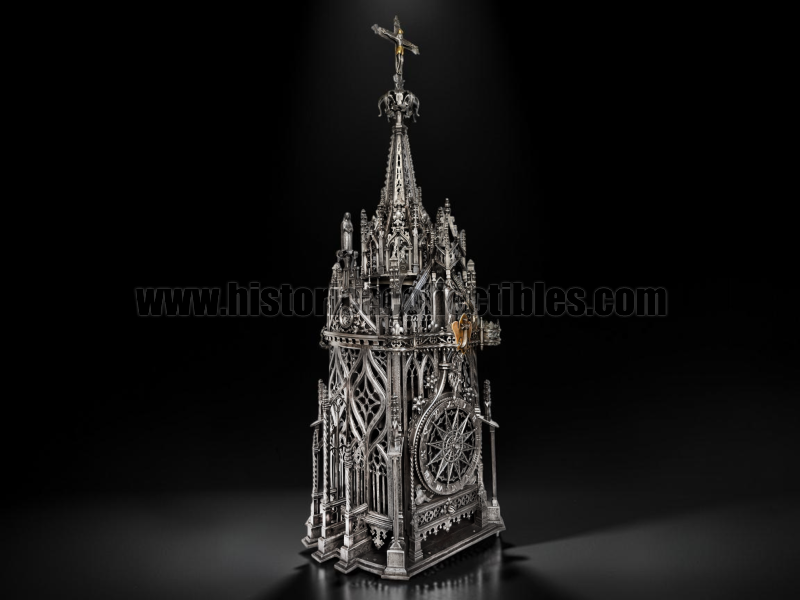
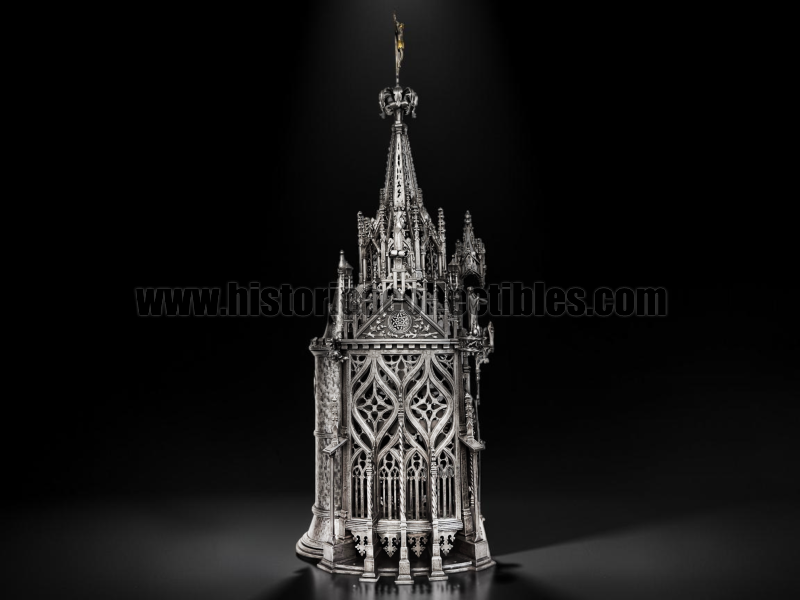
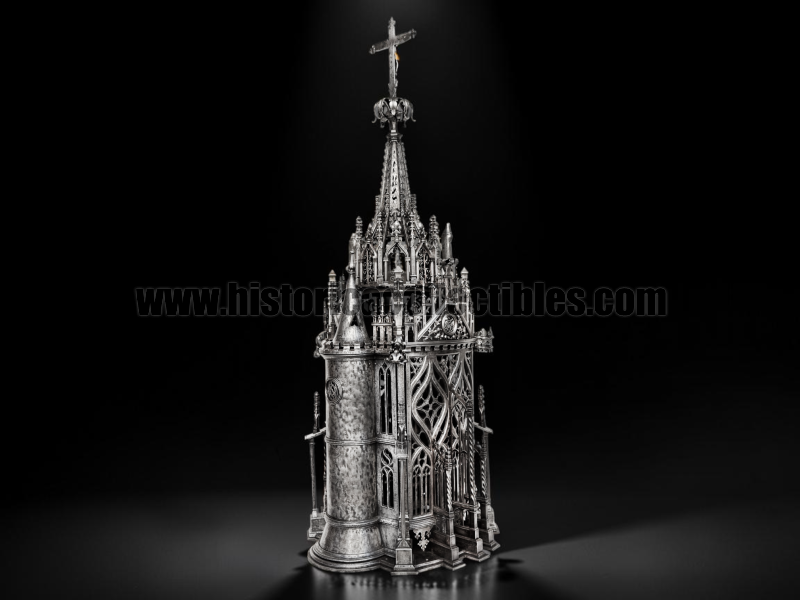
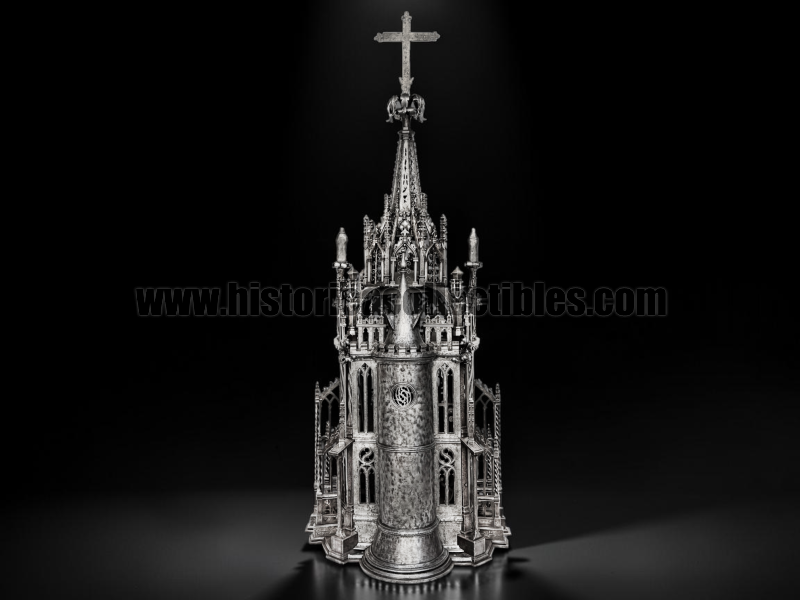
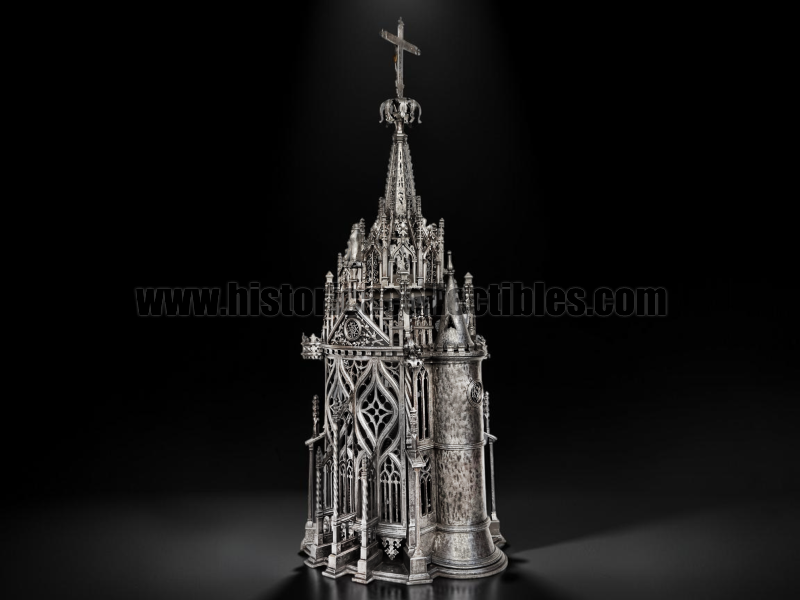
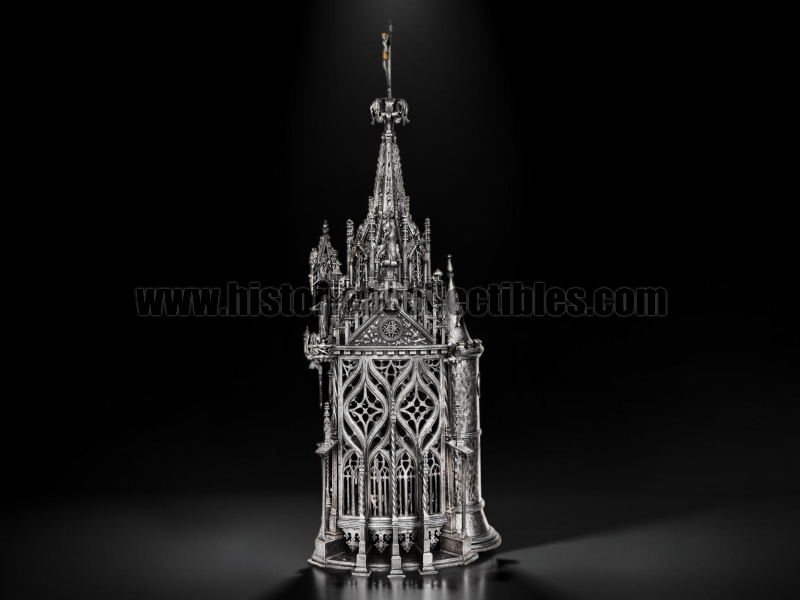
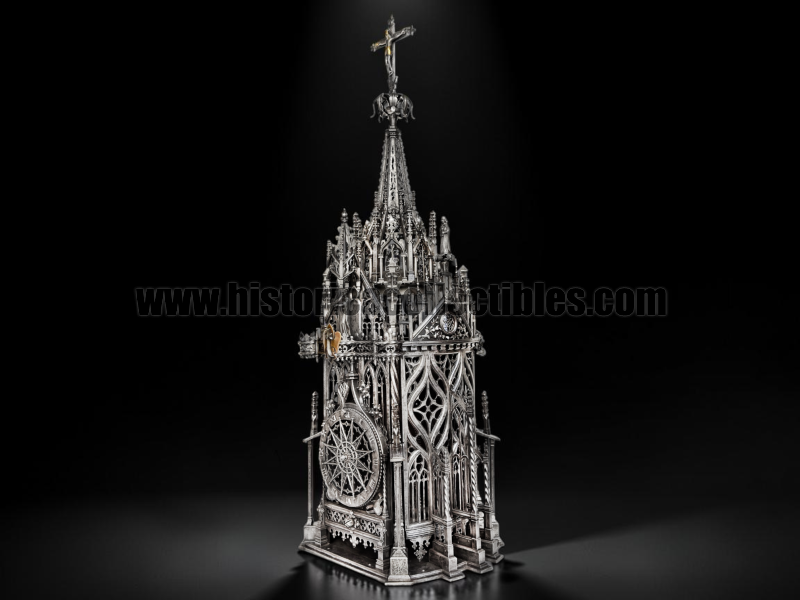
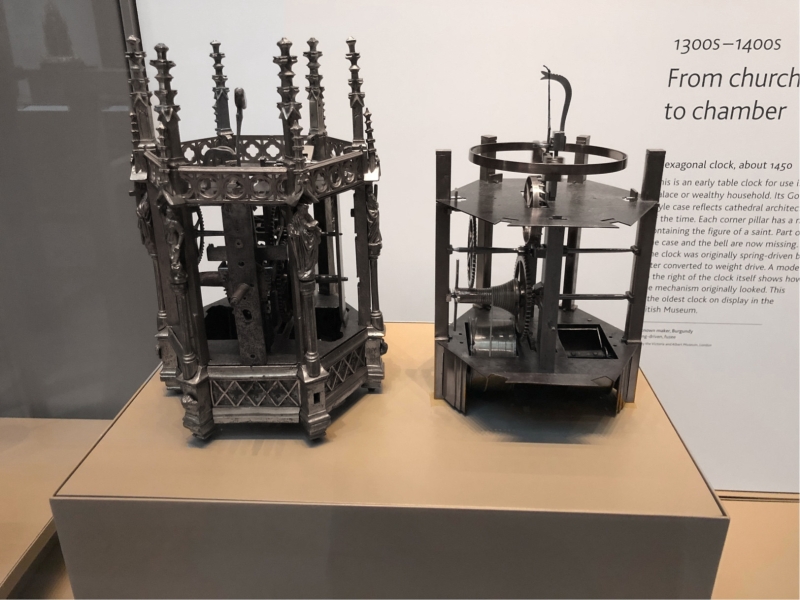
A majestic monumental clock crafted entirely of wrought iron and modeled by hand, attributed to a Magister Ferrarius active in France between the late 15th and early 16th centuries, during the Flamboyant Gothic or French Flamboyant period. Given its quality of execution, technical complexity, and symbolic significance, the work is attributable to a French royal commission, likely dating to the reigns of Louis XI, Charles VIII, or Louis XII.
The complex features a typically medieval metal superstructure that faithfully reproduces the architectural scheme of the imposing cathedrals of the Flamboyant Gothic period, rising upwards through pointed arches, ribbed vaults, and lateral pillars that support the entire structure. On the exterior, additional structural support is provided by elaborate buttresses and flying buttresses, decorated with rich floral ornamentation. The two large side panels, formed by lancet windows and rose windows, are crafted and decorated using the Spanish-French openwork technique known as orbe-voie, consisting of the superposition of multiple perforated plates, each contributing to the composition of a unified design. This is surmounted by a roof that is likewise entirely perforated, with decorated ridges and pinnacles. Four arched ribs, anchored to the lateral pillars, form a domed load-bearing structure whose function is to support all the constituent elements of the large lantern and the perforated octagonal spire.
The summit is embellished with a large open fleur-de-lys, from which rises a solemn crucifix depicting a Christus Triumphator Coronatus. Crafted entirely of wrought iron and finely sculpted, like the cross itself, it symbolizes Christ's victory over death.
At the apex of the two side panels are two sculptures, also executed in wrought and chiseled iron, depicting the Virgin Mary and Saint John the Apostle. The latter, traditionally present at the Crucifixion, embodies faith and witness.
However, an alternative identification of the figure of Saint John cannot be ruled out, as he may instead represent Joseph of Arimathea. According to Christian tradition, he collected in a chalice—the Holy Grail—the blood that flowed from Christ's pierced side. This interpretation is supported by the significant detail of the finely sculpted chalice held in the figure's hands.
All the elements that make up the structure, made of wrought and hand-forged iron, are joined together and to the clock case without the use of bolts or screws, but exclusively by means of solid iron wedges. The supporting pillars, however, are secured to a single iron base with large threaded bolts.
The massive clock case, like the components of the movement responsible for its operation, is rigorously crafted in wrought iron and can be observed almost entirely through the architectural superstructure described above.
The movement, featuring an escapement and regulating mechanism, incorporates a train of wheels that transmits motion to the hammer, which strikes the bell, probably sounding the quarter-hours, half-hours, and hours. Following the invention of the pendulum in the mid-seventeenth century, during a period marked by the growing importance of precise calculation and timekeeping, the mechanism was partially modified. It was equipped with two spring barrels wound by a single key and with a pendulum ingeniously housed inside the rear tower, already present in the original superstructure, where it served as a regulator, ensuring greater accuracy in timekeeping.
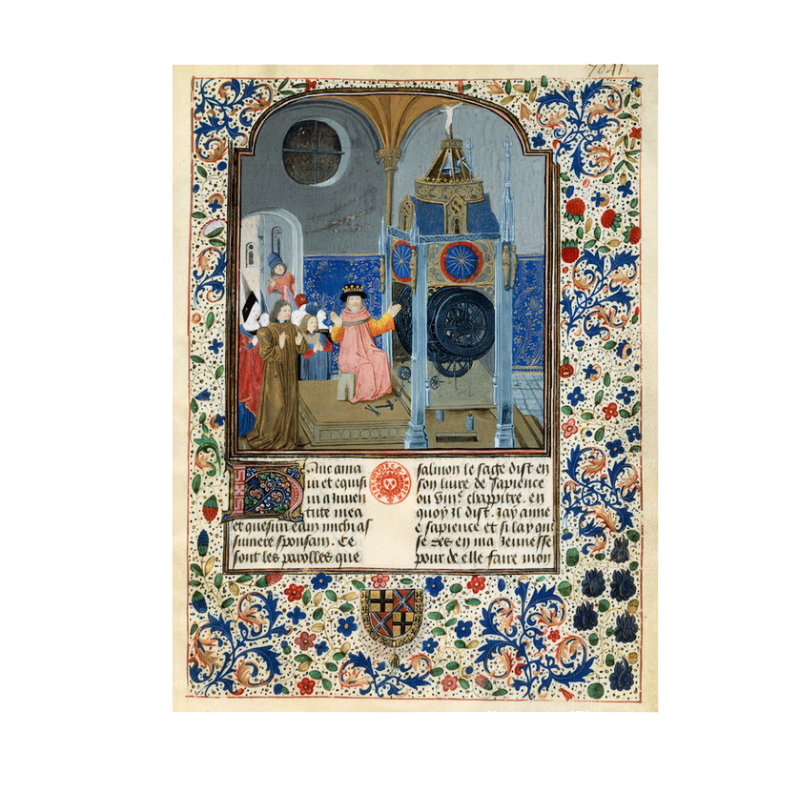
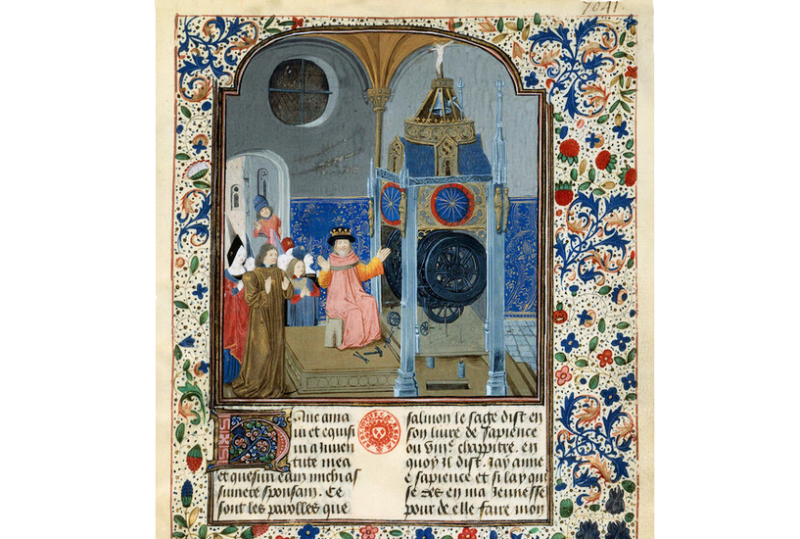
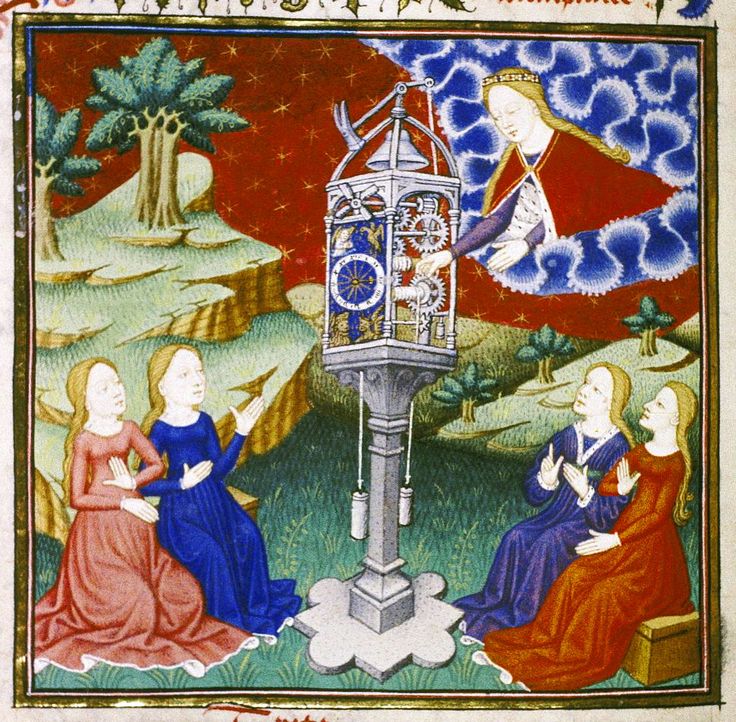
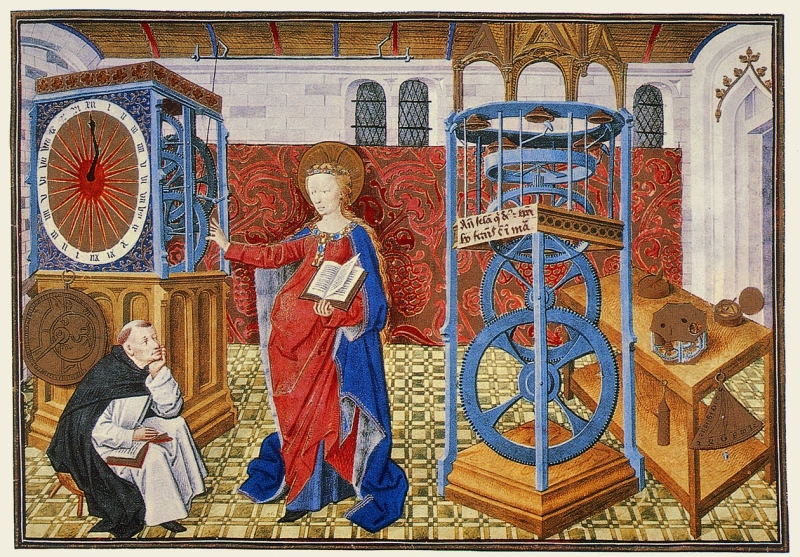
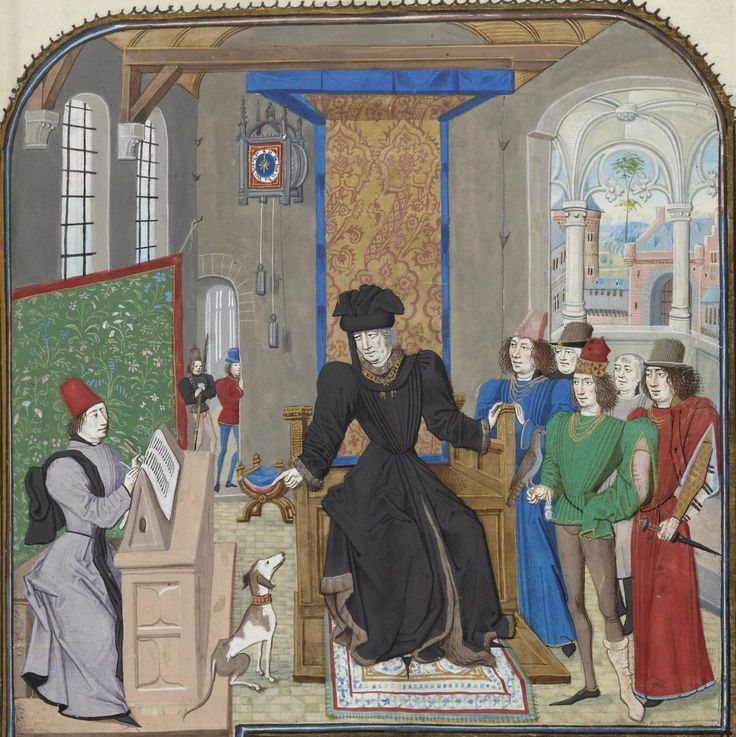
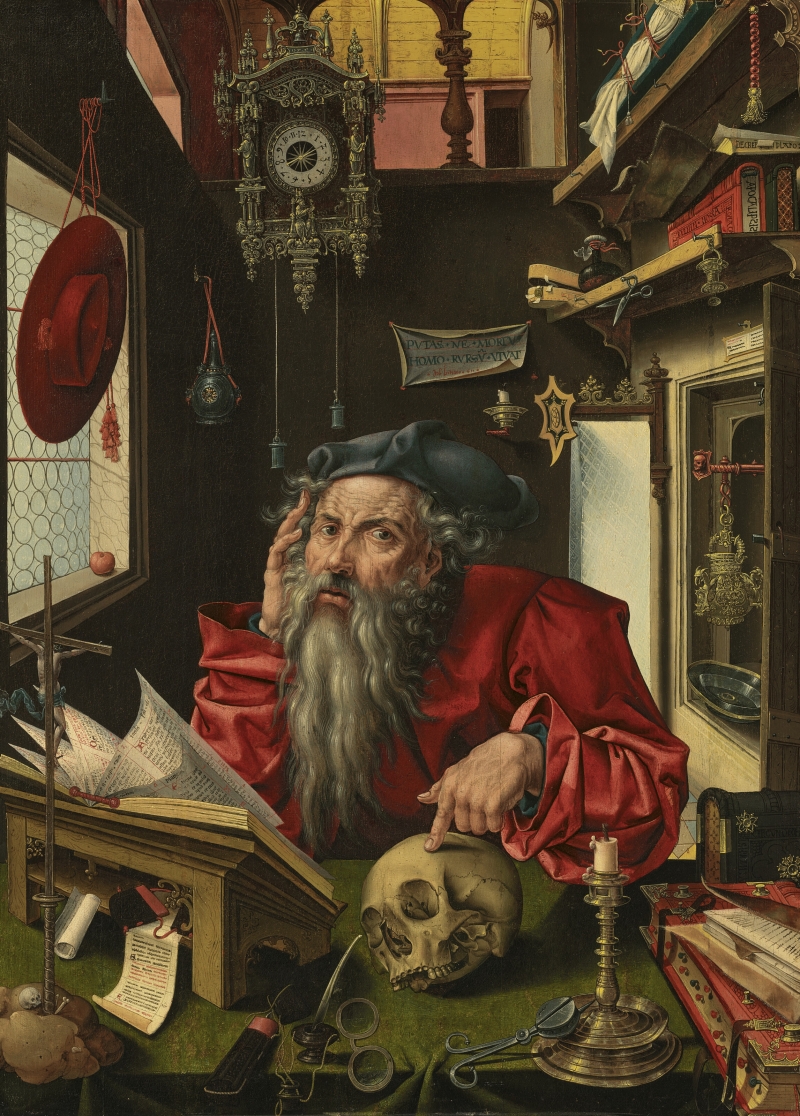
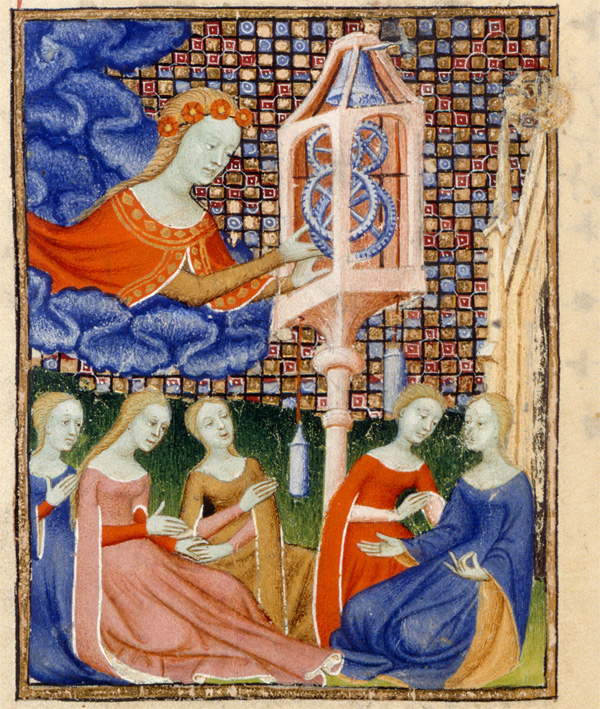
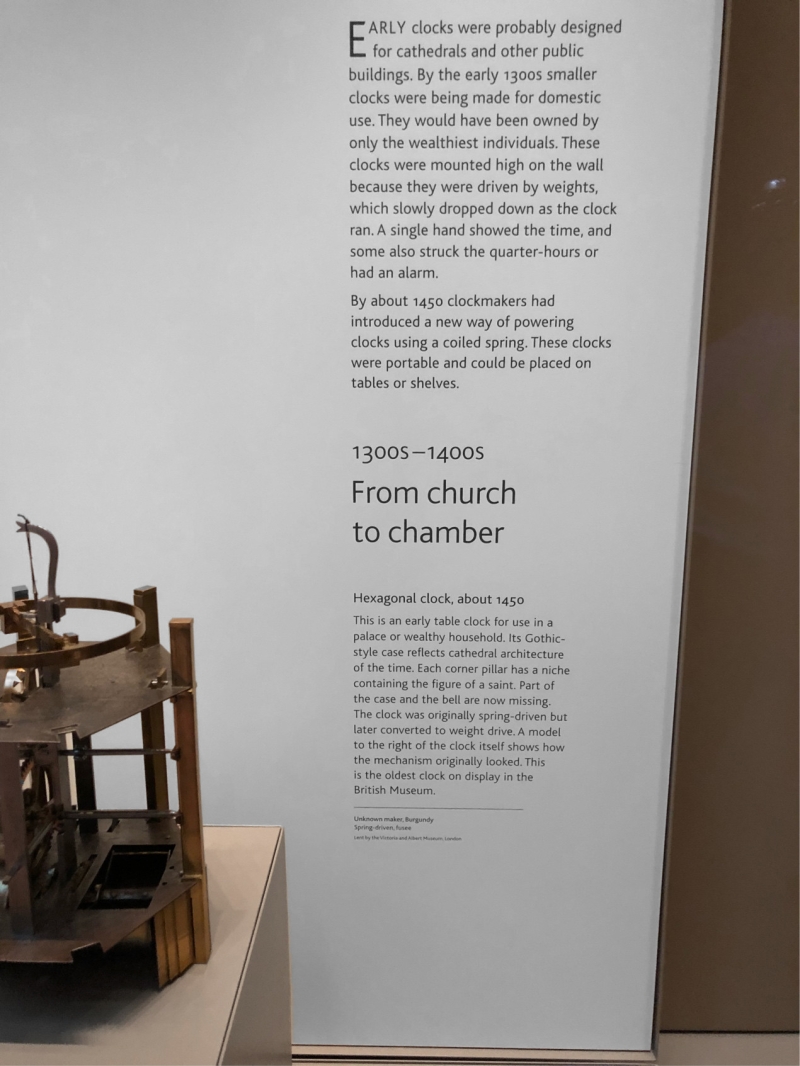
These modifications eventually became standard on almost all large clock movements dating from the fourteenth century onward. Clear evidence of this process is provided both by the more modest clock that belonged to King Charles VIII of France—likely commissioned by his chamberlain, who later also served King Louis XII, and placed in the royal residence at Nançay, in Sologne, today preserved at the Musée du Château Charles VII in Mehun-sur-Yèvre (inv. no. D.996.22.11)—and by the cathedral clock that belonged to Philip the Good, Duke of Burgundy, currently preserved at the Germanisches Nationalmuseum in Nuremberg, as well as by the clock preserved at the Metropolitan Museum of Art in New York (inv. no. 17.190.640).
Another distinctive feature of this clock is its large and unusual hour dial, magnificently carved and pierced. Originally designed to rotate continuously rather than employing the traditional central hand found on most clocks, this solution creates a striking visual effect. The passage of time—hours and minutes—is indicated by a fixed index positioned along the vertical axis of the superstructure.
Furthermore, centrally positioned on the main face is a brass plaque, perhaps originally gilded, in the shape of a fleur-de-lys surmounted by a cross likewise decorated with fleurs-de-lys, known as the croix fleurdelisée, the emblem of the royal dynasty and the symbol most closely associated with the French monarchy. This cross also appears on the reverse of gold and silver coins, such as the écu d'or, during the reigns of Louis XI, Charles VIII, and Louis XII.
The presence of two royal crowns placed on either side of the superstructure further supports this interpretation.
The information concerning these extraordinary cathedral clocks is now well documented and historically verified, demonstrating that such commissions were reserved exclusively for European kings and emperors.
The characteristics that define and make this clock structure particularly fascinating are united by the single material used throughout its construction: wrought iron, an essential aspect to consider. Every component was produced through meticulous hand-forging, hammering, and finishing with files and abrasive stones, reflecting the perfect combination of stylistic rigor and technical mastery achieved by the Magister Ferrarius. Thanks to his profound technical knowledge and exceptional craftsmanship, he was able to shape the metal into the most sinuous and complex forms, creating this magnificent example of architectural micro-sculpture, which fully embodies all the artistic and architectural principles of the late French Flamboyant Gothic period.
The dimensions of the work are impressive:
Height 120 cm
Width 50 cm
Depth 48 cm
The total weight is approximately 50 kg.
References:
Musèes de la Règion Centre (Musée du château Charles VII, Mehun-sur-Yèvre), Numéro d'inventaire: D.996.22.11 (https://webmuseo.com/ws/musees-centre-val-de-loire...)
Germanisches Nationalmuseum di Norimberga - Inventarnummer: HG9771: Clock Philip the Good, Duke of Burgundy ( https://www.gnm.de/objekte/standuhr-herzog-philipp...).
Serrurerie ou les ouvrages en fer forgé du Moyen-Age et de la Renaissance de I.H. de HEFNER-ALTENECK - T.3
Victorian & Albert Museum - Accession number: M.11-1940 (https://collections.vam.ac.uk/item/O140682/chamber...)
Metrololitan Museum of New York - Object Number: 17.190.640 (https://www.metmuseum.org/art/collection/search/19...)
Metrololitan Museum of New York - Object Number: 93.15 (https://www.metmuseum.org/art/collection/search/46...)
Metrololitan Museum of New York - Object Number: 55.76.1a–g (https://www.metmuseum.org/art/collection/search/47...)
Metrololitan Museum of New York - Object Number: 11.204.2a (https://www.metmuseum.org/art/collection/search/46...)
Metrololitan Museum of New York - Object Number: 25.120.439 (https://www.metmuseum.org/art/collection/search/46...)
Metrololitan Museum of New York - Object Number: 55.61.3a, b (https://www.metmuseum.org/art/collection/search/47...)
Metrololitan Museum of New York - Object Number: 55.61.2a–d (https://www.metmuseum.org/art/collection/search/47...)
Metrololitan Museum of New York - Object Number: 55.76.2a-f (https://www.metmuseum.org/art/collection/search/47...)
Metropolitan Museum of New York - Object Number: 2020.255 (https://www.metmuseum.org/art/collection/search/84...)
Louvre Museum - Object Number: OA 5954 ; CL 22092 (https://collections.louvre.fr/en/ark:/53355/cl0100...)
Louvre Museum - Object Number: OA 855 ; CL 22095 (https://collections.louvre.fr/en/ark:/53355/cl0101...)
British Museum Londra: (https://hsm.stackexchange.com/questions/7258/when-...)
British Museum (Video): Minuto 0:36 (https://www.youtube.com/watch?v=An0fBwGHyco)