Doppelfernrohr 7x50 Srb&Stys, Flip-Up Oculars, Artillery Kriegsmarine, about 1940
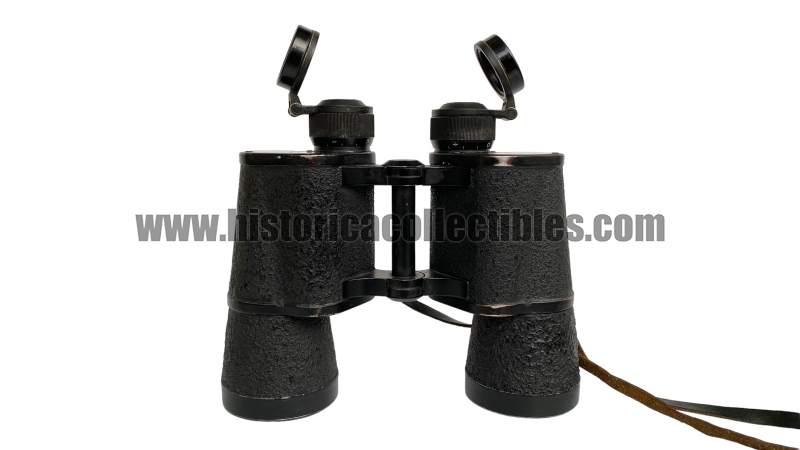
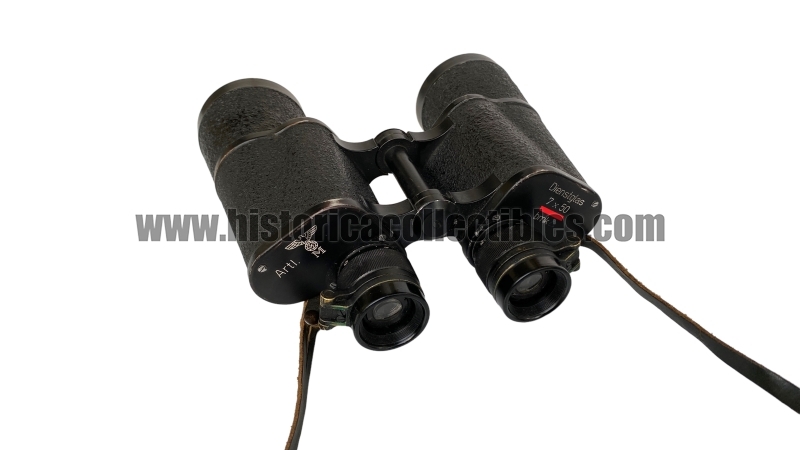
Doppelfernrohr 7x50, equipped with Flip-Up eyepieces, produced by "Bmk" or Srb & Stys - Fabrik Praziser Messinstrumente, Prague (Czech), around 1941, supplied exclusively to the Coastal Artillery departments of the Kriegsmarine, to defend the main ports and German strategic sites.
In fact, on the left ocular plate there is not only the Kriegsmarine acceptance mark (Eagle with M) but also the inscription ARTL = Artillery, rare to find on this model of binoculars in fact very few specimens with this feature are known.
Also, on the right ocular plate, the characteristics of the binoculars are shown, namely "Dienstglas", "7x50", "Serial Number" and encrypted manufacturer's mark, according to the provisions of the Oberkommando der Wehrmacht starting from around 1937, "bmk".
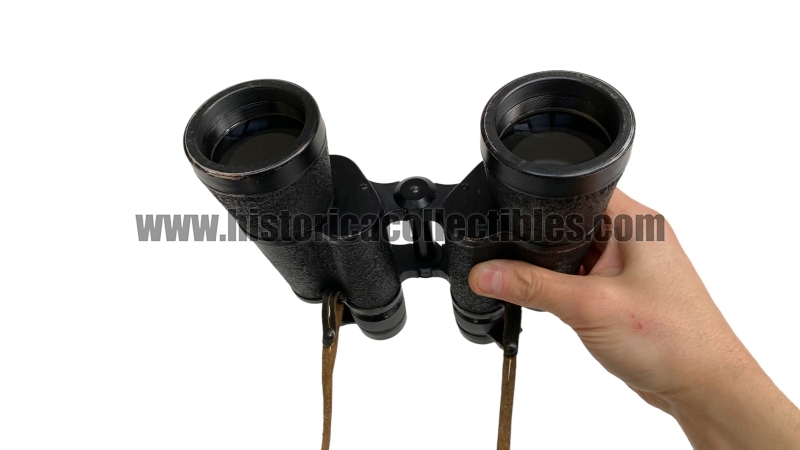
The eyepieces are equipped with "Flip-Up" mechanisms, which allowed the observer to choose the most comfortable way to observe, therefore they rotate on themselves according to the diopter that is set and there is also the possibility of isolate them, raise them (a spring mechanism keeps them open). There is the artillery reticle visible when sighting through the right eyepiece.
The view is perfect and all mechanisms work properly.
The company was founded by Jaroslav Srb (1892 - 1967) who began his studies in the optical field at the Technical University of Prague.
During the First World War he worked at Zeiss where he met the optical mechanic Josef Stys (1899-1850) who became a partner and was a designer and optician of their company which they later called Srb & Stys.
The company, founded on 11/21/1919, had, among its first projects, the repair of microscopes and the production of micro lamps. Srb&Stys was based in Kavalirka, at the XVII of Kosire. Just a few months after their opening they dedicated themselves to the production of optical equipment for Geodesy, Astronomy and Meteorology.
In 1921, the Czechoslovakian Department of Defense commissioned Srb&Stys to supply theodolites. For the Ministry of Education they produced microscopes which mounted Zeiss optics.
In 1924 they created their own laboratory dedicated to the process of "polishing" lenses. In 1937 the company moved to a large building in front of their now old factory. They had 300 workers who were employed in grinding lenses.
Srb&Stys supplied telescopes and binoculars to the Turkish Army, telescopes to the Yugoslav Army and surveying instruments to Greece. Jaroslav Srb and Josef Stys founded "Romanian Czechoslovakian Optics" as a subsidiary of their Prague-based Srb&Stys, Romania.
In 1937 the company had 860 workers and was at its peak development and was thinking of expanding its production by opening a new factory in England. In 1939, with the outbreak of the Second World War and the occupation of Czechoslovakia by the Germans, Srb&Stys saw its almost unstoppable development abruptly interrupted. During World War II the company was under full German control and fully complied with the requested supplies.
In 1940 Jaroslav Srb was arrested for sabotage and was later released due to lack of evidence but was strictly forbidden to enter his factory.
In 1945 Jaroslav Srb and Josef Stys decided to abandon the production of military optical equipment to dedicate themselves exclusively to the production of binoculars, microscopes and theodolites for the civilian market.
In May 1945 "The Revolutionary Works Council" attacked Srb&Stys by placing it under commissionership and making it available "to the people". The company had more than 500 employees and was placed under state control and was renamed "Meopta".
During the communist revolution in February 1949, Stys was unreasonably arrested and died shortly after his release in 1950.
In 1963, in a drastic reorganization, the company was renamed ZPA Kosire and production concentrated on making electromechanical devices, tape memories, power supplies and optical measuring devices for CNC machines. In 1996, bankruptcy was declared.