
"Salvatore Todaro Surface Vehicles School" chronometer, Xª MAS Flotilla, circa 1944
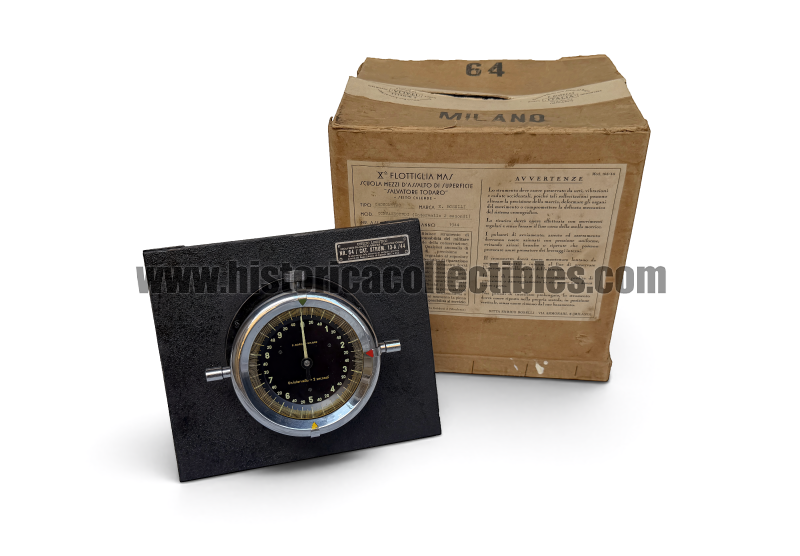
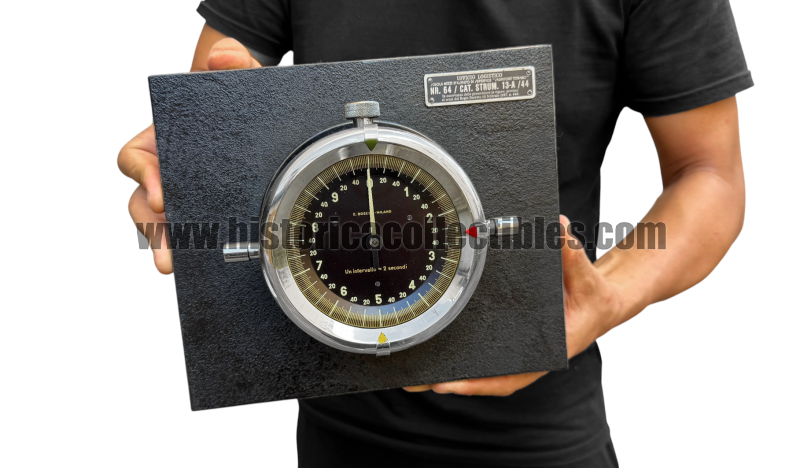
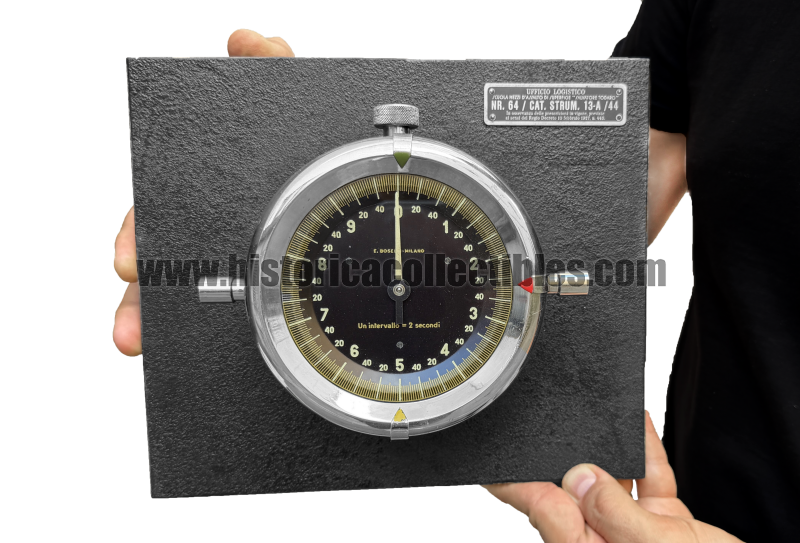

A large tabletop chronometer specially produced by E. Boselli of Milan for the "Salvatore Todaro" Surface Assault Vehicles School of the Xª MAS Flotilla in Sesto Calende, starting in 1943.
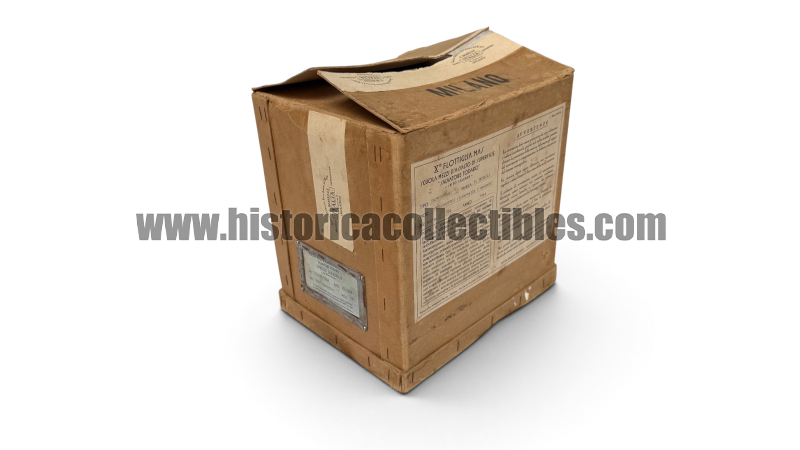
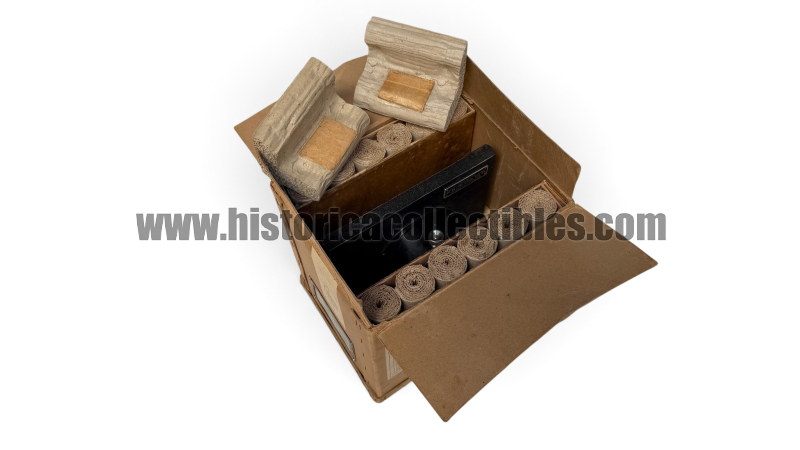
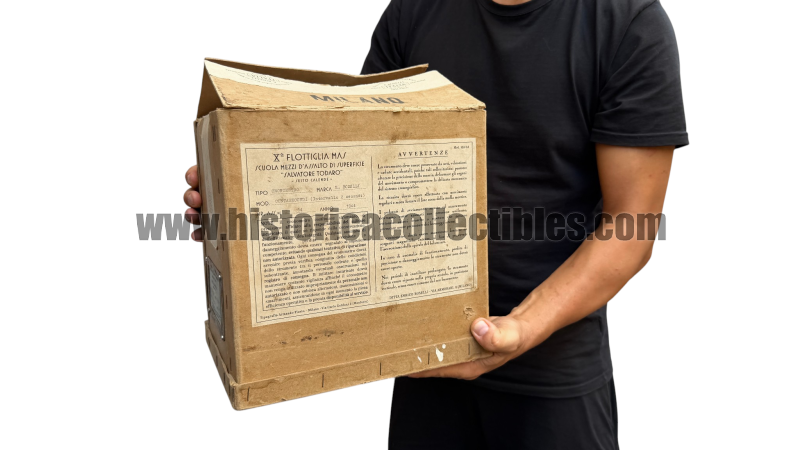
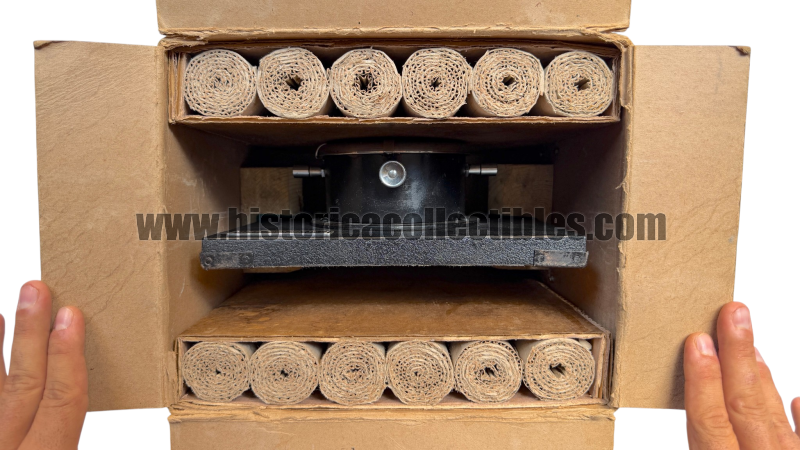
This chronometer is supplied with its original, still perfectly preserved, case. One side of the case features a cartouche with embossed lettering, bearing the heading "Xª MAS Flotilla - Surface Assault Vehicles School "Salvatore Todaro" - Sesto Calende. This label not only records the watch's classification within the school's internal "load" registers, but also contains useful warnings regarding its operation and preservation. These warnings were issued both by the military, which served as instructions for the soldiers/instructors who used it, and by E. Boselli, regarding its operation. The document was printed by "Tipografia Armando Fior di Milano" on behalf of "Ditta Enrico Boselli di Milano" and also documents, for the first time ever, the address of this company, which had been an "Official Supplier to the Royal Navy and Royal Air Force" since the 1930s: Via Armorari, 8 (Milan).
Furthermore, located on the side of the box and in a dedicated slot, is a label indicating specific registry information from the Logistics Office of the "Salvatore Todaro" Surface Assault Vehicles School. This information refers, in addition to internal classifications within the School, to Royal Decree No. 443 of February 10, 1927, which specifically regulated the procedures for receiving, recording, storing, and responsibilities for the material.
What is surprising about this case/box, however, is the presence of what appears to be the "sealing tape" used by E. Boselli. The "E. Boselli" logo is present on it, but it is not accompanied by the usual words "Official Supplier for the Royal Air Force and Royal Navy," but rather "Official Supplier to the Armed Forces of the Kingdom." This detail, in fact, demonstrates how the "E. Boselli" company continued, even after September 8, 1943, to supply equipment to the armed forces of the Italian Social Republic. In fact, in this case, it did not use the designation "Regia Marina or Regia Aeronautica," but rather "Forze Armate del Regno," which continued with this name until 1945, also encompassing the armed forces of the RSI.
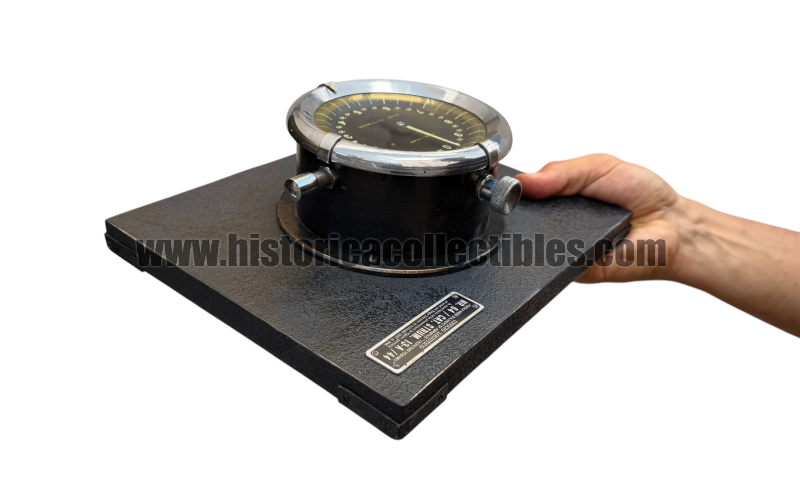
The chronograph is mounted on a base that, due to its construction and overall configuration, suggests it was intended for use on land rather than directly aboard a naval vessel. The base bears a metal plate, addressed to the Logistics Office of the "Salvatore Todaro" Surface Assault Vehicles School, which contains the same specifications as the external label attached to the side of the case.
The presence of moving indexes or memory pointers on the chronograph dial suggests a use for recording and comparing chronometric intervals, even partial or intermediate ones. These indexes could be manually moved until they coincided with the position reached by the chronograph hand at a given moment, thus creating a visual reference corresponding to the starting point of the next measurement.
Once this reference was established, the angular distance between the moving index and the chronograph hand allowed the time interval elapsed since the reference event to be quickly assessed, without necessarily having to stop the chronograph using one of the two control buttons on the sides of the chronograph (one to stop the hand, and one to reset the chronograph).
The instrument's configuration therefore appears compatible with activities requiring the recording and comparison of multiple consecutive time intervals while keeping the chronograph running.
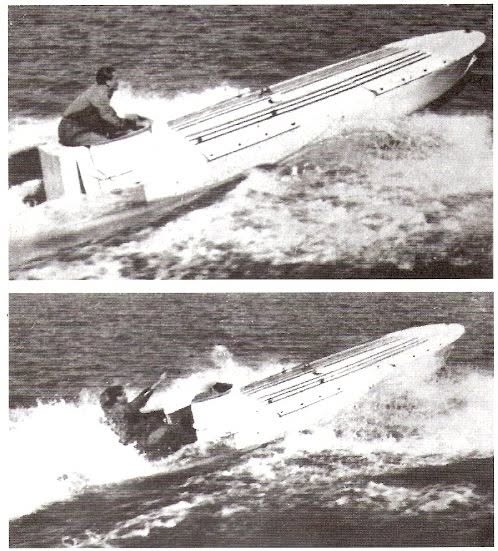
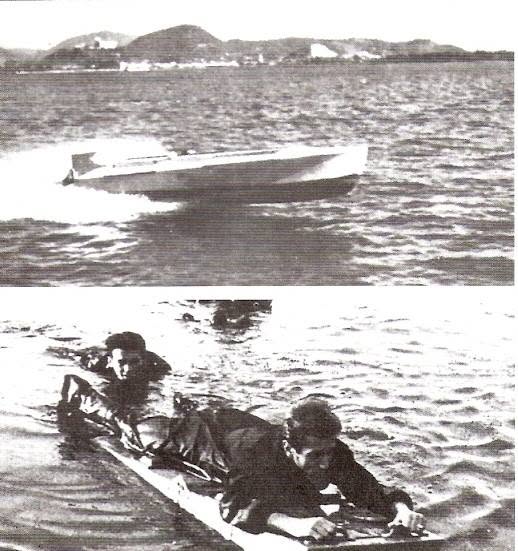
In this context, it is extremely likely that its specific use could have been linked to training or timekeeping activities involving the explosive MTM (Modified Tourist Motorboat) boats, as the intent of the "Salvatore Todaro Surface Means School" of the Xª MAS Flotilla was precisely to instruct and train marines in the use of these deadly weapons of war.
The chronometer is in perfect working order, and its winding, which is done manually using a ring nut on the top, appears to be fully efficient.
It is in excellent condition, thanks also to the presence of its original case and the chronometer's external chrome plating, which has preserved its aesthetic integrity.
The "Salvatore Todaro" Surface Assault Vehicle School of the Xª MAS Flotilla:
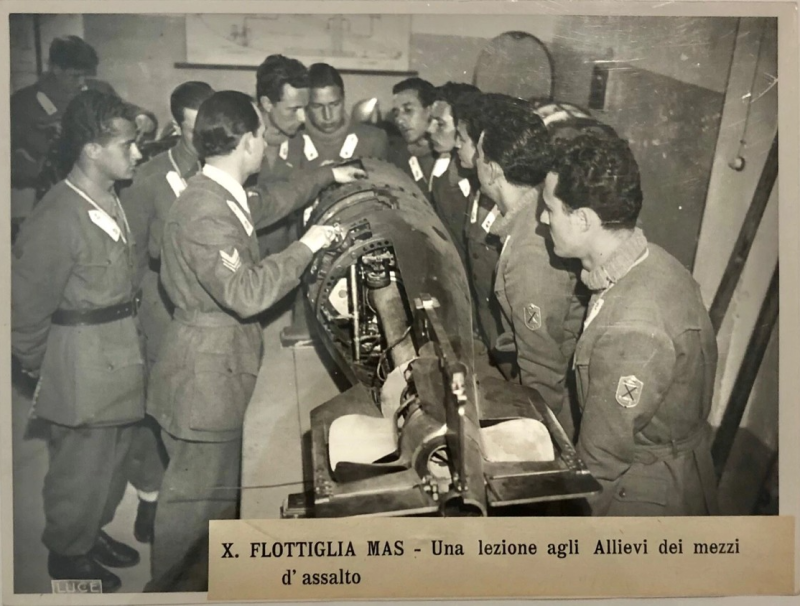
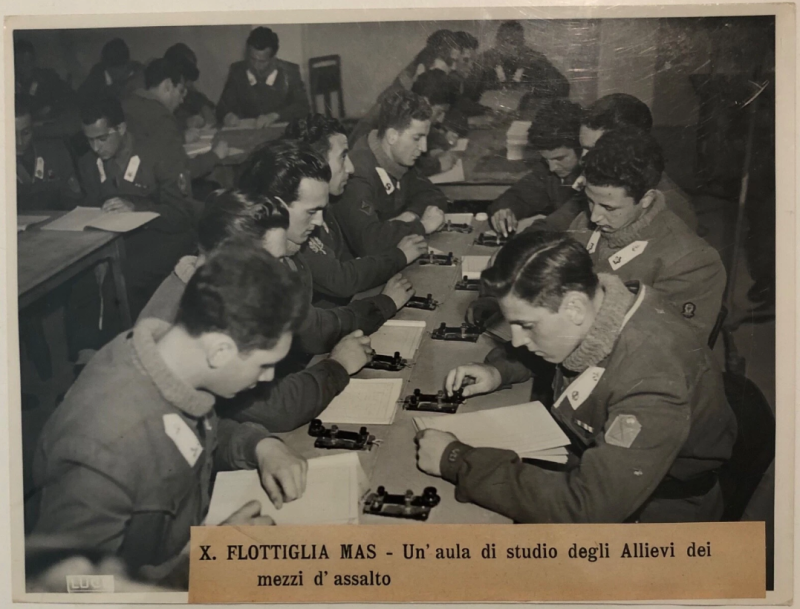
The "Salvatore Todaro" Surface Assault Vehicle School was a military training center of the Italian Social Republic (RSI), established in September 1943 within the former Sant'Anna seaplane base in Sesto Calende, on the shores of Lake Maggiore.
The school was part of the Xª MAS Flotilla and was named after the famous submarine commander Salvatore Todaro.
Main Activities: Assault motorboats (MTM explosive boats) were assembled in the facility's warehouses. Pilots were trained to fly the vehicles close to enemy ships on high-risk missions.
Geographic Location: It was located on the Royal Air Force seaplane base in Sant'Anna (Sesto Calende), a strategic area near the Ticino River.
Wartime Involvement: Due to its strategic importance and proximity to the SIAI-Marchetti aircraft plants, the facility was a frequent target of Allied bombing during the final stages of World War II.
The Area Today: After years of decommissioning and reclamation, the former seaplane base and school grounds have been converted and now house the Europa Park. One of the original hangars has been restored and is used for exhibitions and conferences.
Royal Decree No. 443 of February 10, 1927, reported on the Chronometer's Cartouches and Plates:
"Regulations for the Administration and Accounting of Military Corps, Institutes, and Establishments," which specifically governed the procedures for receiving, recording, storing, and maintaining responsibility for the material.
Principles applicable to the military personnel responsible for the material in 1944
The military personnel in charge assumed the following responsibilities:
1. Safeguarding the entrusted material: The consignee was required to preserve the material received, preventing its loss, deterioration, or unauthorized use.
2. Personal Responsibility for Delivery: The material had to be recorded as having been received through administrative and inventory records, indicating the nature, quantity, and condition of the item.
3. Obligation of Supervision and Conservation: The person in charge was responsible for ensuring the correct placement of the material, protection from tampering, maintenance of its working order, and periodic inspection of the instrument.
4. Liability for negligence: In the event of loss, damage or theft resulting from carelessness or lack of supervision, the soldier could be held liable according to the military administrative and criminal regulations in force.
The Sesto Calende School:
Nestled on the Lombardy shore of Lake Maggiore, just north of Sesto Calende, on the road to Angera, lies an important site steeped in military history.
It is the Sant'Anna seaplane base, owned by the Società Idrovolanti Alta Italia (S.I.A.I., now known as SIAI-Marchetti), founded in 1915 in Sesto Calende, where the facilities were located. It has been reclaimed and turned into a park by the municipality of Sesto Calende and the Province of Varese for several years.
Starting in 1916, it served as a training ground for seaplane pilots, and in the years between the 1920s and 1930s, seaplanes were tested that brought fame and prestige to our country.
Between the 1920s and 1930s, the Sant'Anna Seaplane Base became a launch pad for seaplanes, the most famous of which was the S.55 flown by Italo Balbo in the transatlantic flights of 1930-31 and 1933.
Umberto Maddalena took off from here in September 1920, setting the record for the longest seaplane raid, flying from Sant'Anna to Helsinki in a SIAI S.16 seaplane.
The seaplane base was also used as a base in 1925 by aviator Francesco De Pinedo and engineer Ernesto Campanelli, who flew for 370 hours, covering 1,000 km (4,000 mi) with the SIAI S.16 "Gennariello" seaplane, 55,000 kilometers from Sant'Anna to Melbourne, Tokyo and Rome.
After September 8, 1943, the complex was home to the surface assault craft pilot school of the renowned Xª MAS Flotilla.
This is where the explosive-tipped motorboats to be launched against enemy vessels were assembled, and the daring pilots who would pilot them to within a few dozen meters of the target were trained.
The school was named after the valiant commander Salvatore Todaro and was specifically called the "Salvatore Todaro" Surface Assault Craft School. The training school conducted tests on explosive boats (MTM, MTSM), sabotage motorboats, and the M1 and M2 fast attack motor torpedo boats, produced in the SIAI-Marchetti factories in Sesto Calende and Vergiate, which had located part of its production facilities nearby, in the area now occupied by the Verbella shipyard.
The school was known to the Anglo-American Air Force, which targeted it for numerous bombings and strafings, along with the nearby bridge over the Ticino River in Sesto Calende.
In 2002, after about 50 years, the area was reclaimed, made accessible, and transformed into what is now Parco Europa, after defusing the numerous unexploded bombs and leveling the blast craters.
Europa Park, located in Sant'Anna, is a large green area on the river accessible to all, equipped with a playground for children.
The park, currently managed by the Sant'Anna company, covers an area of approximately 9 hectares and occupies what was once the former Sant'Anna Military Seaplane Base. This area was also used for the retrieval (via the now partially demolished crane-equipped pier) of seaplanes built by the SIAI Marchetti factory, which had located part of its facilities nearby, in the area now occupied by the Verbella shipyard.
History of Tipografia Editoriale Libraria Pirola:
Tipografia Editoriale Libraria Pirola is one of the most important historical institutions in Milanese publishing, famous for having maintained its printing presses since 1781.
Originally founded in 1781 by brothers Giacomo and Gaetano Pirola, the company has distinguished itself over the centuries for its production closely linked to Milan's institutions, bureaucracy, and civic life.
During the Second World War, and particularly in 1944, under the direction of the Bosisio family (who had acquired and consolidated the business in 1910), Pirola found itself operating in a context of extreme emergency and under the strict control of the Prefectural Cabinet of the RSI. The workshop maintained production to guarantee the civilian orders necessary for the local administrative system.
The company was the absolute reference in Milan for the printing of legal and administrative forms, codes, and texts for professionals. This specialization allowed its workshops to continue operating, as its products were considered essential to the functioning of the courts and public offices of the Italian Social Republic. The files relating to the supervision and industrial control of this company and many other printing companies from 1944 are still recorded and can be consulted at the Prefecture Cabinet Archive.
References: