
Wristwatch A. Cairelli-Rome "Specialists School-Military Air Force", Sergio Duilio Fanali, circa 1958

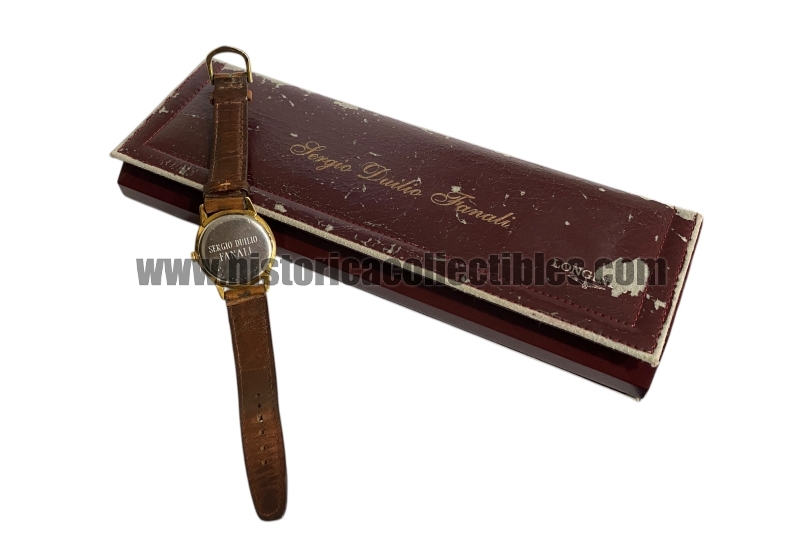

Military-institutional wristwatch, awarded to the legendary pilot and officer Sergio Duilio Fanali, made by the Swiss manufacturer Longines for the A. Cairelli company, a historic supplier of instruments and timepieces to the Italian Armed Forces. This piece is distinguished by the logo of the "Scuola Specialisti – Aeronautica Militare," a mark attesting to its official aeronautical designation.
The watch was awarded to General Sergio Duilio Fanali, a leading figure in the Royal Air Force during World War II and the postwar Italian Air Force. The timepiece is accompanied by its original Longines-branded box, featuring the recipient's name on the lid and the A. Cairelli – Roma logo on the inside.
The overall configuration suggests a special order made for the Italian Air Force, likely as an official gift bestowed upon Fanali upon his appointment as Interim Inspector of all Air Force Schools (1958–1961), a highly prestigious position that culminated in his subsequent promotion to Deputy Commander of the Allied Air Forces Southern Europe.
The movement, without a Longines marking, belongs to a type of caliber widely used in Swiss watchmaking at the time, frequently adopted even by high-end manufacturers. This characteristic, far from diminishing its appeal, is consistent with military-specific or special-commission production of the era. In this context, the watch's full authenticity and historical value are unequivocally attested by the presence of the original personalized box and the direct references to the client and the recipient.
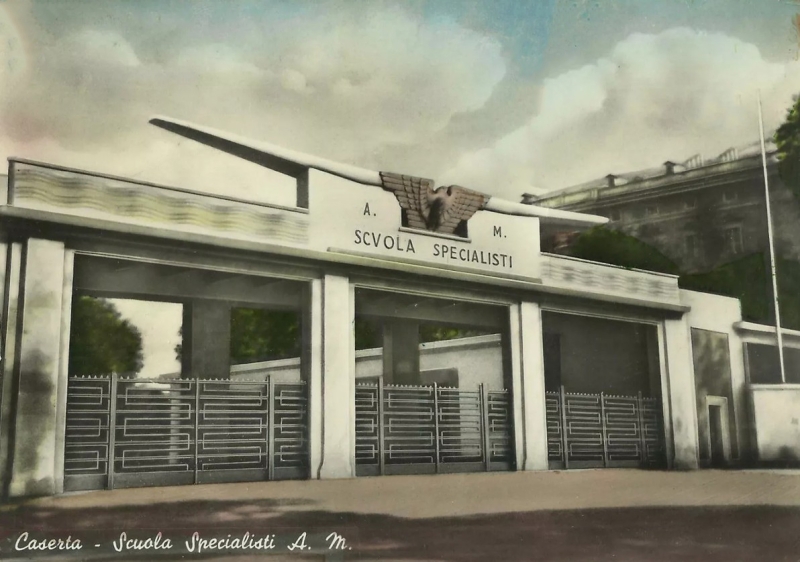
The Air Force Specialists School was created in 1948, following the reorganization of the Air Force Non-Commissioned Officers School, previously located at the site of the Air Force Academy in Pozzuoli. Since its founding, it has always provided initial training for "specialists," that is, personnel involved in various capacities in the management and maintenance of weapons systems and command, control, and communications systems. In the late 1970s, the Taranto and Macerata Specialist Schools, which offered courses in logistics and administration, were also reunited at the Caserta site.
Having assumed the new name of Air Force Non-Commissioned Officers School in July 1979, the institute continued its mission and, following the division of the non-commissioned officer role into the Warrant Officers' Role and the Warrant Officers' Role established by Legislative Decree no. 196 of 12 May 1995, from 1999 until towards the end of 2005; starting from 1 November of that year, the two-year courses for Warrant Officers were transferred to the Air Force Warrant Officers' School based in Viterbo.
The training center for specialists remained in the city of Caserta, initially at the Royal Palace of Caserta until January 16, 2016, and subsequently at Viale Ellittico.
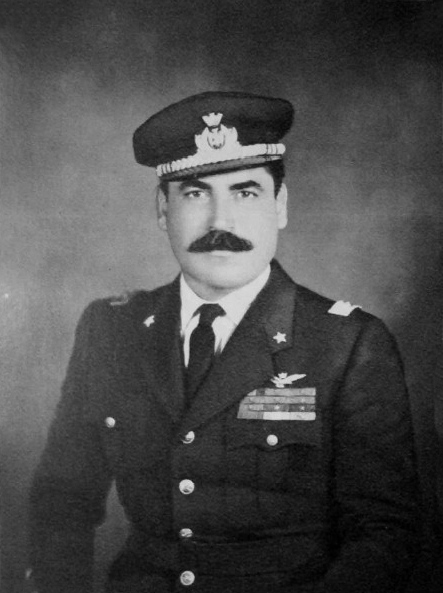
Sergio Duilio Fanali (Rome, June 21, 1911 – Scauri di Minturno, August 27, 1987) was an Italian aviator and general.
Military career:
He entered the eighth "Ibis" course in 1930 at the Air Force Academy in Caserta at the royal palace and was promoted to second lieutenant in October 1932. He obtained his pilot's license in 1933 and his military pilot's license in 1934. In 1937, he joined the High Speed Department in Desenzano sul Garda.
Spanish Civil War and World War II:
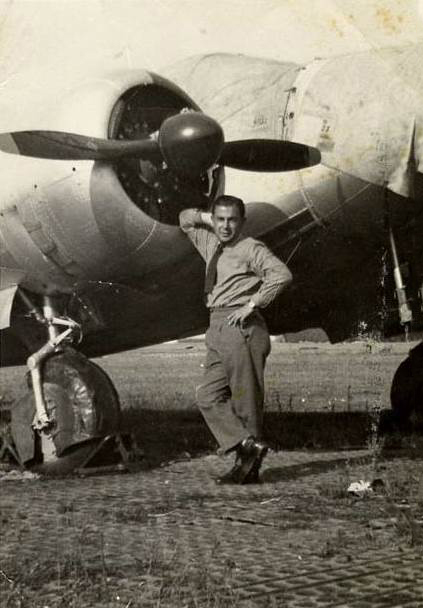
In 1937, with the rank of lieutenant, Fanali volunteered to fight in the Spanish Civil War with the Legionary Air Force against the Spanish Republic, alongside Franco's forces and alongside Portuguese and German troops. His plane was hit several times, but never shot down.
On February 18, 1938, during the decisive battle of Teruel in Spain, twelve Breda Ba.65 aircraft from the 65th Squadron were employed to strafe and destroy lines of communication. During the attack, aircraft No. 18, piloted by Captain Fanali, was hit by approximately one hundred shell fragments, but the robust structure of the Breda assault aircraft allowed it to return to base despite the damage.
The Battle of Teruel, fought between December 1937 and February 1938, saw the Nationalist forces win, with heavy losses for the Republicans, and proved decisive in the outcome of the conflict. The Aviazione Legionaria, which played a key role in the battle, deployed its maximum effort on February 18, flying approximately 150 sorties with CR.32 fighters, S.79, S.81, and BR.20 bombers, and Ba.65 assault aircraft.
He returned to Italy in 1938 and in 1940 was in Libya as commander of the 165th Squadron of the 12th Fighter Group of the 50th Assault Wing. In 1942, he moved from Sicily as commander of the 155th Group of the 51st Wing, taking part in the attacks against Allied bases in Malta.
After the 1943 armistice, Fanali participated in the War of Liberation from Sardinia with the Italian Co-Belligerent Air Force. In early 1945, he was appointed operational commander of the 51st Wing.
Lieutenant Colonel Fanali concluded World War II with six silver medals (three of which were field medals), two bronze medals (one of which was field medals), two War Merit Crosses, commemorative medals for the Spanish and Albanian campaigns, and a medal of merit for the volunteers of the Spanish Campaign.
He received two promotions for war merit.
Fanali's 15 kills between 1940 and 1942, however, cannot be verified with certainty. He was slightly wounded twice, in the face and in the leg.